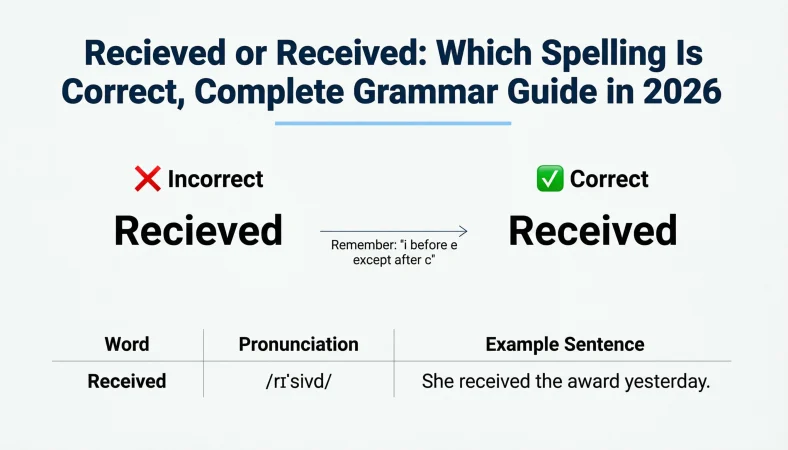
Quick Answer: Received is the correct spelling. Recieved is a common misspelling. Remember the rule: “i before e, except after c”, so the correct form is received.
Spelling accuracy is essential for clear and professional communication, whether you are writing emails, academic papers, business documents, or everyday messages. One of the most commonly misspelled English words is received. Many writers mistakenly use recieved, often because the placement of the letters “i” and “e” can be confusing. However, only one spelling is recognized as correct in standard English.
Understanding the correct form helps improve writing quality and prevents avoidable errors that can affect credibility. The word received is the past tense and past participle of “receive,” meaning to get, accept, or be given something. It follows the familiar spelling pattern often remembered by the rule, “i before e, except after c.”
While English has exceptions to many spelling rules, received follows this guideline perfectly. Knowing the difference between recieved and received can help writers communicate more effectively and maintain accuracy in both formal and informal contexts.
Quick Answer Table
| Feature | Received | Recieved |
| Correct Spelling | ✅ Yes | ❌ No |
| Meaning | To get, obtain, or be given something | Misspelling of received |
| Standard English Usage | ✅ Accepted | ❌ Not accepted |
| Found in Dictionaries | ✅ Yes | ❌ No |
| Suitable for Academic Writing | ✅ Yes | ❌ No |
| Example Sentence | “I received your message.” | Incorrect usage |
Which One Is Correct?
When comparing recieved or received, the correct word is:
✅ Received
The spelling received follows the common English spelling pattern:
“I before E except after C.”
Since the letters ei come after the letter c, the correct form becomes:
received
Examples:
- I received your email yesterday.
- She received an excellence award.
- We received the package on time.
The form recieved reverses the letters and does not follow standard English spelling rules.
Meaning of the Correct Word
What Does “Received” Mean?
Received is the past tense and past participle of the verb receive.
Definition
To receive means:
- To get something
- To accept something
- To be given something
- To experience something
Simple Explanation
Whenever something comes to you from another person, organization, or source, you have received it.
Examples
Receiving Information
- I received your text message this morning.
- The manager received the report.
Receiving Physical Objects
- She received a birthday gift.
- They received a shipment of books.
Receiving Recognition
- He received praise from his teacher.
- The actor received several awards.
Receiving Communication
- We received an invitation to the event.
- The company received hundreds of applications.
Grammatical Function of “Received”
The word received can function as:
Past Tense Verb
- I received the documents yesterday.
- She received the package today.
Past Participle
- The payment has been received.
- Your request was received successfully.
Adjective (Less Common)
Sometimes received can describe something generally accepted.
Example:
- This is a widely received opinion.
Meaning of the Incorrect or Alternative Word
Is “Recieved” a Real Word?
No.
Recieved is not a recognized English word.
It is simply a spelling error that occurs when people accidentally reverse the letters e and i.
Why It Happens
Many English learners remember the sound of the word rather than its spelling.
Because the pronunciation does not clearly emphasize the order of the letters, writers often mistakenly type:
❌ recieved
instead of:
✅ received
Dictionary Status
Major dictionaries do not list recieved as a standard word.
Instead, spell-check tools automatically suggest:
received
Key Differences Between the Two Words
Recieved vs Received
| Feature | Received | Recieved |
| Spelling | Correct | Incorrect |
| Dictionary Entry | Yes | No |
| Grammar | Proper English | Error |
| Professional Writing | Accepted | Not accepted |
| Academic Use | Correct | Incorrect |
| Search Engine Recognition | Recognized | Treated as typo |
Spelling Difference
The only difference is the order of two letters:
- Received → ei
- Recieved → ie
Meaning Difference
There is no meaning difference because recieved has no independent meaning.
Grammar Difference
- Received = grammatically correct
- Recieved = grammatical error
Recognition Difference
Professional editors, teachers, employers, and academic institutions expect the spelling received.
Using recieved may create a negative impression about writing accuracy.
Pronunciation Differences
Interestingly, there is no pronunciation difference because only one form is correct.
Received Pronunciation
Received
/rɪˈsiːvd/
Pronounced as:
ri-SEEV’D
Example:
I received the letter yesterday.
Since recieved is not a valid word, it has no official pronunciation.
Common Mistakes People Make
The confusion surrounding recieved or received comes from several common causes.
1. Reversing the Letters
Many writers accidentally type:
❌ recieved
instead of:
✅ received
This is the most common error.
2. Forgetting the “I Before E” Rule
A traditional spelling guideline states:
I before E except after C.
Because receive contains a c before the vowel pair, it becomes:
receive → received
not:
recieve → recieved
3. Typing Too Quickly
Fast typing often causes letter transposition.
Examples:
- recieved
- recieve
- receved
- receieved
These are all spelling mistakes.
4. Relying on Pronunciation Alone
English pronunciation doesn’t always reveal spelling clearly.
Because “received” sounds like “re-seevd,” many learners guess the spelling incorrectly.
Correct Usage Examples
Let’s explore how received appears in different contexts.
Casual Examples
- I received your message.
- We received the photos today.
- She received my invitation.
- They received good news.
Professional Examples
- We received your application and will review it shortly.
- The company received positive customer feedback.
- Our office received the signed contract.
- Payment was received successfully.
Educational Examples
- Students received their exam results.
- The university received thousands of applications.
- Researchers received funding for the project.
- The school received a government grant.
Literary and Metaphorical Examples
- He received wisdom from his grandfather.
- The village received the first light of dawn.
- She received comfort during difficult times.
- The hero received a warm welcome upon returning home.
Common Phrases Using “Received”
The word received frequently appears in everyday English.
Business English
- Received payment
- Received invoice
- Received order
- Received confirmation
- Received request
Email Communication
- Message received
- Email received
- Application received
- Documents received
Academic Writing
- Received support
- Received approval
- Received recognition
- Received feedback
Customer Service
- Complaint received
- Inquiry received
- Request received
- Package received
Word Origin / Etymology
Understanding the history of a word often helps you remember its spelling.
Origin of Receive
The word receive comes from:
- Old French: receivre
- Latin: recipere
The Latin components include:
- re- = back
- capere = take
The original meaning was:
“To take back” or “to accept.”
Over centuries, the word evolved into Middle English and eventually became the modern English word receive.
The past tense form naturally became:
received
Because English inherited much of its spelling from French and Latin, the unusual ei sequence remained.
Why the Incorrect Version Became Popular
If recieved is wrong, why do so many people write it?
Several reasons explain its popularity.
Letter Reversal Is Common
Human brains often process familiar words as visual patterns rather than individual letters.
As a result, people accidentally switch:
- ie
- ei
without noticing.
English Spelling Is Inconsistent
English contains many words that use:
IE Pattern
- believe
- achieve
- relief
- chief
Because these words are common, writers often assume that ” receive follows the same pattern.
It does not.
Autocorrect Creates Dependence
Many people rely on spell-check software.
When writing by hand or during exams, spelling mistakes become more noticeable.
Easy Memory Tricks
Here are some simple ways to remember the correct spelling.
Trick #1: After C Comes EI
Remember:
After C, use EI.
Examples:
- receive
- ceiling
- deceit
- perceive
This instantly gives you:
✅ received
Trick #2: Think of “Receipt”
Notice the connection:
- receive
- receipt
Both words share the same cei pattern.
If you can spell receipt, you can remember received.
Trick #3: Remember the Rule
I before E except after C.
Since receive has a C before the vowels:
receive → received
Trick #4: Visual Memory
Picture the word:
REC-EI-VED
Highlight the EI in your mind.
Repeated exposure helps build automatic recall.
Related Words and Semantic Variations
Understanding related vocabulary strengthens your overall grammar skills.
Verb Forms
| Form | Word |
| Base Verb | Receive |
| Present Participle | Receiving |
| Past Tense | Received |
| Past Participle | Received |
Related Terms
- Acceptance
- Reception
- Recipient
- Receiver
- Receiving
- Receipt
- Receptionist
Semantic Keywords
- Correct spelling
- English grammar
- Spelling mistake
- Word comparison
- Grammar guide
- Common English errors
- Writing tips
- Vocabulary learning
- English language rules
- Proper word usage
Received in Formal vs Informal Writing
Formal Writing
Use received in:
- Academic papers
- Business emails
- Legal documents
- Research reports
- Professional correspondence
Example:
We received your proposal and appreciate your submission.
Informal Writing
The same spelling remains correct.
Example:
I received your text a few minutes ago.
Unlike some English words, received does not change between formal and informal contexts.
Recieved or Received in Emails
One of the most searched questions online involves email communication.
Correct Examples
- I received your email.
- We have received your request.
- Your payment has been received.
- The attachment was received successfully.
Incorrect Examples
- I recieved your email.
- Your request was recieved.
Professional emails should always use received.
Frequently Confused Words Similar to Received
People who misspell received often struggle with these words too:
| Correct Word | Common Misspelling |
| Receive | Recieve |
| Received | Recieved |
| Believe | Beleive |
| Achieve | Acheive |
| Perceive | Percieve |
| Ceiling | Cieling |
Learning these patterns improves overall spelling accuracy.
FAQs
1. Is received or recieved correct?
Received is correct. Recieved is a spelling mistake.
2. Why do people spell received as recieved?
People often reverse the letters e and i because English spelling patterns can be confusing.
3. Is recieved in the dictionary?
No. Standard dictionaries do not recognize recieved as a correct word.
4. What does received mean?
It means to get, obtain, accept, or be given something.
5. How do you remember the spelling of received?
Use the rule:
I before E except after C.
Since there is a C before the vowels, use EI.
6. Is received a verb?
Yes. It is the past tense and past participle form of receive.
7. How is received pronounced?
It is pronounced:
/rɪˈsiːvd/
or
ri-SEEV’D
8. Can I use recieved in formal writing?
No. It is considered a spelling error and should never be used in professional, academic, or business writing.
9. Is received used in emails?
Yes. It is extremely common in email communication.
Examples:
- Message received.
- I received your email.
- We have received your request.
10. What is the difference between receive and received?
Receive is the base verb, while received is the past tense and past participle form.
Receive is the base verb, while received is the past tense and past participle form.
Examples:
- I receive emails daily.
- I received an email yesterday.
Conclusion
In conclusion, the correct spelling is received, while recieved is incorrect and should be avoided in all forms of writing. This word follows the common English spelling rule “i before e, except after c,” which helps writers remember its proper form. Using received ensures your writing stays accurate, clear, and professional. It is especially important in academic work, business communication, and formal documents where spelling errors can affect credibility. By consistently using the correct spelling, you improve the quality of your language and reduce confusion for readers. Always double-check this word to maintain strong and error-free communication in everyday writing tasks.
The correct spelling is received, while recieved is incorrect and should be avoided in all forms of writing. This word follows the common English spelling rule “i before e, except after c,” which helps writers remember its proper form. Using received ensures your writing stays accurate, clear, and professional. It is especially important in academic work, business communication, and formal documents where spelling errors can affect credibility. By consistently using the correct spelling, you improve the quality of your language and reduce confusion for readers. Always double-check this word to maintain strong and error-free communication in everyday writing tasks.