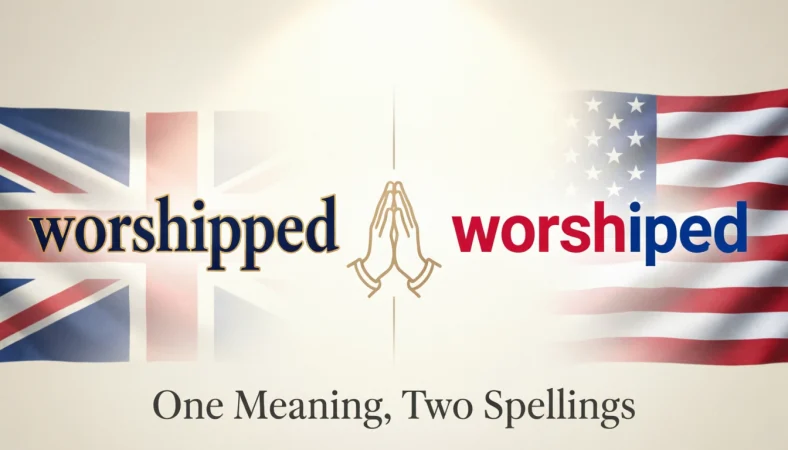
Quick answer:Worshipped and worshiped both are correct spellings. Worshipped → British English (double p).Worshiped → American English (single p)
Worshipped or Worshiped both forms are used in English. Worshipped with a double p is the preferred spelling in British English, while worshiped with a single p is commonly used in American English.
Both spellings have the same meaning and are the past tense and past participle of the verb worship, meaning to show respect, honor, or devotion. Understanding this small difference helps you write correctly for your intended audience and maintain consistency in your English style.
Quick Answer Table
| Aspect | Worshipped | Worshiped |
| Primary Usage | British English | American English |
| Correctness | Correct | Correct |
| Spelling Pattern | Double consonant | Single consonant |
| Pronunciation | WOR shipt | WOR shipt |
| Common In | UK, Australia, New Zealand, South Africa | United States, Canada |
| Example Sentence | The congregation worshipped together every Sunday. | The congregation worshiped together every Sunday. |
Which One Is Correct?
When it comes to “worshipped or worshiped,” the simple answer is that both spellings are grammatically correct. Neither version represents a mistake, a typo, or an incorrect form of the word. Instead, the difference lies in regional spelling conventions that have evolved over time.
In British English, the preferred spelling is “worshipped” with two ‘p’s. This follows the standard British rule of doubling the final consonant when adding a suffix to a word that ends with a vowel followed by a single consonant, especially when the stress falls on the last syllable.
American English, however, simplifies this rule in many cases, resulting in “worshiped” with just one ‘p’. American English tends to favor fewer letters when possible, leading to this streamlined spelling.
The word derives from “worship,” which functions as both a noun and a verb. When adding the past tense suffix ” ed” or the present participle ” ing,” the spelling changes based on these regional preferences.
It’s important to note that while “worshipped or worshiped” represents a regional spelling variation, both are accepted in their respective dialects. The key is consistency. If you’re writing for a British audience, stick with “worshipped.” If your readers are primarily American, use “worshiped.”
Meaning of the Correct Word
Definition and Explanation
Both “worshipped” and “worshiped” carry the exact same meaning. They represent the past tense and past participle form of the verb “worship.” The word describes the act of showing reverence, adoration, or devotion to a deity, religious figure, or sacred object.
Beyond religious contexts, “worship” can also describe intense admiration or devotion to someone or something. People might worship a celebrity, worship nature, or even worship material possessions. In these extended uses, the spelling preferences for “worshipped or worshiped” remain consistent with regional conventions.
The word carries deep emotional and spiritual weight. When someone has worshipped or worshiped, they have engaged in acts of devotion, prayer, praise, or ritual honoring something they consider sacred or worthy of ultimate respect.
Usage in Context
In religious settings, you might encounter sentences like:
The faithful worshipped at the ancient cathedral every morning.
In secular contexts, the word can appear in more figurative ways:
The art critics worshipped the painter’s revolutionary technique.
Fans worshipped the ground their favorite musician walked on.
Real World Examples
Here are examples showing how both spellings appear in real world writing:
British English example:
The pilgrims worshipped at the shrine for three days before continuing their journey.
American English example:
The congregation worshiped in the new sanctuary for the first time last Sunday.
Academic context:
Researchers discovered that ancient civilizations worshipped multiple deities associated with natural phenomena.
Literary context:
The protagonist worshiped the memory of his lost love, visiting her grave every year.
Meaning of the Alternative Spelling
Neither spelling represents an incorrect or alternative meaning. The confusion about “worshipped or worshiped” stems purely from spelling conventions rather than semantic differences.
Some people mistakenly believe that one spelling is wrong, but this misconception arises from unfamiliarity with regional variations. If you’ve primarily learned American English, “worshipped” might look odd to you. Similarly, British English speakers might initially consider “worshiped” to be a spelling error.
The alternative spelling simply reflects different grammatical rules applied to the word “worship.” In British English, the doubling rule applies more strictly, resulting in “worshipped.” In American English, the simplified spelling rule leads to “worshiped.
Key Differences Between the Two Words
Spelling
The most obvious difference between “worshipped or worshiped” is the number of ‘p’s. “Worshipped” contains a double ‘p’, following the pattern of words like “stopped,” “shopped,” and “tipped.” “Worshiped” contains a single ‘p’, following the American pattern of simplifying double consonants when the stress isn’t strongly on the final syllable.
Regional Recognition
“Worshipped” is recognized and preferred in:
- United Kingdom
- Australia
- New Zealand
- South Africa
- India (following British conventions)
“Worshiped” is recognized and preferred in:
- United States
- Canada
Grammar Rules
The difference in spelling relates to how English handles consonant doubling. In British English, if a word ends with a single vowel followed by a single consonant, and the stress falls on the final syllable, the consonant doubles when adding suffixes. However, “worship” presents an interesting case because the stress falls on the first syllable.
In British English, there’s a tendency to double the final consonant even when the stress isn’t on the final syllable, especially for words ending in ‘ p’. This creates “worshipped” and “worshipping.”
American English, by contrast, typically only doubles the consonant when the stress is on the final syllable. Since “worship” has stress on the first syllable, Americans write “worshiped” and “worshiping.”
Pronunciation
Despite the spelling difference, both versions are pronounced identically. The pronunciation remains “WOR shipt” with a short ‘i’ sound in the second syllable. The number of ‘p’s doesn’t affect how the word sounds when spoken.
Common Mistakes People Make
Even native English speakers often make mistakes with “worshipped or worshiped.” Here are the most frequent errors:
Mixing spellings inconsistently: One of the most common mistakes is using both spellings in the same document without realizing it. This creates inconsistency that can make writing appear careless or unprofessional.
Assuming one is wrong: Many writers believe their preferred spelling is the only correct one. This can lead to unnecessary corrections of perfectly valid variants in others’ writing.
Applying the wrong rule for other words: The confusion about “worshipped or worshiped” often spreads to other words ending in ‘ ship’ or similar patterns, causing writers to overcorrect or apply inconsistent rules.
Forgetting the rule for different suffixes: Some writers know the rule for the past tense ” ed” but forget to apply it to other forms like “worshipping” or “worshipper.” The same spelling preference applies across all forms of the word.
Auto correct confusion: Spell checkers often flag one version or the other, causing unnecessary uncertainty. Your spell checker might mark “worshipped” as incorrect if set to American English, or “worshiped” as incorrect if set to British English.
Correct Usage Examples
Casual Examples
When we think about “worshipped or worshiped” in everyday conversation, both forms appear naturally:
My grandmother worshipped at the same church for fifty years.
The fans worshiped their team even after they lost the championship.
We worshipped together as a family during the holidays.
She worshiped the sun, spending every possible moment at the beach.
They worshipped the ground he walked on, treating him like royalty.
Professional Examples
In professional writing, consistency with your audience’s regional preferences is important:
The report detailed how employees worshipped the company’s founding principles.
The study revealed that participants worshiped cultural icons more than religious figures.
Our survey found that twenty percent of respondents worshipped weekly.
The consultant recommended that managers worshiped transparency and honesty.
The analysis showed that consumers worshipped brands that aligned with their values.
Educational Examples
In educational contexts, both forms appear depending on the curriculum:
The history textbook explained how ancient Egyptians worshipped numerous gods.
Students learned that the Romans worshiped at temples dedicated to various deities.
The lesson plan taught that people worshipped natural forces before developing formal religions.
The research paper compared how different cultures worshiped their ancestors.
The anthropology professor discussed how communities worshipped through music and dance.
Literary and Metaphorical Examples
Writers often use “worshipped or worshiped” metaphorically to convey intense devotion:
The poet worshipped the beauty of the autumn leaves, writing verse after verse in their honor.
The protagonist worshiped knowledge, spending his entire inheritance on books.
The artist worshiped the muse that inspired his greatest creations.
The young lovers worshipped each other with devotion that bordered on obsession.
The philosopher worshipped reason, believing logic could solve all of humanity’s problems.
Word Origin / Etymology
Understanding the etymology of “worship” helps clarify why we have two spellings for “worshipped or worshiped.”
The word “worship” traces back to Old English “weorðscipe” or “wurðscipe,” which meant “condition of being worthy.” This compound combined “weorð” (worth) with ” scipe” (ship, meaning condition or state). In this original sense, “worship” meant the state of being worthy of honor or respect.
Over time, the meaning shifted toward the expression of honor and reverence, particularly toward divine beings. By the Middle English period, the spelling had evolved to “worship” and the religious connotations became primary.
The spelling variations reflect the broader historical development of English. Before dictionaries standardized spelling, writers spelled words according to personal preference. As British and American English diverged, spelling differences emerged across many words, not just “worshipped or worshiped.”
The British tendency to double consonants arises from Samuel Johnson’s dictionary, which established many spelling conventions that still influence British English today. Meanwhile, Noah Webster’s American dictionary often simplified spellings, leading to the single consonant version in American English.
Why the Incorrect Version Became Popular
Neither version is truly “incorrect,” but it’s worth understanding why one might seem more popular or familiar depending on context.
In American English, the simplified spelling “worshiped” became standard primarily through Noah Webster’s influence. Webster believed in simplifying English spelling to make it more logical and easier to learn. His dictionary, published in the early 19th century, promoted spellings like “center” instead of “centre” and “color” instead of “colour.” For “worshiped,” Webster applied the rule that words with stress on the first syllable don’t double the final consonant.
British English maintained the double consonant tradition because it more consistently applied the rule that words ending in a vowel plus a single consonant double the consonant before a suffix, regardless of stress patterns.
The internet age has made these variations more visible and occasionally more confusing. Writers encounter both versions regularly, and auto correct features in word processors can reinforce one preference over the other.
Easy Memory Tricks
Remembering whether to use “worshipped or worshiped” becomes much easier with these simple memory tricks:
Think of your audience: If you’re writing for British readers, remember that British English has more “pp” because it’s more proper. Americans prefer “p” alone because they like to keep things simple.
The stress rule: American English doubles consonants only when the stress is on the last syllable. Since “worship” is stressed on the first syllable, Americans use one “p.” British English doubles more often, so they use two.
Remember the shoes: Imagine “worshipped” with two “p’s” as having two shoes, one on each foot. The British version with two “p’s” has both shoes. The American version with one “p” has just one shoe.
Check your spell checker: Your word processor can help you maintain consistency. Set it to British or American English, and follow its guidance for “worshipped or worshiped.”
Apply the same rule to “travel”: The same pattern applies to “travel.” British English uses “travelled” and “travelling,” while American English uses “traveled” and “traveling.” If you know your preference for “traveled,” you can apply the same to “worshiped.”
Remember the dictionary: Samuel Johnson preferred double consonants in British English, while Noah Webster preferred simplified spelling in American English. Think of Johnson for the British, Webster for the American.
FAQs
Q1. Is “worshipped” or “worshiped” correct?
Both are correct. Worshipped is British English, while worshiped is American English.
Q2. What is the past tense of worship?
The past tense is worshipped (UK) or worshiped (US).
Q3. How do you spell worshipped in British English?
British English uses worshipped with double p.
Q4. Why does American English use worshiped?
American spelling often simplifies doubled consonants, so it uses worshiped.
Q5. Is worshipping or worshiping correct?
Both are correct: worshipping (British) and worshiping (American).
Q6. Can I use both spellings in one document?
It is better not to mix them. Choose one style and stay consistent.
Q7. Do worshipped and worshiped have different meanings?
No. Both mean the same thing: showed honor, respect, or devotion.
Q8. How do you pronounce worshipped and worshiped?
Both are pronounced the same: WOR-shipt.
Q9. Which spelling should I use for international writing?
Choose one variety of English and use it consistently. Many international writers use American spelling.
Q10. Are other words spelled this way too?
Yes. Examples include travelled/traveled, cancelled/canceled, and labelled/labeled
Conclusion
The difference between worshipped and worshiped is based on regional spelling, not correctness. Worshipped is the preferred British English spelling, while worshiped is the American English spelling. Both forms are correct and have the same meaning.
The most important rule is consistency. Choose the spelling that matches your audience or writing style and use it throughout your content. Understanding this small variation helps you write more accurately and professionally.