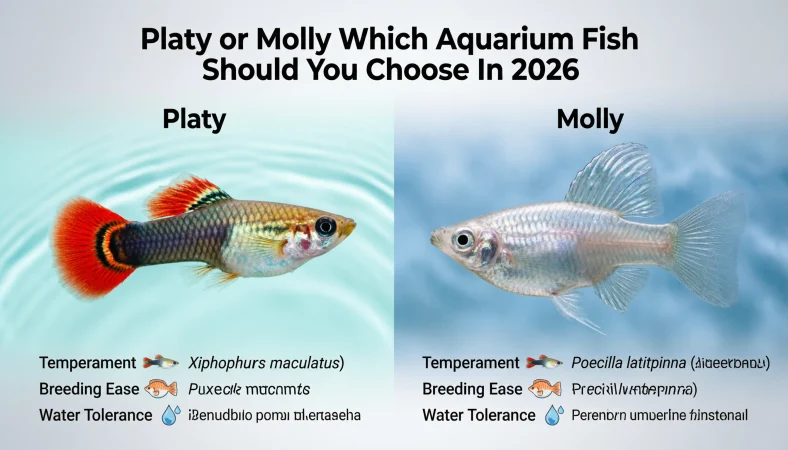
Platy and Molly are both popular freshwater aquarium fish but Platy are generally smaller and easier for beginners, while Molly often grows larger and prefers slightly more stable water conditions.
Platy and Molly are two of the most popular freshwater aquarium fish among beginners and experienced aquarists due to their bright colors, peaceful nature, and easy care requirements. Both belong to the Poeciliidae family and are live-bearing fish, meaning they give birth to free-swimming fry instead of laying eggs. Platies are generally smaller, more adaptable, and highly recommended for beginners because they can thrive in a wide range of water conditions. Mollies, on the other hand, are slightly larger and more active, often requiring a bit more stable water quality and occasional salt tolerance depending on the species.
The difference between Platy and Molly helps fish keepers make better decisions about tank setup, compatibility, and long-term care. While both species are peaceful and social, they may behave differently in community tanks. Choosing the right fish depends on tank size, water conditions, and the level of experience of the aquarist. This makes proper research important before setting up a healthy aquarium environment.
Quick Answer Table
| Feature | Platy | Molly |
| Scientific name | Xiphophorus maculatus / variatus | Poecilia sphenops / latipinna |
| Adult size | 1.52.5 inches (46 cm) | 35 inches (7.512 cm) |
| Water temperature | 7077°F (2125°C) | 7282°F (2228°C) |
| pH preference | 7.08.0 | 7.58.5 |
| Salinity | Freshwater only | Brackish optional (prefers some salt) |
| Temperament | Peaceful, community-friendly | Peaceful but can be fin-nippers |
| Lifespan | 23 years | 35 years |
| Best for | Small tanks, beginners | Larger tanks, planted setups |
Which One Is Correct? Platy or Molly?
Here’s the short answer: Both are correct, but they are different fish with different needs.
- Platy (short for platyfish) is a small, peaceful livebearer from Central America. Perfect for small community tanks.
- Molly (short for mollienesia) is a larger, slightly more demanding livebearer from the same region. Needs more space and harder water.
The confusion between platy or molly happens because both are livebearers (they give birth to live young instead of laying eggs), both are sold in most pet stores, and both come in many color varieties. But experienced aquarists know: choosing the wrong one for your water can lead to sick fish and disappointment.
Let’s break down each fish so you can choose wisely.
Meaning of Platy (The Small Community Favorite)
Platy refers to several species of small, colorful freshwater fish in the genus Xiphophorus. The two most common are the southern platy (Xiphophorus maculatus) and the variable platy (Xiphophorus variatus).
Key characteristics of platies
- Size: Small, rarely exceeds 2.5 inches
- Shape: Stocky, rounded body with a fan-shaped tail
- Colors: Orange, red, yellow, blue, black, and countless hybrids (including “Mickey Mouse” platies)
- Gender differences: Males have a modified anal fin called a gonopodium; females are larger and rounder
- Hardiness: Extremely hardy, excellent for beginners
Water parameters for platies
| Parameter | Ideal range |
| Temperature | 7077°F (2125°C) |
| pH | 7.08.0 |
| Hardness | 1028 dGH (moderate to hard) |
| Tank size minimum | 10 gallons |
Real-world usage examples
- *My 20-gallon community tank has eight platies, and they’re constantly breeding.*
- Platies are perfect for beginners because they tolerate a wide range of water conditions.
- The orange platy stands out beautifully against green plants.
- I started with three platies. Six months later, I have twenty.
Pros and cons of platies
| Pros | Cons |
| Very hardy and forgiving | Breed prolifically (can overpopulate) |
| Peaceful with other community fish | Eat their own fry (need hiding places) |
| Available in many colors | Short lifespan (23 years) |
| Inexpensive ($36 each) | Males may chase females constantly |
Meaning of Molly (The Larger Brackish Option)
Molly refers to several species in the genus Poecilia, including the common molly (Poecilia sphenops), sailfin molly (Poecilia latipinna), and Yucatan molly (Poecilia velifera).
Key characteristics of mollies
- Size: Medium to large, 3 to 5 inches (sailfins can reach 6 inches)
- Shape: More elongated body with a pointed snout; sailfin males have enormous dorsal fins
- Colors: Black, silver, gold, dalmatian (spotted), balloon (deformed body shape, controversial)
- Gender differences: Males have a gonopodium and larger dorsal fins (especially sailfins)
- Hardiness: Moderate, more sensitive than platies, especially to poor water quality
Water parameters for mollies
| Parameter | Ideal range |
| Temperature | 7282°F (2228°C) |
| pH | 7.58.5 (alkaline) |
| Hardness | 1530 dGH (hard to very hard) |
| Salinity | Can add aquarium salt (12 tsp per gallon) |
| Tank size minimum | 20 gallons (30+ for sailfins) |
Real-world usage examples
- My black mollies thrive in hard, alkaline tap water with added salt.
- *Sailfin mollies need at least a 30-gallon tank because of their size.*
- Mollies are more prone to ich if water conditions aren’t perfect.
- I keep my mollies in a brackish tank with a little aquarium salt.
Pros and cons of mollies
| Pros | Cons |
| Larger, more “impressive” size | Need harder, more alkaline water |
| Beautiful fin shapes (sailfins) | More sensitive to poor water quality |
| Longer lifespan (35 years) | May nip long-finned tank mates |
| Available in striking color morphs | Often require salt for optimal health |
| Eat algae well | Need larger tanks (20+ gallons) |
Key Differences Between Platy and Molly
| Category | Platy | Molly |
| Maximum size | 2.5 inches | 5 inches (sailfins to 6) |
| Minimum tank size | 10 gallons | 20 gallons (30 for sailfins) |
| pH preference | 7.08.0 | 7.58.5 |
| Salt needed? | No (freshwater only) | Beneficial (brackish optional) |
| Algae eating | Moderate | Excellent |
| Fin nipping | Rare | Possible, especially sailfins |
| Fry survival | Low (eat their young) | Low (eat their young) |
| Price range | $36 | 515(sailfins515(sailfins1525) |
| Color variety | Very high | High, but fewer than platies |
| Best for beginners | Excellent | Good (but not as forgiving) |
Common Mistakes People Make
Even experienced aquarists confuse these fish. Avoid these errors:
Mistake 1: Keeping mollies in soft, acidic water
❌ My tap water is pH 6.8 and soft. Mollies should be fine.
✅ Mollies need hard, alkaline water (pH 7.5+). Soft, acidic water causes stress, fin rot, and death.
Fix: Add crushed coral to your filter or use a buffer. Or choose platies instead.
Mistake 2: Putting mollies in a 10-gallon tank
❌ *A 10-gallon is fine for a few mollies.*
✅ Mollies grow to 45 inches and are active swimmers. They need 20 gallons minimum. Sailfins need 30+.
Fix: If you only have a 10-gallon tank, get platies (or a betta, or shrimp).
Mistake 3: Adding salt to a platy tank
❌ Mollies like salt, so I’ll add salt for my platies too.
✅ Platies are freshwater fish. They don’t need salt, and long-term salt exposure can harm them.
Fix: Only add salt to Molly tanks. Keep platies in pure freshwater.
Mistake 4: Confusing gender differences
❌ I bought three mollies, all females. Why do I have babies?
✅ Female livebearers can store sperm for months. Even without a male present, she can produce multiple batches of fry.
Fix: If you don’t want babies, buy only males. But males may fight. Or accept that babies will happen.
Mistake 5: Overcrowding with both species
❌ *I’ll put 6 platies and 6 mollies in my 20-gallon.*
✅ That’s 12 fish, many of which will reach 35 inches. Overcrowding causes poor water quality and disease.
Fix: In a 20-gallon tank, choose one species. 68 platies OR 45 mollies. Not both.
Correct Usage Examples
Casual examples (beginner aquarists)
- I got my first fish, three platies. They’re so easy to care for.
- My black Molly just had 30 babies. What do I do?
- Platies are always hungry. They beg like puppies.
- My sailfin molly flares its fin at the glass. So dramatic.
Professional examples (aquarium stores and forums)
- Recommend platies for customers with small tanks or soft water.
- Mollies are excellent for controlling hair algae, but only in hard, alkaline water.
- When customers ask Platy or Molly, I first test their tap water pH and hardness.
- Never keep mollies with soft-water fish like tetras or angelfish.
Educational examples (aquarium science)
- Both platies and mollies are ovoviviparous; eggs develop inside the female, and live young are born.
- The gestation period for platies is 2430 days; for mollies, 3545 days.
- Selective breeding has produced the “balloon molly,” but this body shape causes organ compression and health issues.
Side-by-side comparison table for quick reference
| Your situation | Choose Platy | Choose Molly |
| 10-gallon tank | ✅ Yes | ❌ No |
| Hard, alkaline tap water (pH 8.0) | ✅ Yes | ✅ Yes (excellent) |
| Soft, acidic tap water (pH 6.5) | ✅ Yes (tolerates) | ❌ No |
| Want fish that eat algae | ❌ Okay | ✅ Excellent |
| Beginner with no experience | ✅ Best choice | ❌ Not recommended |
| Want larger, “showy” fish | ❌ Too small | ✅ Sailfin mollies |
| Limited budget | ✅ $36 each | ❌ $1020 each |
Word Origin / Etymology
Platy is short for platyfish, from the Greek platys meaning “broad” or “flat.” This refers to the fish’s wide, compressed body shape. The scientific name Xiphophorus means “sword bearer” (from Greek xiphos = sword, phoros = bearer), referring to the sword-like extension on the tail of related swordtails.
Molly is short for mollienisia, the old genus name. Poecilia comes from the Greek poikilos, meaning “variegated” or “colorful.” The common name “molly” is simply a shortened, friendlier version of the scientific name.
Both genera are part of the family Poeciliidae, the livebearers.
Why “Platy or Molly” Debates Never End
Aquarium forums have argued this question for decades. Here’s why:
- Appearance overlap Some platies and mollies look similar, especially young fish or color morphs like “black platy” and “black molly.”
- Both are livebearers. Beginners learn “livebearer” as a category and assume all livebearers are the same.
- Pet store mislabeling Fish are often misidentified at stores. You might buy a “platy” that’s actually a young molly.
- Hybridization Platies and swordtails hybridize. Mollies hybridize with guppies (Endler’s). But platies and mollies cannot crossbreed; they’re too different.
The result? Endless “which is better” threads. The answer always comes back to: What are your water parameters and tank size?
Easy Memory Tricks
Never confuse platy or molly again with these simple tricks.
The “Size and Salt” Trick
| Word | Memory trick |
| Platy | Small, like a “plate” (round and flat). No salt needed. |
| Molly | Larger, like “Molly the Marine” (needs salt/minerals). |
The “Alphabet Order” Trick
- Platy → Petite (small)
- Molly → Massive (larger)
The “Water pH” Trick
- Platy = P = 7.0 (neutral)
- Molly = M = the 8th letter of the alphabet → pH 8.0 (alkaline)
One-sentence rule
Platies fit in small tanks and soft water; mollies need big tanks and hard, salty water.
FAQs
Can platies and mollies live together?
Yes, but with caution. They can share a tank if:
- The tank is at least 30 gallons
- Water parameters are a compromise (pH 7.5, hard water)
- You monitor for aggression (mollies may nip platies)
- You don’t overstock
However, it’s better to choose one species for optimal health.
Do platies or mollies eat their babies?
Both do. Platies and mollies are cannibalistic toward their own fry. To save babies, add dense plants (Java moss, guppy grass) or move pregnant females to a breeding box.
Which is better for a 5-gallon tank?
Neither. 5 gallons is too small for platies or mollies. Platies need 10 gallons minimum. Mollies need 20+. For a 5-gallon, consider a betta or shrimp.
Do mollies really need salt?
Not strictly, but they thrive with it. In hard, alkaline water, mollies can live without salt. But adding aquarium salt (1 tsp per gallon) reduces stress, prevents disease, and improves breeding. Platies should not have salt.
Which lives longer, “platy or molly”?
Mollies live longer (35 years vs. 23 years for platies). However, mollies are more prone to disease if water conditions aren’t perfect, so their “average” lifespan in beginner tanks may be shorter.
Can platies and mollies breed with each other?
No. They are different genera (Xiphophorus vs. Poecilia). They cannot hybridize. Platies can breed with swordtails. Mollies can breed with guppies and endlers. But platy-molly hybrids do not exist.
Conclusion
In conclusion, both Platy and Molly are excellent aquarium fish, but they suit slightly different needs. Platies are more beginner-friendly due to their hardiness and easy care, while Mollies offer more variety in size and appearance but may need more stable water conditions.
Choosing between them depends on your tank setup, experience level, and care routine. With proper maintenance, both fish can live healthy, active, and colorful lives in a well-balanced aquarium.