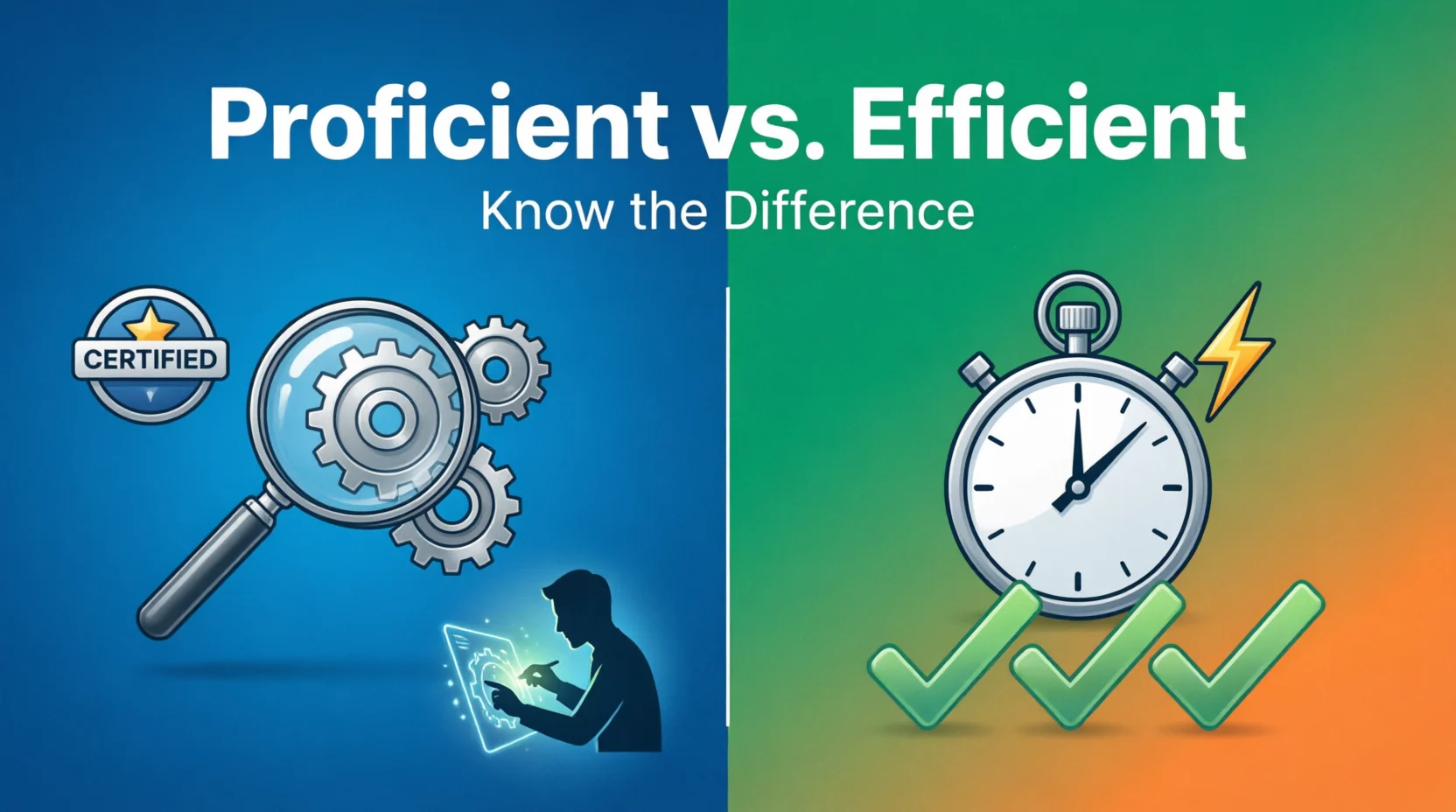
“Proficient” means having strong skill or competence in something, while “efficient” means doing something in a way that saves time, effort, or resources.
The difference between “proficient” and “efficient” is important for clear communication in both academic and professional writing. Although these two words are often used in similar contexts, they carry distinct meanings that reflect different types of ability. “Proficient” refers to a person’s level of skill or expertise in performing a task, showing that they have gained knowledge and competence through practice and experience. On the other hand, “efficient” focuses on how well a task is completed with minimal waste of time, effort, or resources.
In real-life situations, these words are often used to describe workers, students, systems, and even machines, but they are not interchangeable. A person can be proficient in a skill but not always efficient in using it under time pressure, while someone can be efficient without being highly skilled in the task itself.
Quick Answer Table
| Feature | Proficient | Efficient |
| Core meaning | Skilled, competent, expert | Productive, organized, minimal waste |
| Focus | Ability/skill level | Time/resources/speed |
| Opposite | Incompetent, unskilled | Inefficient, wasteful |
| Measures | How well you do something | How quickly or cheaply you do it |
| Example sentence | She is proficient in three languages. | He runs an efficient household. |
| Common with | “in” (proficient in Excel) | “at” or no preposition (efficient engine) |
Which One Is Correct? Proficient or Efficient?
Here’s the short answer: Both are correct, but they are not interchangeable.
- Proficient means you have a high level of skill or knowledge. You know how to do something well.
- Efficient means achieving maximum productivity with minimal wasted effort or resources. You do something quickly and without waste.
The confusion between proficient and efficient happens because skilled people are often efficient, but not always. A highly proficient worker might be slow. A highly efficient worker might make mistakes.
Choosing the right word shows that you understand what you’re praising: skill or speed.
Meaning of “Proficient” (Skill Over Speed)
Proficient comes from the Latin proficere, meaning “to make progress.” A proficient person has advanced beyond beginner level. They can perform tasks correctly and independently.
Key characteristics of proficient
- High level of skill or knowledge
- Can perform tasks without supervision
- Makes a few errors
- Speed is not the primary factor
- Often followed by “in” or “at.”
Real-world usage examples
- She is proficient in Microsoft Excel, including pivot tables and macros.
- After two years of lessons, he became proficient at playing the piano.
- The technician is proficient in diagnosing engine problems.
- You don’t need to be an expert, but you should be proficient in basic coding.
Proficient on a skills scale
| Level | Description |
| Novice | Beginner, needs guidance |
| Intermediate | Some skills can handle basic tasks |
| Proficient | High skill, works independently |
| Expert | Mastery can teach others |
Common phrases with “proficient”.
| Phrase | Meaning |
| Proficient in | Skilled in a specific area (proficient in Spanish) |
| Proficient at | Skilled at an activity (proficient at troubleshooting) |
| Proficient user | Someone who uses software/systems with competence |
Meaning of “Efficient” (Speed and Resource Management)
Efficient comes from Latin efficiente,m meaning “to produce, accomplish.” An efficient person achieves results with minimal waste of time, energy, money, or materials.
Key characteristics of efficient
- Maximizes output for given input
- Minimizes wasted resources
- Often fast, but speed alone isn’t efficiency
- Can be applied to systems, machines, and people
- Often followed by “at” or used without a preposition
Real-world usage examples
- Her efficient filing system saves the team hours each week.
- This new dishwasher is more efficient, using less water and electricity.
- He is efficient at processing customer returns quickly.
- An efficient worker completes tasks with fewer steps.
Efficiency in different contexts
| Context | What efficiency means |
| Manufacturing | More products per hour, less scrap material |
| Driving | Better fuel economy (miles per gallon) |
| Office work | Fewer clicks, less back-and-forth, faster completion |
| Energy | Less electricity or fuel for the same output |
Common phrases with “efficient.”
| Phrase | Meaning |
| Efficient at | Skilled at doing something quickly (efficient at data entry) |
| Fuel-efficient | Uses less fuel per mile |
| Cost-efficient | Good value for money spent |
| Energy-efficient | Uses less energy for the same performance |
Key Differences Between Proficient and Efficient
| Category | Proficient | Efficient |
| Primary focus | Skill level | Resource usage (time, energy, money) |
| Question it answers | “How well?” | “How quickly/cheaply?” |
| Can someone be… | Proficient but slow | Efficient but error-prone |
| Typical preposition | “in” (proficient in French) | “at” (efficient at scheduling) |
| Applied to people | Yes (skill) | Yes (work habits) |
| Applied to machines | Rarely (machines aren’t “skilled”) | Often (efficient engine) |
| Applied to systems | Rarely | Often (efficient process) |
| Opposite | Incompetent | Inefficient |
Common Mistakes People Make
The confusion between “proficient” and “efficient” appears everywhere in resumes, emails, and even published articles. Avoid these errors:
Mistake 1: Using “efficient” when you mean “proficient.”
❌ She is efficient in three programming languages. (Skill, not speed)
✅ She is proficient in three programming languages.
Why it’s wrong: Programming language skills are about knowledge and ability. Efficiency doesn’t capture that.
Mistake 2: Using “proficient” when you mean “efficient.”
❌ This new printer is more proficient. (Machines aren’t skilled)
✅ This new printer is more efficient. (Faster, less waste)
Why it’s wrong: Proficient describes living beings with learned skills. Printers don’t learn.
Mistake 3: Using both when describing the same person incorrectly
❌ *He is a proficient and efficient worker who takes six hours to complete a 30-minute task.* (Contradiction)
✅ He is a proficient worker who takes six hours, OR He is an efficient worker who finishes quickly.
You cannot be both if the task takes 6x longer than needed. That’s inefficient.
Mistake 4: Confusing “efficient” with “effective.”
- Efficient = doing things right (minimizing waste)
- Effective = doing the right things (achieving the goal)
A car can be fuel-efficient (good) but ineffective at climbing mountains (wrong tool). A worker can be efficient at the wrong task and still fail.
Mistake 5: Overusing both on resumes without evidence
❌ “Proficient in Microsoft Word, efficient at email.”
✅ *”Proficient in Microsoft Word (created 20+ templates used by entire department). Efficient at email management (reduced response time from 24 to 4 hours).”
Claiming proficiency or efficiency without proof is meaningless. Add metrics.
Correct Usage Examples
Casual examples (everyday conversation)
- I’m proficient at grilling steak, but don’t ask me to bake.
- Our new coffee maker is so efficient that it brews a pot in two minutes.
- She’s proficient in sign language, so she helped translate.
- Taking the highway is more efficient than local roads, even if it’s longer.
Professional examples (resumes and reviews)
- The candidate is proficient in Python, SQL, and Tableau.
- We need to design a more efficient approval workflow.
- Her team is proficient at crisis management but inefficient at routine tasks.
- Promoted because he is both proficient (knows the product) and efficient (closes deals fast).
Side-by-side comparison (same person, different traits)
| Statement | Meaning |
| Maria is proficient in graphic design. | Maria has strong design skills. |
| Maria is an efficient graphic designer. | Maria works quickly and uses resources well. |
| Maria is proficient but not efficient. | Maria designs beautiful work slowly. |
| Maria is efficient but not proficient. | Maria finishes fast, but quality suffers. |
| Maria is both proficient and efficient. | Maria is skilled AND fast. The ideal employee. |
Educational examples (classroom)
- To become proficient in a language, you need thousands of hours of practice.
- An efficient study method is active recall, not passive rereading.
- Teachers assess proficiency (can the student do it?) separately from efficiency (how long did it take?).
Literary/metaphorical examples
- Time is the most efficient editor; it cuts everything that doesn’t matter.
- She was proficient in the grammar of grief, having learned its irregular verbs too young.
- An efficient heart wastes no beats. A proficient heart knows exactly when to skip one.
Word Origin / Etymology
Proficient
From Latin proficere (to make progress, accomplish). Broken down: pro- (forward) + facere (to do, make). A proficient person is someone who “does forward” and makes progress and accomplishes tasks skillfully. Entered English in the late 16th century.
Efficient
From Latin efficientem (producing, effective). Broken down: *ex-* (out) + facere (to do, make). An efficient person “does out” and produces results from input. Entered English in the late 14th century.
Both words share the same Latin root facere (to do/make). That’s why they look and sound similar. But their prefixes change the meaning completely:
- Pro- (forward) → skill-based progress
- *Ex-* (out) → output-based productivity
Why “Proficient or Efficient” Confusion Is So Common
Language learners and native speakers alike mix up these two words. Three main reasons:
- Same Latin root – Both come from facere (to do). They feel related because they are.
- Similar spelling – Proficient vs. Efficient: both end in -ient, both have F and C.
- Overlap in ideal workers – The best employees are both. But praising someone as “proficient” or “efficient” sounds equally positive, so people swap them carelessly.
The result? Millions of resumes claiming “efficient in Photoshop” (wrong) and “proficient at time management” (awkward).
Easy Memory Tricks
Never confuse proficient or efficient again with these simple tricks.
The “K” vs. “Q” Trick
| Word | Think of | Because |
| Proficient | Knowledge | Skill is about what you KNOW. |
| Efficient | Quick | Efficiency is about how QUICK (or low-waste) you are. |
K for Knowledge (proficient). Q for Quick (efficient).
The Preposition Trick
- Proficient IN something (a language, a tool, a subject)
- Efficient AT something (a task, a process)
You can say, “in,” lean toward proficiency. If you need “at,” both work, but efficiency emphasizes speed.
The “Machine Test”
Ask yourself: Can a machine do this?
- A machine can be efficient (uses less fuel).
- A machine cannot be proficient (machines aren’t skilled; they’re programmed).
If you’re describing a person’s skill, use proficient. If you’re describing a process or device’s output, use efficient.
One-sentence rule
Proficient is about how WELL you do something; efficient is about how FAST or CHEAP you do it.
FAQs
Can someone be proficient without being efficient?
Yes. A master craftsman might spend hours on one perfect piece. Highly skilled (proficient). Terribly slow (inefficient).
Can someone be efficient without being proficient?
Yes. An assembly line worker might place parts very fast (efficient) but still make many mistakes (not proficient). Speed without skill.
Which is more important for employees?
It depends on the role:
- Proficiency matters more for doctors, engineers, and lawyers (errors are costly)
- Efficiency matters more for data entry, customer service, and manufacturing (volume matters)
The best employees are both.
How do I say “proficient in” on a resume without sounding generic?
Be specific. Instead of “proficient in Microsoft Office,” write “proficient in Excel (pivot tables, VLOOKUP, macros).” Instead of “proficient in Spanish,” write “proficient in Spanish (professional working proficiency).”
Is “efficient” always positive?
Not always. “Efficient” can feel cold or robotic when applied to humans. “She runs an efficient household” might praise organization or imply a lack of warmth. Context matters.
Can I use both words in the same sentence?
Yes, to contrast or combine:
- She is proficient in the work but not efficient at completing it.
- He is both proficient and efficient, the ideal project manager.
Conclusion
In conclusion, “proficient” refers to having strong skill or expertise in a subject or task, while “efficient” focuses on completing work in a smart, time-saving, and resource-effective way. Both words describe positive abilities, but they highlight different aspects of performance.
Using them correctly improves clarity in writing and helps avoid confusion in communication. A good understanding of these terms supports better academic writing, professional expression, and everyday language use.