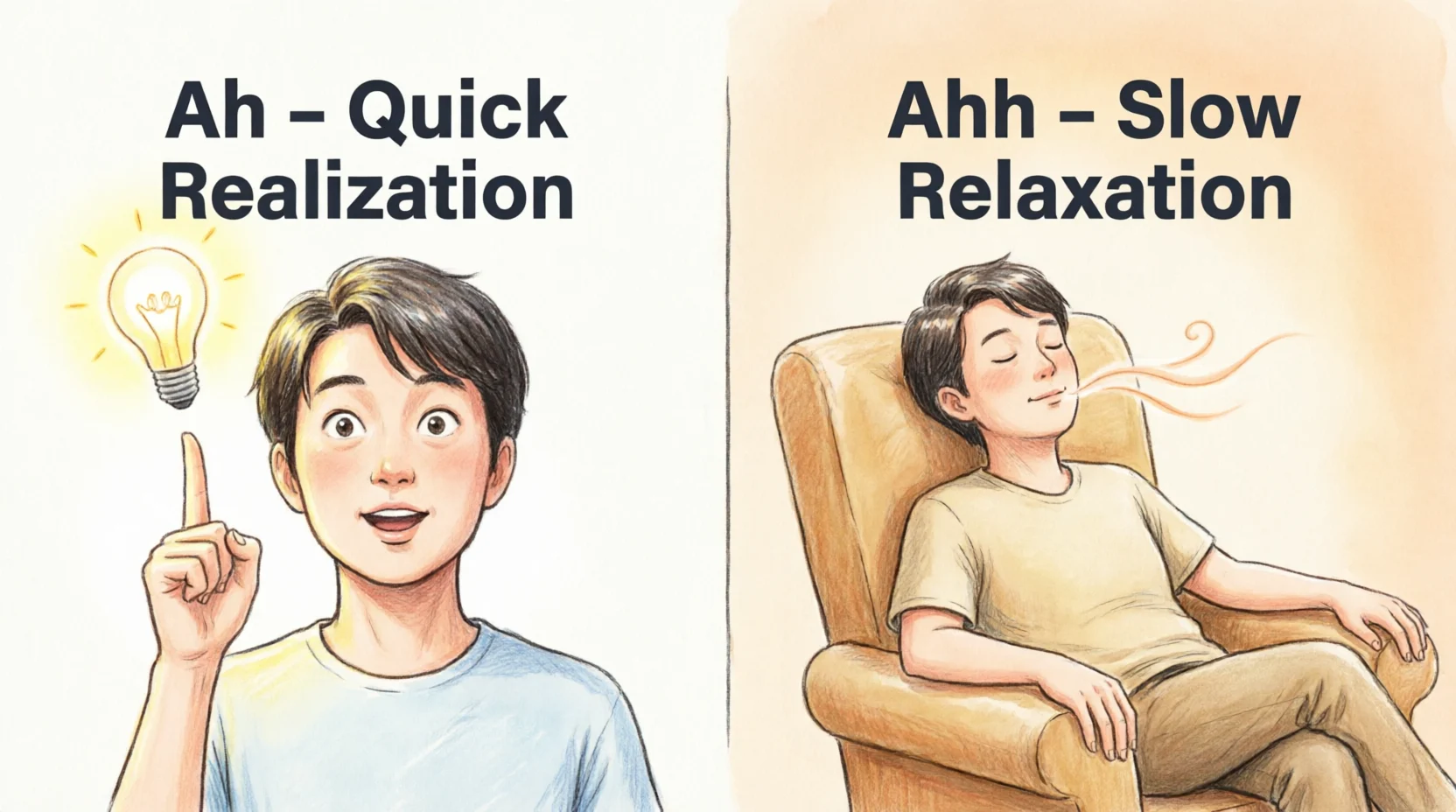
Quick Ans: Use ah for quick moments of realization (Ah, I see); use ahh for slow, drawn-out feelings of pleasure or relief (Ahh, that feels good).
The difference between “ah” and “ahh” may look small, but these expressions can completely change the tone and emotion of a sentence. In everyday English, people use both words to show feelings such as surprise, understanding, relief, happiness, or realization. However, the number of letters often affects how the emotion sounds to readers. “Ah” is usually considered the standard and more formal spelling, while “ahh” creates a longer, more expressive sound that feels emotional and conversational.
Understanding this distinction is important for students, writers, bloggers, and social media users who want to communicate naturally and clearly. In modern digital communication, even small spelling choices can influence meaning, tone, and reader engagement. Learning when to use “ah” or “ahh” correctly helps improve writing accuracy, emotional expression, and overall language confidence in both formal and informal English communication.
Quick Answer Table
| Feature | Ah | Ahh |
| Correct spelling | ✅ Yes | ✅ Yes |
| Primary meaning | Realization, understanding, mild surprise | Relaxation, pleasure, relief, or longer sigh |
| Duration implied | Short, quick | Extended, drawn out |
| Typical context | “Ah, I get it now.” | “Ahh, this massage is wonderful.” |
| Emotional intensity | Neutral to mild | Warm, soothing, or relieved |
| Example sentence | Ah, now I see the problem. | Ahh, that’s exactly what I needed. |
Which One Is Correct? Ah or Ahh?
Here’s the truth: Both are correct, but they convey different tones and lengths.
- Ah (with one H) is the standard spelling for a short exclamation of realization, understanding, or mild surprise.
- Ahh (with two H’s) extends the sound, suggesting a longer, more drawn-out expression, often of relaxation, pleasure, relief, or contentment.
The confusion between ah and ahh happens because English doesn’t have strict rules for interjections (words that express emotion). Writers add extra letters to show length or emphasis. But there are patterns, and knowing them will make your writing more precise.
Think of it this way: Ah is a quick nod. Ahh is a deep sigh.
Meaning of “Ah” (The Short Realization)
Ah is an interjection. It’s one of the most common sound words in English. You use it to show:
- Sudden understanding or realization
- Mild surprise or acknowledgment
- Discovery or insight
Key characteristics of “ah.”
- Short Pronounced quickly (like the A in “father”)
- Neutral to mild emotion, not strongly positive or negative
- Often followed by the explanation “Ah, that explains it.”
Real-world usage examples
- Ah, now I understand what you meant.
- Ah, so that’s where I left my keys.
- Ah, I see the problem now.
- Ah, yes. That makes perfect sense.
Common contexts for “ah.”
| Context | Example |
| Learning something new | Ah, that’s how the formula works. |
| Solving a puzzle | Ah, the missing piece was here all along. |
| Recognizing a mistake | Ah, I see my error now. |
| Mild surprise | Ah, you’re home early. |
Meaning of “Ahh” (The Extended Sigh)
Ahh is also an interjection, but the extra H changes the feeling. The double H indicates a lengthened sound, like a sigh of relief, a moan of pleasure, or a long, contented exhale.
Key characteristics of “ahh.”
- Longer in duration, hold the “ah” sound for a beat or two
- Warm or soothing emotion: Pleasure, relief, contentment, or relaxation
- Often, ” Ahh ” can stand alone as a complete sentence
Real-world usage examples
- Ahh, this hot bath is perfect.
- *Ahh, I finally sat down after a 12-hour shift.*
- Ahh, that feels so good.
- Ahh, what a beautiful view.
Common contexts for “ahh.”
| Context | Example |
| Physical relaxation | Ahh, this massage is heaven. |
| Relief after stress | Ahh, the deadline is finally over. |
| Enjoying food or drink | Ahh, this coffee is exactly what I needed. |
| Appreciating beauty | Ahh, look at that sunset. |
Key Differences Between Ah and Ahh
| Category | Ah | Ahh |
| Number of H’s | 1 | 2 |
| Duration | Short, quick | Extended, drawn out |
| Primary emotion | Realization, understanding, mild surprise | Pleasure, relief, relaxation, contentment |
| Body language | Quick nod, finger snap | Deep sigh, leaning back, closing eyes |
| Can you follow “ah” with more words? | Yes (often does) | Yes, but often stands alone |
| Typical in writing | Explanatory, instructional texts | Casual, emotional, or sensory writing |
| Is formal writing appropriate? | Yes (dialogue, quotes) | Rare (too informal) |
Common Mistakes People Make
Even native English speakers get confused. Avoid these errors:
Mistake 1: Using “ahh” for sudden realization
❌ Ahh, now I get it! (sounds like you’re sighing while understanding)
✅ Ah, now I get it! (quick, clean realization)
Why it’s wrong: Realization is fast. Adding an extra H slows it down unnaturally.
Mistake 2: Using “ah” for deep relaxation
❌ Ah, this bath feels wonderful. (too short; sounds dismissive)
✅ Ahh, this bath feels wonderful. (extended sound matches the feeling)
Why it’s wrong: Relaxation is slow. A short “ah” sounds like you’re just acknowledging the bath, not enjoying it.
Mistake 3: Adding too many H’s (“ahhhh”)
❌ Ahhhhh, I see.
✅ Ah, I see. (for realization) Or Ahh, I see (for reluctant understanding)
More than two H’s is generally overkill. Use “ahh” for extended sounds. “Ahhhh” looks like a scream or a yawn.
Mistake 4: Using either in formal writing
❌ Ah, the quarterly report indicates positive growth.
✅ The quarterly report indicates positive growth. (remove interjection entirely)
Interjections belong in dialogue, casual writing, and first-person narration, not in business reports or academic papers.
Mistake 5: Capitalization inconsistency
❌ AH, I forgot my keys.
✅ Ah, I forgot my keys.
“Ah” is not an acronym. Don’t capitalize the whole word unless you’re SHOUTING (which is a different effect entirely).
Correct Usage Examples
Casual examples (texts and social media)
- Ah, so that’s why you were late.
- Ahh, just got into bed. Best feeling ever.
- Ah, I see what you did there.
- Ahh, finally Friday.
Professional examples (dialogue in writing)
- The detective nodded. “Ah, now the evidence makes sense.”
- She leaned back in her chair. “Ahh, I’ve been waiting for this vacation for months.”
- “Ah, a common mistake,” the teacher said gently.
- He took a sip of coffee. “Ahh, that’s the good stuff.”
Comparative examples (side by side)
| Situation | Ah | Ahh |
| You solve a math problem | Ah, the answer is 42. | ❌ Too slow |
| You sit in a hot tub | ❌ Too short | Ahh, this is paradise. |
| You find your lost phone | Ah, there it is. | Ahh, what a relief. (also works, but longer) |
| You taste excellent chocolate | ❌ Too short | Ahh, that’s incredible. |
Literary examples
- “Ah,” said the professor, “you’ve finally arrived at the correct conclusion.”
- She exhaled deeply. “Ahh.” The word was barely a sound, more a release than a word at all.
Word Origin / Etymology
Ah is ancient. It appears in Old English as ah (an exclamation of surprise, pain, or joy). Similar forms exist across Indo-European languages: Latin ah, Greek *a*, and Sanskrit ah. It’s a natural human sound, one of the first vocalizations infants make.
Ahh is not a separate etymological word. It’s simply ah with an extra H added in writing to indicate a lengthened pronunciation. The double H convention emerged with informal writing (letters, then later texting and social media). There’s no ancient root, just a practical spelling trick.
In short, Ah is the dictionary word. Ahh is the expressive variant.
Why “Ah or Ahh” Confusion Is So Common
Search social media for “ah vs ahh,” and you’ll find endless debates. Why?
- No official rulebook. Dictionaries list “ah” but often don’t mention “ahh” at all. Writers invent their own rules.
- Tone is subjective. One person’s “ah” of realization might feel like “ahh” of relief to someone else.
- Autocorrect interference. Some devices change “ahh” to “ah” automatically, creating confusion.
- Generational differences: Younger texters use “ahh” more for relaxation; older writers stick with “ah.”
- Cross-language influence: Other languages (like Japanese) use “ah” differently, affecting bilingual writers.
The result? Millions of messages where the intended emotion doesn’t match the spelling.
Easy Memory Tricks
Never confuse ah or ahh again with these simple tricks.
The Duration Trick
| Spelling | Think of |
| Ah (1 H) | One quick sound. Like a snap of your fingers. |
| Ahh (2 H’s) | Two beats. Like a sigh that fills two seconds. |
Rule: More H’s = longer sound = stronger emotion.
The Emotion Map
| Emotion | Spelling |
| Realization, understanding, discovery | Ah |
| Relaxation, pleasure, relief, contentment | Ahh |
| Pain, fear, surprise (sharp) | Ah (or “ouch”) |
| Deep, prolonged pleasure | Ahh |
One-sentence rule
Use “ah” for quick knowing; use “ahh” for slow feeling.
The “Fill in the Blank” Test
Read these aloud. Which feels right?
- _____, now I understand the recipe. → Ah (quick)
- _____, this blanket is so soft. → Ahh (slow)
FAQs
Is “ahh” a real word?
Yes, in informal English. Most dictionaries don’t list “ahh” separately (they list “ah” and note that repeated letters indicate length). But in practice, “ahh” is widely understood and accepted in casual writing.
Can I use “ah” for pleasure and “ahh” for realization?
You can, but it will confuse readers. Stick to the standard: ah for realization, ahh for relaxation/pleasure. Breaking the pattern creates ambiguity.
How many H’s are too many?
Three or more H’s (“ahhh”) is generally excessive. It reads as:
- A scream (“Ahhh! A spider!”)
- A yawn (“Ahhh, I’m tired”)
- Mocking or sarcasm (“Ahhh, so smart of you”)
For most writing, one or two H’s is enough.
Is “ah” or “ahh” more formal?
Ah is more formal (though still too casual for academic or business writing). Ahh is very informal. Use neither in formal documents.
Do other languages use “ah” and “ahh” the same way?
Not exactly. In Japanese, “ah” (あ) can mean realization OR pleasure depending on context. In Spanish, “ah” is closer to English “oh.” If you’re writing in English, follow English conventions.
What’s the difference between “ah” and “oh”?
- Ah = realization, understanding, mild surprise
- Oh = surprise, acknowledgment, or hesitation
Ah, I see vs. Oh, I didn’t expect you.
Conclusion
In conclusion, both “ah” and “ahh” are correct, but they serve different purposes in writing and conversation. “Ah” is typically used in formal or standard English to express realization or understanding, while “ahh” adds stronger emotion, comfort, excitement, or relief in casual communication. Knowing the difference helps writers choose the right tone for their audience and context.
Whether you are writing professionally, chatting online, or creating content for social media, using these expressions correctly can make your communication sound more natural, engaging, and emotionally clear.