Quick answer: Fulfil and Fulfill are both correct spellings.
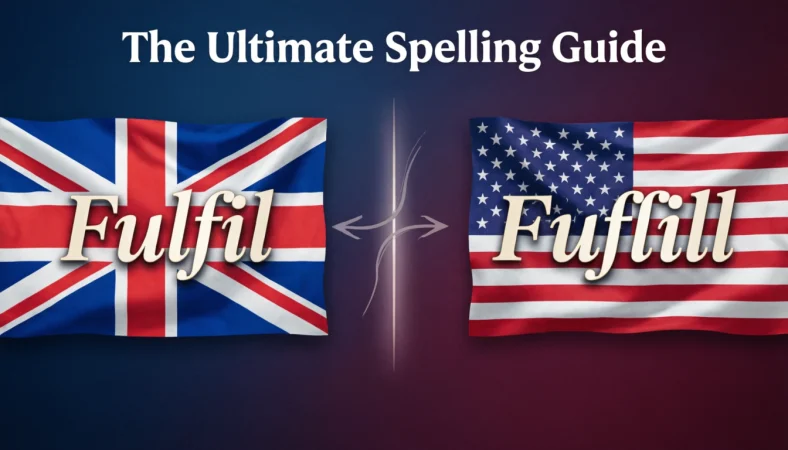
Fulfill is the preferred spelling in American English, while fulfil is commonly used in British English and other Commonwealth varieties. Both mean to complete, satisfy, or carry out something.
Fulfil or Fulfill is a common spelling difference , Both forms are correct and have the same meaning: to complete something, meet a requirement, or satisfy a need. The main difference is based on regional English preferences rather than grammar.
Fulfill is the standard spelling in American English, while fulfil is preferred in British English and many Commonwealth countries. Understanding this small spelling variation helps you write more accurately and maintain consistency with your target audience.
Quick Answer Table
Here is a handy reference table to quickly understand the key differences between these two spellings:
| Aspect | Fulfil | Fulfill |
| Correct Spelling | Yes | Yes |
| Primary Region | British English | American English |
| Meaning | To carry out, satisfy, or complete | To carry out, satisfy, or complete |
| Double L Rule | Single L at the end | Double L at the end |
| Example Sentence | The team worked hard to fulfil the project requirements. | The team worked hard to fulfill the project requirements. |
| Common in | UK, Australia, New Zealand, South Africa | United States, Canada |
| Pronunciation | /fʊlˈfɪl/ | /fʊlˈfɪl/ |
| Variants | Fulfilled, fulfilling, fulfilment | Fulfilled, fulfilling, fulfillment |
Which One Is Correct?
The short answer is that both spellings are correct. Neither one is a typo or a mistake. The confusion arises because English has evolved differently in various parts of the world, leading to distinct spelling conventions.
British English traditionally uses the single L spelling: fulfil. This is the standard form in the United Kingdom, Australia, New Zealand, South Africa, and many other Commonwealth countries. If you are writing for a British audience, this is your go to spelling.
American English, on the other hand, uses the double L spelling: fulfill. This is the accepted form in the United States and is also commonly used in Canada. When writing for American readers, this is the spelling you should choose.
Interestingly, both forms share the same pronunciation and the exact same meaning. The difference is purely orthographic, meaning it is a matter of spelling convention rather than any actual variation in usage or definition.
Meaning of Fulfil
When you choose to use “fulfil” or “fulfill,” you are expressing the same core concept. The verb means to carry out a promise, satisfy a requirement, or bring something to completion. It is a versatile word that appears in countless contexts across professional, personal, and creative writing.
Definition and Explanation
To fulfil something means to achieve, satisfy, or complete it. The word carries a sense of accomplishment and meeting expectations. Whether you are fulfilling a contract, fulfilling a dream, or fulfilling a responsibility, the meaning remains consistent.
Consider these key aspects of the word’s meaning:
- Completing a task: When you finish something that was required or expected of you
- Satisfying a condition: Meeting the necessary criteria or requirements
- Realizing potential: Bringing something to its intended or expected state
- Keeping promises: Following through on commitments you have made
- Achieving satisfaction: Providing enough of what is needed or desired
Real World Usage Examples
Here are some examples that demonstrate how this verb functions in everyday language:
- The team worked tirelessly to fulfil the contract obligations before the deadline.
- She wanted to fulfil her lifelong dream of becoming a published author.
- The new employee was eager to fulfil all the requirements of the position.
- The company promised to fulfil every order within 24 hours.
- His role is to fulfil the duties assigned by the board of directors.
- The restaurant could not fulfil the dietary requirements of all guests.
- Education should help students fulfil their potential.
- The organization exists to fulfil a vital community need.
Meaning of Fulfill
When you use “fulfill,” you are expressing the same exact definition as “fulfil.” The only difference is the spelling convention. This version is the standard in American English and has become increasingly recognizable worldwide due to the influence of American media and technology.
Definition and Explanation
Fulfill carries the same meaning as its British counterpart. It encompasses the ideas of completion, satisfaction, and achievement. The word can be used in professional contexts, personal reflections, and creative expressions with equal effectiveness.
In American usage, this spelling is found in legal documents, business communications, academic writing, and casual conversation alike. The double L has become a hallmark of American English spelling patterns, similar to how other words like “traveling” vs “travelling” follow the same regional pattern.
Key Usage Points
- Professional contexts: Every manager needs to fulfill their responsibilities.
- Personal aspirations: She wanted to fulfill her ambitions in the arts.
- Legal requirements: The contract must fulfill certain legal obligations.
- Customer satisfaction: We work hard to fulfill our clients’ expectations.
- Spiritual or emotional: Meditation helps him fulfill a sense of inner peace.
Key Differences Between the Two Words
Although these words mean the same thing, they differ in several important ways. Understanding these distinctions helps you make the right choice for your audience.
Spelling Differences
The primary difference is simple. British English uses a single L at the end of the base form, while American English uses a double L. This pattern extends to related forms of the word.
When adding suffixes, both spellings follow their respective rules. For instance, “fulfilled” retains the double L in American English but uses a single L in British English. The same applies to “fulfilling” and “fulfillment.”
Regional Usage
Geography is the deciding factor in which spelling you should use. The table below illustrates the regional preferences clearly:
| Region | Preferred Spelling | Example |
| United Kingdom | Fulfil | The charity aims to fulfil its mission. |
| Australia | Fulfil | All students must fulfil the course requirements. |
| New Zealand | Fulfil | The government promised to fulfil the election pledges. |
| South Africa | Fulfil | We need to fulfil the terms of the agreement. |
| United States | Fulfill | The company will fulfill your order by tomorrow. |
| Canada | Fulfill | She wants to fulfill her teaching certification. |
Pronunciation
Despite the spelling differences, both forms are pronounced identically. The word is typically pronounced as /fʊlˈfɪl/, with the stress on the second syllable. The pronunciation is consistent across all English speaking regions.
Grammatical Usage
Both forms function identically as verbs. They are transitive verbs, meaning they require a direct object. For example, you must fulfil something or fulfill something. You cannot simply “fulfil” without specifying what is being fulfilled.
The verb forms similarly across both spellings:
- Present tense: I fulfil / fulfill
- Past tense: I fulfilled (both spellings)
- Present participle: I am fulfilling (both spellings)
- Past participle: I have fulfilled (both spellings)
- Noun form: fulfilment (British) / fulfillment (American)
Recognition and Acceptance
Both spellings are recognized and accepted in their respective regions. However, using the wrong spelling for your audience might be noticed by careful readers. In professional and academic contexts, following the regional convention is generally expected.
The double L spelling (fulfill) has become more globally recognized due to American cultural influence. Many non native English speakers learn American English first, making “fulfill” more familiar to international audiences.
Common Mistakes People Make
Understanding what errors commonly occur can help you avoid them in your own writing.
Using the Wrong Regional Spelling
One of the most frequent mistakes is using the wrong spelling for the target audience. For example, using “fulfil” in an American publication may appear unusual to American readers, while using “fulfill” in British publications might be considered incorrect by British grammar purists.
Incorrect: The American company needs to fulfil its obligations. (American context)
Correct: The American company needs to fulfill its obligations.
Incorrect: The British charity needs to fulfill its mission. (British context)
Correct: The British charity needs to fulfil its mission.
Inconsistent Spelling
Another common error involves inconsistent spelling within the same document. Some writers accidentally switch between “fulfil” and “fulfill” multiple times in one piece of writing, which looks unprofessional.
Incorrect: We will fulfil the contract and then fulfill all remaining orders.
Correct (American): We will fulfill the contract and then fulfill all remaining orders.
Correct (British): We will fulfil the contract and then fulfil all remaining orders.
Confusion with Suffixes
Adding suffixes can also cause confusion. Some writers become uncertain whether to keep the double L or revert to a single L when creating related forms.
Incorrect (American): The fulfilment of the contract is overdue.
Correct (American): The fulfillment of the contract is overdue.
Incorrect (British): The fulfillment of the contract is overdue.
Correct (British): The fulfilment of the contract is overdue.
Misusing the Word Entirely
Occasionally, people confuse “fulfil” or “fulfill” with similar sounding words. The word is often mistaken for “fill,” “full,” or even “file.” This confusion usually arises from trying to sound more formal than necessary.
Incorrect: Please file the request by Friday.
Correct: Please fulfil the request by Friday.
Incorrect: He wants to full his potential.
Correct: He wants to fulfil his potential.
Overgeneralizing the Spelling Rule
Some writers incorrectly assume that all words ending with “fil” follow the same regional spelling pattern. While many do, not all follow the same rule, leading to errors.
Incorrect (British): She needs to distil the information. (This is correct in British English actually, but the rule is not universal)
Important: The “fulfil” spelling pattern is consistent, but always double check specific words rather than assuming.
Correct Usage Examples Across Contexts
Seeing the word used correctly in various contexts helps solidify understanding. Here are examples spanning casual, professional, educational, and literary settings.
Casual and Everyday Examples
These examples show how the word appears in daily conversation and informal writing:
- I need to fulfil my promise to take the kids to the zoo this weekend.
- The bakery always fulfils special orders for birthday cakes.
- She found that volunteering helped her fulfil a deep sense of purpose.
- We had to fulfil several requirements before moving into the new apartment.
- The team could not fulfil all the customer requests during the sale.
Professional and Business Examples
In the workplace, this verb appears frequently in relation to responsibilities, contracts, and customer service:
- The project manager must fulfil all client deliverables by the quarterly deadline.
- Our department needs to fulfill the new compliance regulations effective next month.
- The sales representative promised to fulfill the order within five business days.
- As a company, we fulfil our obligations to shareholders through transparent reporting.
- The supplier failed to fulfil the contract terms, resulting in financial penalties.
- Every employee should fulfill their duties with integrity and professionalism.
- The insurance policy fulfills the legal requirements for business coverage.
- Customer service teams work hard to fulfill every reasonable request.
Educational and Academic Examples
Students and educators frequently encounter this word in academic contexts:
- The course is designed to help students fulfil their academic potential.
- All candidates must fulfill the prerequisite requirements before enrolling.
- The research project aims to fulfil the university’s standards for excellence.
- Students need to fulfil specific credit hours to graduate.
- The scholarship program helps deserving students fulfil their educational dreams.
Literary and Metaphorical Examples
Writers often use this word in more creative or expressive ways:
- The hero’s journey is to fulfil a destiny foretold by ancient prophecy.
- Love alone cannot fulfil all the needs of the human heart.
- The ancient temple was built to fulfil the gods’ demands for worship.
- He spent his life trying to fulfil the impossible standards set by his father.
- The novel explores how people seek to fulfil their deepest desires.
Word Origin and Etymology
Understanding where words come from often helps make their usage clearer. The journey of “fulfil” and “fulfill” through history is fascinating and explains many of the regional spelling differences we see today.
Old English Roots
The word traces back to Old English “fullfyllan,” which means “to fill full.” This combination of “full” and “fyllan” (to fill) gave us the core meaning of completing or satisfying something completely. The concept of filling something until it is full naturally evolved into the idea of fulfilling requirements, desires, or obligations.
Middle English Development
During the Middle English period, the word transformed into “fullfillen.” The spelling varied considerably, as was common in that era of inconsistent written English. The word was sometimes written as “fullfylle” or “fulfille,” depending on the region and the individual scribe’s preferences.
The Influence of Norman French
After the Norman Conquest in 1066, French heavily influenced the English language. The French word “accomplir” contributed to the semantic range of fulfil, adding layers of meaning related to accomplishment and completion beyond just physical filling.
The Great Vowel Shift
Between the 15th and 18th centuries, the Great Vowel Shift changed English pronunciation. This linguistic evolution affected how the word was pronounced and, to some extent, how it was spelled. The shift helped standardize many spellings, though regional variations persisted.
American English Divergence
When American English began to diverge from British English in the 18th and 19th centuries, spelling differences emerged. Noah Webster, the influential American lexicographer, advocated for simplified spellings. His dictionaries promoted forms with single consonants before suffixes in some cases but supported the double L in “fulfill” as part of American spelling conventions.
Modern Standardization
Today, both spellings are fully accepted in their respective regions. The British preference for “fulfil” aligns with their tendency toward shorter spellings in certain cases, while the American preference for “fulfill” aligns with their tendency to retain double consonants before suffixes.
Why the Incorrect Version Became Popular
Neither version is actually incorrect, but both forms have experienced fluctuations in popularity over time. Understanding why one might seem more common than the other helps demystify the confusion.
Influence of American Media
American English has become extremely influential globally due to Hollywood movies, television shows, music, and the internet. This widespread exposure has made American spellings more recognizable to international audiences. Many English learners worldwide first encounter American English, making “fulfill” more familiar to them.
Spell Checker Influence
Early spelling checkers and word processors often defaulted to American English. Microsoft Word, for example, has historically defaulted to American spelling unless users changed the language settings. This led many writers to unwittingly adopt American spellings, even in British contexts.
The Internet Era
The internet has accelerated the blending of regional spellings. Social media, email, and digital content often mix British and American conventions. A single blog post might use “fulfill” while the author is based in the UK, or a British news outlet might accidentally publish content using American spellings due to editorial oversight.
Search Engine Optimization (SEO)
Some writers and content creators choose spellings based on their primary target audience. American audiences are larger in terms of search volume, so many writers intentionally use “fulfill” to reach more readers. This commercial consideration has influenced the visibility of American spelling online.
Globalization of Business
International business has created a melting pot of English varieties. Companies operating across borders often develop their own style guides that might mix conventions. Some multinational corporations default to American English for consistency, making “fulfill” more prominent in global business communications.
Educational Trends
English language teaching materials often favor either British or American English based on the institution’s preference. Many international schools and language programs adopt American English due to its global prevalence, further spreading the double L spelling.
The Role of E commerce and Customer Service
The e-commerce industry has contributed significantly to the spread of “fulfill.” Terms like “order fulfillment” are standard in American business English, and many international companies adopt this terminology to align with industry standards. This usage has become so common that it has crossed regional boundaries.
Easy Memory Tricks
Remembering which spelling to use in different situations does not have to be difficult. These memory tricks will help you choose correctly every time.
The Country Trick
A simple way to remember which spelling to use is to associate the region with the number of L’s used.
- British English uses the United Kingdom as its reference. Count the “U” in “United” and “Kingdom” and think of a single L in the middle. Alternatively, remember that British English uses a single L in many words, just like a single “L” in “London.”
- American English uses the United States. Think of “American” having many letters, with double letters like “mm” and “tt,” so it makes sense that they use double L’s as well.
The “Full” Association
Remember that both words come from the concept of “filling full.” In American English, they keep the “l” in “full” more visibly intact. The word “full” ends with a double L in English, and American English retains that double L more consistently.
- Fulfill = full + fill (American keeps both L’s)
- Fulfil = ful + fill (British drops one L)
The Geography Method
Think about the spelling in terms of geography:
- A single L travels across the Atlantic from America to Britain, losing its partner along the way. In Britain, they use fewer L’s, just as the country is smaller in size.
- Double L’s are bigger and bolder, like America’s reputation for being larger and more expansive.
The Common Words Pattern
Notice that British English often shortens words that end with a vowel + consonant pattern:
- British: travelled, counselling, modelling
- American: traveled, counseling, modeling
When you see one of these patterns, you can remember that “fulfil” follows the same British pattern of dropping the second consonant.
The Pronunciation Clue
Both words are pronounced the same way, but the spelling can be linked to common speech patterns in each region. In American English, words often have longer, more drawn out vowel sounds due to rhotic pronunciation, while British English sometimes uses shorter sounds. The extra L in “fulfill” could remind you of the longer, more emphatic American way of speaking.
The Acronym Method
Create a simple acronym:
- FULFILL = Full United Long Form, I Love Letters (American)
- FULFIL = Fewer United Letters, Friendly In London (British)
The Visual Association
Picture each spelling visually in your mind:
- Fulfill with its double L’s looks like two pillars, reminiscent of the tall buildings in American cities like New York.
- Fulfil with its single L looks more compact, like the smaller, historic buildings in London.
The Browser Language Check
In your writing software, check your language setting. If you are set to English (United States), use “fulfill.” If you are set to English (United Kingdom), use “fulfil.” This practical check works for any standardized document.
The Context Consideration
Consider your audience:
- If you are writing for an American company, use “fulfill” to match their expected spelling.
- If you are writing for a British university, use “fulfil” to meet academic conventions.
- If you are writing a global document, choose one spelling and maintain consistency throughout.
FAQs
1. Is fulfil or fulfill correct in British English?
British English uses fulfil (single L).
2. Is fulfil or fulfill correct in American English?
American English uses fulfill (double L).
3. Are fulfil and fulfill both correct?
Yes, both are correct regional spellings with the same meaning.
4. Do fulfil and fulfill have different meanings?
No, both mean to complete, satisfy, or carry out something.
5. How are fulfil and fulfill pronounced?
Both are pronounced the same: ful-FIL.
6. Which spelling should I use internationally?
Choose fulfill for American audiences and fulfil for British/Commonwealth audiences.
7. What is the noun form of fulfil/fulfill?
British: fulfilment | American: fulfillment.
8. Is fulfilled spelled with one or two Ls?
Both use double L: fulfilled.
9. Which spelling is more common online?
Fulfill is more common due to American English influence.
10. Does spelling affect meaning or SEO?
No, the meaning is the same, but consistency helps writing quality
Conclusion
The difference between fulfil and fulfill is mainly about regional spelling, not meaning. Both words are correct and mean to complete, satisfy, or achieve something. The choice depends on whether you are following British or American English conventions.
Use fulfill for American English and fulfil for British, Australian, and other Commonwealth varieties. The most important thing is consistenc choosing the spelling that matches your audience will make your writing clearer and more professional.