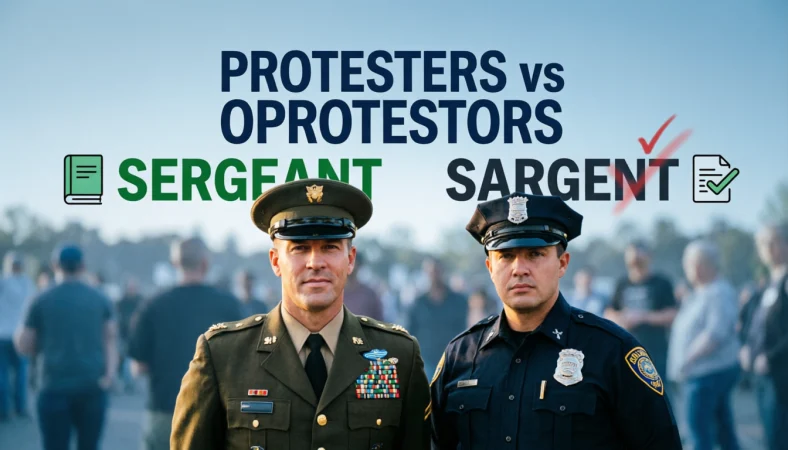
Quick answer:Sergeant is the correct spelling. Sargent is a common misspelling (or a surname), but the military rank is spelled sergeant.
Sergeant or Sargent is a common spelling confusion because the two words look and sound similar. However, when referring to the military or police rank, the correct spelling is sergeant with an “e” after the “s.”
Sargent is generally not a correct spelling for the rank and is usually a misspelling or a surname. Understanding this difference helps you avoid a common English mistake and ensures your writing remains accurate and professional.
Quick Answer Table
| Feature | Sergeant | Sargent |
| Correct spelling? | ✅ Yes | ❌ Usually No |
| Meaning | A military or police rank | Usually a misspelling of sergeant |
| Common usage | Official and standard English | Typo or surname |
| Dictionary recognition | Yes | Not as a rank |
| Example sentence | The sergeant briefed the team before deployment. | Incorrect when referring to a military rank. |
Quick Answer
Sergeant is the correct spelling when referring to a military or police rank.
Sargent is generally considered a misspelling, although it can be a legitimate surname.
Which One Is Correct?
The correct word is:
✅ Sergeant
This spelling is recognized by major dictionaries, military organizations, law enforcement agencies, educational institutions, and style guides.
Examples
- The sergeant inspected the troops.
- A police sergeant supervised the officers.
- The army promoted him to sergeant after years of service.
If you write sargent instead of sergeant in these contexts, it will typically be considered an error.
Meaning of the Correct Word
What Does Sergeant Mean?
A sergeant is a non-commissioned officer rank used in military organizations and many police departments.
Definition
A sergeant is an officer who supervises personnel and helps enforce discipline, training, and operational procedures.
Common Contexts
Military
In many armed forces, a sergeant serves as a leadership position between junior enlisted personnel and higher-ranking officers.
Examples:
- The sergeant trained new recruits.
- Every sergeant must demonstrate leadership skills.
Police
Many police departments use the rank of sergeant for supervisory officers.
Examples:
- The police sergeant managed the investigation.
- Citizens spoke with the sergeant regarding the incident.
Historical Usage
Historically, sergeants performed various military and administrative duties throughout Europe.
Example:
- Medieval armies often relied on experienced sergeants.
Meaning of the Incorrect or Alternative Word
Is Sargent a Real Word?
In most cases, sargent is not the correct spelling of the military or police rank.
However, it can be valid in certain situations.
When Sargent Is Correct
As a Surname
Many people legitimately have the last name Sargent.
Examples:
- John Singer Sargent was a famous American artist.
- Sarah Sargent published a new book.
In these cases, Sargent is a proper noun and should remain spelled exactly that way.
As a Typographical Error
Most uses of sargent occur because:
- People spell the word based on pronunciation.
- The spelling seems more intuitive.
- The unusual spelling of sergeant is forgotten.
Therefore, when referring to a rank, sargent is generally incorrect.
Key Differences Between the Two Words
Sergeant vs Sargent
| Feature | Sergeant | Sargent |
| Standard English spelling | ✅ Yes | ❌ No |
| Military rank | ✅ Yes | ❌ No |
| Police rank | ✅ Yes | ❌ No |
| Dictionary entry as rank | ✅ Yes | ❌ No |
| Common typo | ❌ No | ✅ Yes |
| Surname usage | Rare | ✅ Common |
Spelling Difference
Only one letter changes:
- Sergeant
- Sargent
The additional “e” after the first letter makes all the difference.
Meaning Difference
- Sergeant = military or police rank
- Sargent = usually a surname or misspelling
Pronunciation Difference
In most accents, there is little or no noticeable difference.
Sergeant is commonly pronounced:
SUR-jənt
Because the pronunciation does not clearly reveal the spelling, confusion often occurs.
Grammar Difference
Both can function as nouns.
However:
- Sergeant is a common noun.
- Sargent is usually a proper noun when used as a family name.
Examples:
- Sergeant Miller arrived early.
- Mr. Sargent arrived early.
Common Mistakes People Make
1. Spelling by Sound
Many learners write words exactly as they hear them.
Because sergeant sounds similar to sargent, the incorrect version often appears in writing.
❌ The sargent addressed the recruits.
✅ The sergeant addressed the recruits.
2. Auto-Correction Assumptions
Some writers assume spell-check software will catch every mistake.
However, if Sargent exists as a surname in the dictionary, the error may go unnoticed.
3. Confusing Names With Titles
People sometimes see famous individuals with the surname Sargent and assume the spelling applies to the rank as well.
Example:
❌ Police Sargent Johnson
✅ Police Sergeant Johnson
4. Errors in Professional Documents
Misspelling ranks can appear unprofessional in:
- Job applications
- Military records
- Academic writing
- Police reports
- News articles
Accuracy is important in formal communication.
Correct Usage Examples
Casual Examples
- My cousin became a sergeant last year.
- The sergeant spoke to everyone before the event.
- We met a retired army sergeant.
Professional Examples
- The sergeant coordinated the emergency response.
- The police sergeant reviewed the report.
- A sergeant is responsible for supervising personnel.
Educational Examples
- Students studied the responsibilities of a military sergeant.
- The textbook explained the rank structure from corporal to sergeant.
- History classes often discuss the role of sergeants in wartime.
Literary and Metaphorical Examples
- The old sergeant stood like a pillar of discipline.
- His voice carried the authority of a veteran sergeant.
- The team leader acted as the sergeant of the group, keeping everyone organized.
Word Origin / Etymology
Understanding a word’s history often makes its spelling easier to remember.
Origin of Sergeant
The word sergeant comes from:
- Old French: sergent
- Latin: serviens
The Latin root means:
“one who serves”
Over time, the term evolved through French and entered Middle English.
Despite pronunciation changes over centuries, the historical spelling remained largely intact.
This explains why modern English spelling appears unusual compared to how the word sounds.
Historical Development
| Period | Form |
| Latin | serviens |
| Old French | sergent |
| Middle English | sergeaunt |
| Modern English | sergeant |
The modern spelling preserves centuries of linguistic history.
Why the Incorrect Version Became Popular
The popularity of sargent is not random.
Several factors contribute to the mistake.
Phonetic Spelling
People often spell words according to pronunciation.
Because the middle “ea” sound is subtle, writers naturally choose the simpler spelling.
Typing Speed
Fast typing increases the likelihood of dropping letters.
Familiarity With Surnames
Many English speakers encounter the surname Sargent before they encounter the rank sergeant.
This familiarity reinforces the incorrect spelling.
Digital Search Behavior
Online searches reveal thousands of misspellings because users type quickly and rely on search engines to interpret intent.
Sergeant in Military and Law Enforcement Contexts
Military Sergeant
A military sergeant typically:
- Leads soldiers
- Maintains discipline
- Oversees training
- Provides tactical guidance
- Serves as a bridge between officers and enlisted personnel
Common military ranks include:
- Corporal
- Sergeant
- Staff Sergeant
- Sergeant First Class
Police Sergeant
In law enforcement, a sergeant often:
- Supervises patrol officers
- Assigns duties
- Reviews reports
- Oversees investigations
- Coordinates field operations
The rank carries leadership responsibilities and operational authority.
Related Terms and Semantic Keywords
Understanding related vocabulary strengthens topical knowledge.
Common terms associated with sergeant include:
- Military rank
- Police rank
- Non-commissioned officer
- Law enforcement supervisor
- Staff sergeant
- Master sergeant
- First sergeant
- Command structure
- Armed forces
- Military leadership
- Police department
- Public safety
- Officer supervision
- Chain of command
- Promotion rank
These semantic terms frequently appear in searches related to sergeant duties, rank structure, military careers, and public service professions.
Easy Memory Tricks
Remembering the correct spelling doesn’t have to be difficult.
Trick #1: Think of “EA” in Leadership
The word sergEAnt contains EA.
Imagine:
Every Authority
Since sergeants are leaders, the “EA” can remind you of authority.
Trick #2: Remember Official Documents
Military and police organizations always use:
SERGEANT
If you’re writing a title or rank, choose the official spelling.
Trick #3: Associate It With Rank Structure
Think:
Corporal → Sergeant → Staff Sergeant
All official rank charts use sergeant, never sargent.
Trick #4: The Name Exception
If it is someone’s last name, it may be:
Sargent
If it is a rank, it is:
Sergeant
English contains many words whose pronunciation doesn’t perfectly match their spelling.
Examples include:
| Correct Word | Common Misspelling |
| Sergeant | Sargent |
| Lieutenant | Leutenant |
| Colonel | Collonel |
| Accommodation | Accomodation |
| Separate | Seperate |
| Definitely | Definately |
Learning these exceptions improves writing accuracy and professional communication.
FAQs
1. Is sergeant or sargent correct?
Sergeant is the correct spelling for the military and police rank. Sargent is usually a misspelling or a surname.
2. Is sargent a real word?
It is generally not a recognized spelling for the rank, but it can be a legitimate family name.
3. Why is sergeant spelled differently from how it sounds?
The spelling comes from historical French and Latin roots, while pronunciation evolved over time.
4. How do you pronounce sergeant?
Most speakers pronounce it approximately as:
SUR-jənt
5. Can I use sargent in formal writing?
Not when referring to a rank. Use sergeant in professional, academic, military, and law-enforcement writing.
6. Is Sergeant a noun?
Yes. It is a noun referring to a military or police rank.
7. What is a staff sergeant?
A staff sergeant is a higher-ranking non-commissioned officer position used in many military organizations.
8. Why do people misspell sergeant as sargent?
The pronunciation encourages phonetic spelling, making the error very common.
9. Is Sergeant capitalized?
Capitalize it when used as a title before a name.
Examples:
- Sergeant Davis
- Staff Sergeant Brown
Use lowercase when referring to the rank generally.
Example:
- He was promoted to sergeant.
10. Does the confusion affect job applications?
Yes. Misspelling official ranks in resumes, military records, police applications, or even searches related to public-service careers and nurse jobs can create an unprofessional impression.
Conclusion
The confusion exists because the words sound similar, but official English usage overwhelmingly favors sergeant. Whether you’re writing a report, preparing academic work, applying for a position, or discussing military leadership, using the correct spelling demonstrates accuracy and professionalism.
The easiest rule to remember is this:
If it’s a rank, write “sergeant.” If it’s a person’s last name, “Sargent” may be correct.