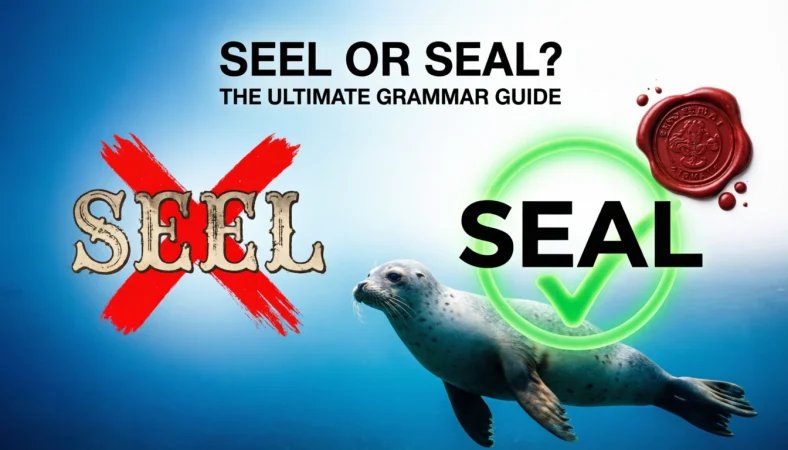
Quick answer:Seal is the correct and commonly used spelling.
Seel is a rare/obsolete word and is not used in normal modern English. Seal can mean to close securely, confirm, or refer to the marine animal
Seel or Seal both words look similar, but they have very different levels of usage in English. The correct and widely used word is seal, which can mean to close something tightly, confirm an agreement, or refer to a marine animal.
Seel exists as a rare and old-fashioned word with limited usage, so it is not used in everyday English. Understanding the difference between these two words helps you avoid spelling mistakes and choose the correct term in writing and communication
Quick Answer Table
| Feature | Correct Word | Incorrect Alternative |
| Correct Spelling | Seal | Seel |
| InCorrect Spelling | Seel | Seal |
| Meaning | To close securely, a marine mammal, or an emblem | A rare variant meaning to close the eyes or to stitch (obsolete) |
| Primary Usage | Nouns and verbs in everyday modern English | Archaic, rare, or dialectal uses |
| Example Sentence | “Please seal the envelope before mailing it.” | “He seel his eyes to the bright sun.” (Rare/obsolete) |
Which One Is Correct: Seel or Seal?
The correct spelling in modern English is “seal” for virtually all common uses. The word “seel” is considered an archaic spelling variant that has largely fallen out of standard usage. While you might occasionally encounter “seel” in historical texts, poetry, or specialized dialectal contexts, “seal” remains the undisputed champion of contemporary English spelling.
Meaning of the Correct Word: “Seal”
Definition and Explanation
The word “seal” serves multiple roles in the English language, functioning as both a noun and a verb with distinct but related meanings.
As a noun, “seal” can refer to:
- A marine mammal found in oceans worldwide, known for its sleek body and playful nature
- A device or emblem used to stamp or impress a design onto surfaces such as wax, paper, or metal
- The impression created by such a device, serving as authentication or security
- A substance or material used to close an opening or prevent leakage
- A symbol of approval, authenticity, or authority
As a verb, “seal” means:
- To close or fasten something securely
- To apply a coating or substance that prevents passage of liquids or air
- To finalize or conclude an agreement or decision
- To authenticate or validate with a stamp or signature
Real World Usage Examples
Here are practical examples of “seal” used correctly in various contexts:
Professional context:
- The contract is now sealed with both parties’ signatures.
- Please ensure you seal the package properly to prevent damage during shipping.
Everyday context:
- Remember to seal the leftovers before placing them in the refrigerator.
- The new windows will seal the house against drafts and cold weather.
Metaphorical context:
- Their handshake sealed the deal that would change both their lives.
- Winning the championship sealed her place in sports history.
Meaning of the Incorrect or Alternative Word: “Seel”
Is “Seel” Incorrect?
While “seel” is not entirely incorrect, it is certainly rare, archaic, and obsolete in modern standard English. The word survives primarily in historical literature, dialectal speech, and specialized contexts.
Definition and Usage
“Seel” has two main definitions:
- To close the eyes, especially in the context of blinding or falconry
- To stitch or sew together (obsolete usage)
In falconry, “to seel” a hawk meant to sew its eyelids shut temporarily to help train the bird. This practice was common in medieval times but has become obsolete in modern animal training practices.
When Might You See “Seel”?
You might encounter “seel” in:
- Shakespearean plays and Elizabethan poetry
- Historical texts about falconry and hunting
- Regional dialects in certain parts of England
- Archaic or literary writing attempting to evoke an old fashioned tone
However, for everyday writing and professional communication, avoiding “seel” entirely is recommended unless you have a specific, deliberate reason to use this archaic form.
Key Differences Between “Seel” and “Seal”
Spelling
The most obvious difference lies in the spelling: “seal” ends with the common “eal” pattern, while “seel” uses the less common “eel” ending. This distinction makes “seal” the standard, recognizable spelling in dictionaries and everyday writing.
Meaning
The meanings differ significantly:
- Seal carries modern, practical meanings related to closing, authenticating, and marine life
- Seel deals with archaic concepts of blinding or sewing, which have little relevance to contemporary communication
Pronunciation
Interestingly, both words are pronounced identically as /siːl/ in standard English. This homophonic quality explains why many writers become confused: they sound the same but have different spellings and meanings. This is a classic case of homophones that cause spelling challenges even for native English speakers.
Grammar Usage
Seal” functions fluidly as a noun and verb in modern grammar:
- Noun: “The seal on the envelope was broken.”
- Verb: “She decided to seal the letter with a kiss.”
“Seel” appears almost exclusively as a transitive verb in archaic contexts:
- “They would seel the hawk’s eyes during training.”
Recognition and Frequency
When you examine modern usage patterns, the contrast becomes stark:
- “Seal” appears millions of times in contemporary English writing across all genres
- “Seel” appears rarely, primarily in historical or specialized contexts
Dictionaries and grammar checkers flag “seel” as an error in most contexts, reinforcing that “seal” is the appropriate choice for modern English communication.
Common Mistakes People Make
Mistake 1: Using “Seel” Instead of “Seal”
The most frequent error occurs when someone writes “seel” when they clearly mean “seal.” This mistake often appears in:
- Professional emails where someone intends to say “seal the deal”
- Instructions about “seeling” containers or packages
- Academic writing discussing “seeled” envelopes or agreements
Mistake 2: Confusing the Archaic Meaning
Some writers mistakenly believe “seel” is just an alternative spelling with the same meaning as “seal.” This misconception can lead to confusing or incorrect sentences that disrupt the reader’s understanding.
Mistake 3: Inconsistent Usage
Even when writers use the correct spelling “seal,” they might struggle with the various noun and verb forms:
- “He sealed the envelope” (past tense of verb)
- “The seal swam gracefully” (noun for the animal)
- “The seal of approval” (noun for the emblem)
Mistake 4: Homophone Confusion with Other Words
The similar pronunciation to words like “ceil” (as in ceiling) creates additional confusion:
- “Ceil” refers to installing a ceiling or covering a surface
- “Seel” refers to the archaic action of closing eyes
- “Seal” refers to closing, authenticating, or marine mammals
Correct Usage Examples of “Seal”
Casual and Everyday Examples
- I need to seal this bag of chips so they stay fresh and crispy.
- The zipper on my jacket doesn’t seal properly anymore.
- Can you help me seal this box for shipping?
- The contractor will seal our driveway next week.
Professional and Business Examples
- The notary will seal the document with her official stamp.
- We need to seal this partnership with a formal agreement.
- The CEO’s signature sealed the merger between the two companies.
- The IT department discovered a breach in data security that allowed unauthorized access to sensitive information, prompting immediate action to seal the vulnerabilities.
Educational and Academic Examples
- Scientists study how marine mammals like seals adapt to their environment.
- The teacher asked students to seal their test papers in envelopes for grading.
- In chemistry class, we learned to seal test tubes to prevent contamination.
- The archaeological team found a clay seal bearing the king’s insignia.
Literary and Metaphorical Examples
- Fate seemed determined to seal his destiny with each passing day.
- The hero’s sacrifice sealed the victory for the rebellion.
- Their whispered promises sealed a bond that would last forever.
- The detective examined the wax seal on the ancient letter, knowing it held secrets that could seal the fate of the entire kingdom.
Word Origin and Etymology
Etymology of “Seal”
The word “seal” boasts a rich linguistic history spanning multiple languages:
- Old English: “seolh” (referring to the marine mammal)
- Old French: “seel” (meaning stamp or emblem)
- Latin: “sigillum” (meaning seal, sign, or stamp)
- Latin: “signum” (meaning sign or token)
The dual origin explains why “seal” developed two distinct meanings: one from Germanic roots (the animal) and one from Romance roots (the emblem and the act of closing). This fascinating etymological journey reflects how English absorbed words from various sources, creating a language rich in meaning and nuance.
Etymology of “Seel”
The word “seel” comes from:
- Old English: “sēlan” (to seal, to close, or to blind)
- Old French: “siler” or “seeler” (to seal)
- Latin: “sigillare” (to seal or stamp)
This shared Latin root explains why “seel” historically had similar meanings to “seal.” However, as English standardized and evolved, “seal” emerged as the dominant spelling while “seel” faded into obscurity.
Why the Incorrect Version Became Popular
Historical Context
The confusion between “seel” and “seal” is largely a historical artifact. During the Middle English period, spelling was not standardized, and writers used various spellings of the same word based on regional dialects, personal preference, and even the whim of the scribe.
The Influence of Old French
As English absorbed vocabulary from Old French after the Norman Conquest, both spellings existed simultaneously. Some writers favored the Old French spelling of “seel” while others preferred the Old English spelling of “seal.” This dual spelling system persisted for centuries.
The Evolution of Standardization
The invention of the printing press in the 15th century and the subsequent standardization of English spelling gradually eliminated many variant spellings. “Seal” emerged as the standard spelling for all common meanings, while “seel” survived only in specialized or archaic contexts.
Modern Persistence
Despite standardization, “seel” persists in:
- Regional dialects, particularly in some parts of northern England
- Historical fiction writers seeking authenticity
- Specialist literature about falconry or medieval practices
- Poetry and literary works intentionally using archaic language
Easy Memory Tricks
Visual Association Trick
Think of “seal” like the animal: a seal lives in the sea. Both words start with “sea.” This visual connection helps you remember that the marine mammal spelling is also the standard spelling for closing and authenticating.
Sound and Spelling Connection
Remember that “seal” sounds like “sea” plus “l.” The sea is vast and common, just like the word “seal” is common in modern English. “Seel” has the double “ee” which is less common, just as the word itself is less common.
Meaning Based Memory Aid
- Seal = Secure, Emblem, Animal, Lock → All common modern meanings
- Seel = Specialty, Extinct, Eyeblinding, Legacy → All rare, historical meanings
Real World Connection
Consider this: the “Great Seal of the United States” uses the standard spelling. If the highest office in the land uses “seal” for matters of national importance, you can confidently use the same spelling for all your everyday needs.
FAQs
Q1. Is it spelled seel or seal?
The correct modern spelling is seal. Seel is an archaic and rarely used word.
Q2. When should I use seal?
Use seal for closing, confirming, protecting something, or referring to the animal.
Q3. What does seal mean?
Seal can mean to close securely, approve officially, or refer to a marine animal.
Q4. Is seel a real word?
Yes, but it is an old-fashioned word mainly found in historical or literary contexts.
Q5. Can I use seel in formal writing?
No, avoid seel in modern formal writing. Use seal instead.
Q6. How are seel and seal pronounced?
Both are pronounced the same: /siːl/.
Q7. Why are seel and seal confused?
They are confused because they sound identical (homophones).
Q8. What is the plural of seal?
The plural is seals (e.g., “Many seals live in the ocean”).
Q9. Can seal be a verb?
Yes. Example: “Please seal the envelope.”
Q10. Is seal used more than seel?
Yes, seal is far more common in everyday English
Conclusion
The difference between seel and seal is simple: seal is the correct and commonly used spelling in modern English, while seel is an outdated word with very limited historical use. Using seal will ensure your writing remains clear, accurate, and suitable for everyday, academic, and professional communication.
Although seel may appear in older texts or specific historical contexts, it is rarely needed today. Remember that seal is the word you will use for closing, confirming, or referring to the marine animal, helping you write with confidence and avoid this common spelling confusion.