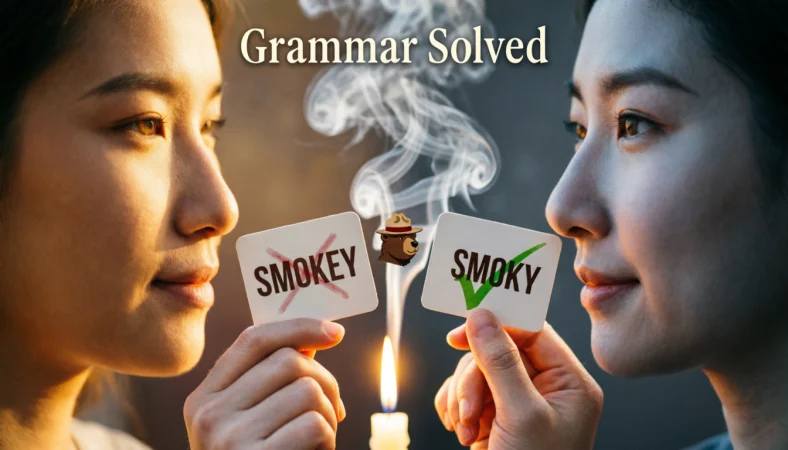
For normal writing, use smoky.Smoky is the standard spelling meaning full of smoke or having a smoke-like quality.
Smokey is usually a proper name (like Smokey Bear) or an informal varian.
Have you ever paused while writing and wondered whether the correct spelling is “smokey” or “smoky”? This small difference often confuses English writers because both forms look and sound almost identical. Although both words exist, they are not always used in the same way.
In this guide, we will explore the real difference between smokey and smoky, explain their meanings, and show when to use each spelling. You will learn simple rules, examples, and memory tips that will help you choose the correct word confidently in everyday and professional writing.
Quick Answer Table
| Feature | Correct Spelling | Common Variation |
| Spelling | smoky | smokey |
| Primary Meaning | filled with or resembling smoke | alternative spelling (rare) |
| Standard Usage | Yes, universally accepted | No, considered incorrect in formal writing |
| Grammar Role | Adjective | Adjective (nonstandard) |
| Example Sentence | The campfire left a smoky haze over the forest. | Smokey Bear is the famous mascot. |
Bottom line: Use smoky for everything related to smoke. Use Smokey only when referring to the proper name Smokey Bear.
Which One Is Correct?
The straightforward answer is smoky. This is the standard, dictionary approved spelling for describing anything that contains, produces, or resembles smoke.
The spelling smokey is generally considered incorrect in formal and professional writing. However, there is one notable exception: proper names, most famously Smokey Bear (the wildfire prevention mascot) and the nickname “Smokey” for people with smoky colored fur or hair.
Think of it this way: all Smokey is smoky, but not everything smoky is Smokey.
Major dictionaries including Merriam Webster, Oxford English Dictionary, and Cambridge Dictionary list “smoky” as the primary spelling. “Smokey” appears only as a variant or is omitted entirely. For SEO content, academic writing, business communication, and professional publishing, “smoky” is your safe and correct choice.
Meaning of the Correct Word: Smoky
Definition
Smoky (adjective) describes something that is:
- Filled with or producing smoke
- Having the characteristics, color, or taste of smoke
- Cloudy, hazy, or darkened by smoke
- Having a flavor or aroma reminiscent of smoke
Detailed Explanation
When you describe air, food, drinks, colors, or even voices as “smoky,” you are evoking the sensory qualities associated with smoke. A smoky room has poor ventilation and lingering cigarette smoke. Smoky whiskey carries notes of peat fire and charred oak. A smoky quartz gem displays a hazy, grayish brown transparency.
The word functions purely as an adjective, modifying nouns to give them that distinct smoke related quality. It follows standard English spelling rules: take the base word “smoke,” remove the final “e,” and add “ y.” This pattern appears in many common adjectives like “icy” from ice, “juicy” from juice, and “creamy” from cream.
Real World Usage Examples
Environmental Context:
- The wildfire created a smoky sky that turned the afternoon sun blood red.
- After the barbecue, her clothes smelled pleasantly smoky.
- Los Angeles mornings often look smoky due to temperature inversions trapping exhaust fumes.
Food and Drink Context:
- This mezcal has a beautifully smoky character from the underground roasting process.
- The chef recommended the smoky paprika for the chicken rub.
- Lapsang souchong tea is famously smoky because the leaves are dried over pine fires.
Visual and Descriptive Context:
- She wore a smoky gray eyeshadow that made her blue eyes pop.
- The mountains appeared smoky in the early morning mist.
- His voice had a smoky, jazz club quality that captivated the audience.
Metaphorical Context:
- The room grew smoky with tension as the argument escalated.
- Their relationship existed in a smoky haze of unresolved feelings.
Meaning of the Incorrect Word: Smokey
Is It Actually Incorrect?
The short answer is yes for standard English. But language is messy, and “smokey” does appear in specific contexts.
Smokey is primarily a proper noun or nickname, not a standard adjective. When you see this spelling, it almost always refers to:
- Smokey Bear – the iconic United States Forest Service mascot who reminds us “Only you can prevent wildfires.” His name is legally trademarked as “Smokey Bear,” not “Smoky Bear.” This intentional branding choice has caused decades of spelling confusion.
- Personal Nicknames – People or animals nicknamed “Smokey,” often due to grayish fur, hair, or a smoky personality trait. For example, a gray cat named Smokey or a blues musician called Smokey.
- Brand Names and Titles – Businesses, songs, albums, and products that deliberately choose the “ey” spelling for stylistic or trademark reasons. Examples include “Smokey Robinson” (the famous singer) and “Smokey and the Bandit” (the film).
Rare but Valid Usage
In very informal writing or dialectal English, some writers use “smokey” as a variant spelling. However, no major style guide (APA, MLA, Chicago, AP) recommends this. Grammar experts consistently flag “smokey” as a misspelling when used as an adjective.
If you submit “smokey air” or “smokey flavor” in a professional document, expect red underlines and editorial corrections. The same applies to SEO optimized content – search engines and readers recognize “smoky” as the authoritative form.
Key Differences Between the Two Words
| Category | Smoky | Smokey |
| Spelling | smoke minus e + y | smoke + ey |
| Part of Speech | Adjective | Proper noun or nonstandard adjective |
| Dictionary Status | Standard entry | Variant or omitted |
| Primary Meaning | Relating to smoke | Name or nickname |
| Pronunciation | /ˈsmoʊki/ | /ˈsmoʊki/ (identical) |
| Formal Writing | Correct and preferred | Incorrect (except proper names) |
| Common Usage Context | Descriptive, sensory, environmental | Mascot, nicknames, brands |
| Etymology Pattern | Standard y suffix | Irregular ey suffix |
Pronunciation Note
Despite the spelling difference, both words sound exactly the same: SMOH kee (rhymes with “rocky” or “talkie”). The long “o” sound followed by a hard “k” and long “e” remains unchanged. This identical pronunciation is why the confusion persists – you cannot hear the difference, only see it in writing.
Grammatical Distinction
“Smoky” functions freely as an adjective before nouns (smoky bacon, smoky air) or after linking verbs (the sky grew smoky). It can also appear in comparative forms: smokier, smokiest.
“Smokey” as a proper noun behaves like any name. You would say “I saw Smokey yesterday” or “Smokey’s hat is famous.” Using “smokey” as an adjective (“smokey flavor”) breaks standard grammar rules.
Common Mistakes People Make
Mistake 1: Using “Smokey” as a General Adjective
This is by far the most frequent error. Writers incorrectly assume that because “Smokey Bear” spells his name with an “e,” the adjective should follow suit.
Incorrect: The barbecue had a delicious smokey taste.
Correct: The barbecue had a delicious smoky taste.
Incorrect: Smokey air filled the casino.
Correct: Smoky air filled the casino.
Mistake 2: Capitalizing “Smoky” When It Should Be Lowercase
Since “smoky” is a regular adjective, it does not require capitalization unless starting a sentence. “Smokey” as a proper noun always capitalizes.
Incorrect: The Smoky Mountains are beautiful in autumn. (Wait – this one is actually correct! See below.)
Clarification: The Great Smoky Mountains (official name) use “Smoky,” not “Smokey.” This is a common point of confusion. The national park spells it “Smoky” despite the bear’s name being “Smokey.” Two different proper nouns, two different spellings.
Mistake 3: Assuming “Smokey” Is Always Wrong
Some grammar purists declare “smokey” completely invalid. But proper names exist outside standard spelling rules. Smokey Robinson is not misspelling his stage name. Smokey Bear is not an error. Context determines correctness.
Mistake 4: Inconsistent Spelling Within a Document
Nothing undermines credibility like switching between “smoky” and “smokey” randomly. Choose “smoky” for all adjectival uses and stick with it. Reserve “Smokey” only for named entities.
Mistake 5: Confusing “Smokey” with “Smoky” in Search Queries
For SEO professionals and content creators, this mistake costs traffic. People search for “smoky barbecue,” “smoky quartz,” and “smoky eye makeup” far more often than “smokey” variations. Using the wrong spelling hurts your search rankings.
Correct Usage Examples
Casual and Everyday Examples
- Last night’s campfire made all my clothes smell smoky.
- I love the smoky heat of chipotle peppers in my chili.
- The sunset looked smoky orange through the wildfire haze.
- Her smoky eye makeup tutorial went viral on TikTok.
- This whiskey has a beautifully smoky finish that lingers on the tongue.
Professional and Business Examples
- The restaurant received complaints about smoky ventilation in the dining area.
- Our new smoky quartz countertops offer a sophisticated, modern aesthetic.
- The wine critic described the vintage as having smoky notes with hints of leather.
- Industrial sites must monitor smoky emissions to comply with environmental regulations.
- The photographer captured the smoky atmosphere of the jazz club perfectly.
Educational and Academic Examples
- In chemistry class, we observed how smoky precipitates indicate certain chemical reactions.
- The geography textbook explained how smoky haze from agricultural burning affects air quality indexes.
- Linguistic analysis shows that “smoky” follows the standard English pattern of dropping the final “e” before adding “ y.”
- Environmental science students measured particulate matter in smoky air samples.
- The literature review examined how authors use smoky imagery to convey mystery and obscurity.
Literary and Metaphorical Examples
- The detective’s memories existed in a smoky blur of half forgotten faces.
- Sunrise bled through the smoky dawn like molten copper.
- His promises dissolved into smoky illusions, beautiful but impossible to hold.
- The old library held a smoky fragrance of aged paper and forgotten stories.
- Between them hung a smoky silence, thick with words neither would speak.
Word Origin and Etymology
The journey of “smoky” begins in Old English. The word “smoca” meant smoke or vapor. By the 14th century, “smokie” appeared as an adjective form. Middle English speakers added the “ y” suffix (meaning “characterized by” or “full of”) to “smoke,” creating “smoky.”
The spelling has been remarkably stable for centuries. Geoffrey Chaucer used forms of “smoky” in The Canterbury Tales (late 1300s). William Shakespeare wrote “smoky” in several plays, including Henry V (“the smoky wars”). The King James Bible (1611) uses “smoky” in descriptions of divine presence and judgment.
The variant “smokey” emerged much later, primarily in American English during the 19th century. Regional dialects occasionally produced the “ ey” ending, but standard English rejected it in favor of the etymologically consistent “ y” form.
The Y Suffix Pattern
English forms countless adjectives by adding “ y” to nouns, typically dropping a final silent “e”:
| Base Noun | Adjective | Rule Applied |
| smoke | smoky | drop e, add y |
| ice | icy | drop e, add y |
| juice | juicy | drop e, add y |
| cream | creamy | keep e? No, drop e |
| lace | lacy | drop e, add y |
| spice | spicy | drop e, add y |
The pattern is consistent: when a noun ends in a silent “e,” you remove the “e” before adding “ y.” “Smokey” breaks this rule by keeping the “e.” That is why grammar experts flag it as an error – it violates a core spelling pattern.
Why the Incorrect Version Became Popular
If “smokey” is technically incorrect, why do so many people use it? Three main reasons explain its persistence.
Reason 1: Smokey Bear
The single biggest influence is Smokey Bear, introduced in 1944. The U.S. Forest Service deliberately chose the “ey” spelling, possibly to differentiate the mascot’s name from the common adjective or simply as a stylistic choice.
Decades of advertising, posters, PSAs, and merchandise drilled “Smokey Bear” into American consciousness. Children grew up spelling his name with an “e.” When those children became adults, they unconsciously transferred that spelling to the adjective. The bear’s cultural footprint is enormous – he has his own zip code (20252) and is recognized by 95% of American adults.
Reason 2: Smokey Robinson and Popular Culture
William “Smokey” Robinson Jr., the legendary Motown singer and songwriter, adopted his nickname in the 1950s. His fame, along with the 1977 film “Smokey and the Bandit” (starring Burt Reynolds), reinforced the “ey” spelling in entertainment contexts.
These cultural touchpoints made “smokey” feel familiar and correct to millions of people, even when used generically.
Reason 3: The EY Pattern in Other Words
English does have legitimate “ ey” adjectives, though they are rare. Words like “clayey” (resembling clay), “honeyey” (resembling honey), and “skyey” (ethereal or celestial) follow the “keep the e” pattern because the base word ends in a vowel sound that requires preservation.
Some writers mistakenly apply this rare pattern to “smoke,” forgetting that the silent “e” in “smoke” follows the standard drop and add rule.
Reason 4: Simple Overcorrection
Once people see “smokey” enough times, they assume both spellings are acceptable. Overcorrection happens when a less common form feels more “special” or “correct” simply because it appears less frequently. In reality, frequency usually indicates correctness in language.
Easy Memory Tricks
Never confuse these spellings again with these simple memory aids.
Trick 1: The E Stands for “Entity”
The letter “E” in “smokey” stands for “Entity” – a specific person, place, or thing. Use “smokey” (with an E) only for named Entities like Smokey Bear, Smokey Robinson, or a pet named Smokey. Use “smoky” (no E) for everything Else.
Memory hook: E = Entity, no E = everything else.
Trick 2: The Silent E Rule
Remember your elementary school grammar: when adding “ y” to a word ending in silent “e,” drop the “e.” Smoke ends with a silent E. Drop it. Smoky. The “ey” spelling keeps a letter that should disappear.
Memory hook: If the E is silent, make it absent.
Trick 3: The Bear Exception
Smokey Bear is the exception, not the rule. Imagine the bear holding up one paw with one finger raised – “One exception, spelled with an E.” For everything else, picture the bear putting that finger down, signaling the E disappears.
Trick 4: Rhyme Test
“Smoky” rhymes with “okay” – both have no extra E sound at the end. “Smokey” would need to rhyme with “hockey” if pronounced differently, but it doesn’t. The identical pronunciation tells you the E is unnecessary.
Trick 5: The Drop Test
Say each spelling out loud. “Smoky” sounds natural. “Smokey” looks wrong when you write it because your brain knows the silent E should vanish. Trust that instinct. If you hesitate between the two, “smoky” is almost always your answer.
FAQs
1. Is it Smokey or Smoky in Great Smoky Mountains?
The correct name is Great Smoky Mountains with y.
2. Which spelling is used for barbecue flavor?
Use smoky for describing food flavor.
3. Which spelling is better for SEO?
Use smoky for general topics because it is the standard spelling.
4. Is smokey correct in formal writing?
Only as a proper name like Smokey Bear.
5. How do you pronounce smokey and smoky?
Both are pronounced the same: SMOH-kee.
6. Is Smokey used as a nickname?
Yes, but it is usually a proper noun or informal nickname.
7. Is smokey in dictionaries?
Some dictionaries list it as a variant, but smoky is the standard form.
8. What is the noun form of smoky?
The noun form is smokiness.
9. Do other languages have this confusion?
No, this spelling confusion is mainly an English issue.
10. Can wrong spelling affect credibility?
Yes. Using smokey instead of smoky can look like a writing mistake in formal content
Conclusion
The difference between smoky and smokey is simple: use smoky for anything related to smoke, taste, smell, or appearance. It is the standard English spelling and the correct choice for normal writing.
Smokey is mainly used for proper names and nicknames like Smokey Bear or Smokey’s BBQ. Choosing the right spelling shows attention to detail and helps your writing stay clear, professional, and accurate.