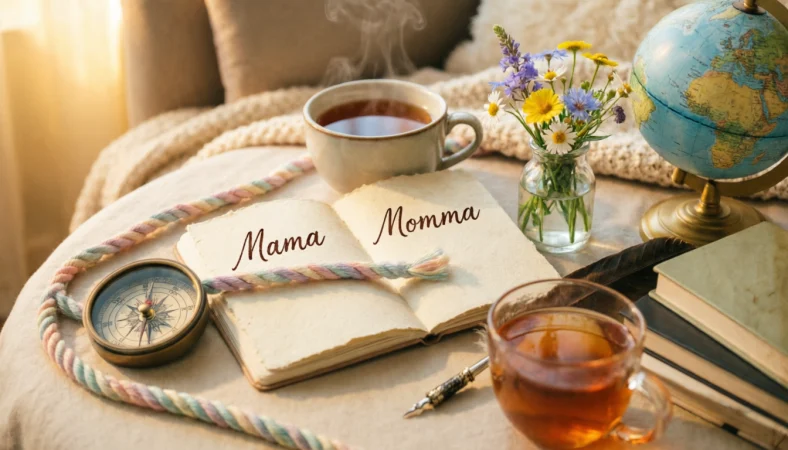
Mama is the more common and standard term for a mother, especially in everyday speech. Momma is a more informal, affectionate, and regional variation, often used in Southern American English.
Example:
- Mama, can you help me?
- My momma makes the best cookies
Both words are terms of endearment for mother, but which one is actually correct? The short answer might surprise you: both are correct. However, the choice between “momma” and “mama” reveals fascinating insights about regional identity, cultural background, and personal preference.
In this comprehensive guide, we’ll explore the subtle differences between “momma” and “mama,” trace their origins, and help you choose the right spelling for your context. Whether you’re writing a heartfelt letter to your mother, crafting a story, or simply curious about language, this guide will clear up the confusion once and for all.
Quick Answer Table
| Aspect | Momma | Mama |
| Correctness | ✅ Correct | ✅ Correct |
| Primary Usage | American English, especially Southern US | Global, used in many languages |
| Meaning | Mother (informal, affectionate) | Mother (informal, affectionate) |
| Vibe/Tone | Cozy, homey, regional warmth | Universal, childlike innocence |
| Example Sentence | “My momma makes the best sweet tea.” | My mama taught me everything I know.” |
| Pronunciation | /ˈmɑː.mə/ (mah ma) | /ˈmɑː.mə/ or /ˈmæ.mə/ (mah ma or ma ma) |
Which One Is Correct?
Here’s the short answer: both “momma” and “mama” are correct spellings. They are both informal, affectionate terms for “mother” and can be used interchangeably in most contexts .
However, the choice between them isn’t entirely random. Think of it like choosing between “soda” and “pop” both are correct, but your choice often reveals where you’re from or your family’s personal traditions.
The word “mama” is the older and more universal spelling. It first appeared in English in the 1500s and exists in remarkably similar forms across dozens of languages worldwide . If you’re looking for a spelling that’s instantly understood globally, “mama” is your safest bet.
The word “momma” is a relative newcomer to English, first recorded in the early 1800s as an American English variant. It’s particularly associated with the Southern United States . If you want to convey a sense of regional warmth, down home comfort, or specifically American informality, “momma” might be your preferred choice.
So, which one should you use? That depends entirely on your audience, your region, and your personal connection to the word.
Meaning of the Correct Word: Understanding “Mama”
“Mama” is an informal, affectionate term for “mother.” It’s one of the most universal words in human language, appearing in countless cultures with very similar sounds .
Definition and Explanation
The word “mama” is rooted in the natural sounds babies make. The “ma” sound is one of the first syllables infants produce, often while babbling or reaching for their primary caregiver . Over time, this simple sound became associated with “mother” across many languages.
Usage of “Mama”
- Children’s speech: Babies and young children often say “mama” as one of their first words.
- Adult affection: Adults frequently use “mama” to refer to their mothers with warmth and familiarity.
- Casual address: You can use “mama” as a direct address, such as “Mama, can you help me?”
- Cultural references: “Mama” appears in songs, books, and sayings worldwide.
Real World Examples
- “I call my mama every Sunday without fail.”
- “Mama always said life was like a box of chocolates.”
- “When I was sick, my mama made me chicken soup.”
Meaning of “Momma”: The American Variant
“Momma” is an alternative spelling of “mama” that carries the same fundamental meaning: an informal, affectionate term for “mother.” It first appeared in American English in the early 1800s and has since become a beloved regional variant .
Definition and Explanation
“Momma” is essentially a phonetic spelling of how some American dialects pronounce “mama.” It’s closely related to the word “mom” (another American favorite) and shares the same warmth and familiarity.
Usage of “Momma”
- American English: Most commonly used in the United States.
- Southern US: Particularly associated with the Southern states, where it conveys regional identity and warmth .
- Affectionate address: Often used by children, adults, and even partners as a term of endearment.
- Slang contexts: In colloquial American English, “momma” can also refer to an attractive woman or a female partner (as in “my momma”) .
Real World Examples
- “My momma makes the best biscuits in Texas.”
- “Don’t you worry, Momma’s got this.”
- “I learned everything about kindness from my momma.”
Key Differences Between “Momma” and “Mama”
While “momma” and “mama” mean the same thing, they differ in several important ways:
Spelling and Regional Distribution
The most obvious difference is the spelling—”momma” contains an “o” while “mama” contains an “a.” This simple spelling difference reflects different regional preferences:
- “Mama” is the global standard, used in English, Spanish, French, Swahili, Russian, and dozens of other languages .
- “Momma” is primarily an American English variant, particularly strong in the Southern states .
Pronunciation Differences
The pronunciation of these two words often differs subtly:
- Mama: /ˈmɑː.mə/ (mah ma) or /ˈmæ.mə/ (ma ma) .
- Momma: /ˈmɑː.mə/ (mah ma), with a slightly more rounded vowel sound .
In practice, the pronunciation difference is minor, but regional accents may emphasize the distinction.
Historical Origins
- Mama dates back to the 1500s in English and exists in ancient forms across many languages .
- Momma was first recorded in 1810 as an American English variant of “mamma” .
Formal vs. Informal Contexts
Both words are informal, but they sit differently on the formality spectrum:
- Mama is the more standard choice for general writing, including published works, song lyrics, and cultural references .
- Momma is more colloquial and carries a distinctly American, often Southern, flavor .
| Feature | Mama | Momma |
| Formality Level | Informal but widely accepted | Very informal, regionally specific |
| Best For | General audiences, global contexts, all ages | Regional US contexts, personal storytelling |
| Tone | Universal warmth | Cozy familiarity |
Common Mistakes People Make
Even though both words are correct, people still make mistakes when using “momma” and “mama.
1. Thinking One Is Incorrect
The most common mistake is assuming that one spelling is wrong. In reality, both are widely accepted and understood as informal terms for “mother” . Neither is a misspelling of the other.
2. Using “Mamma” Incorrectly
The spelling “mamma” exists but is less common in modern English . While it’s correct, it’s often considered old fashioned or more associated with Italian or British English. For most contexts, stick with “momma” or “mama” unless you have a specific reason to use “mamma.”
3. Inconsistent Usage
Once you choose a spelling, be consistent. Switching between “momma” and “mama” in the same piece of writing can confuse your reader . Pick the spelling that feels right for your context and stick with it.
4. Forgetting Capitalization Rules
When you’re addressing your mother directly, “Momma” or “Mama” functions like a proper noun and should be capitalized .
- Correct: “I love you, Mama.”
- Incorrect: “I love you, mama.”
When you’re talking about your mother in general, it’s lowercase.
- Correct: “My mama is a teacher.”
- Incorrect: “My Mama is a teacher.”
Correct Usage Examples
Casual and Everyday Examples
- “Can you ask Momma if she wants to join us for dinner?”
- “I’m going to visit my mama this weekend.”
- “Momma always has the best advice.”
- “Mama, do you remember that summer we spent at the beach?”
Professional and Semi Formal Contexts
- In a memoir: “My mama instilled in me a love of reading from a very young age.”
- In a speech: “My momma taught me that hard work and kindness are the keys to a good life.”
- In a dedication: “For my mama, who taught me everything I know.”
Educational and Literary Examples
- “In many cultures, the word for mother is remarkably similar. In English, we say ‘mama’ or ‘momma,’ while in Spanish it’s ‘mamá.’ These words share a common origin in baby speech.
- “The protagonist’s relationship with her mama is central to the novel’s exploration of family and identity.”
- “Like many Southern writers, she used ‘momma’ to convey a sense of home and regional authenticity.”
Metaphorical and Slang Usage
Both words appear in slang contexts too:
- “Hey mama, you’re looking good tonight.” (Complimenting an attractive woman)
- “My momma is the boss around here.” (Referring to a female partner or boss)
Word Origin / Etymology
The Ancient Roots of “Mama”
The word “mama” has remarkably ancient roots. It traces back to the natural sounds that babies make when learning to speak. The “ma” sound is one of the easiest for infants to produce it requires only a simple opening and closing of the mouth .
Linguists call these “reduplicated syllables” repeated sounds like ma ma, pa pa, da da—that appear in baby babbling across all cultures . Because the sound is so universal, the word for mother in many languages sounds strikingly similar:
- Spanish: Mamá
- French: Maman
- Italian: Mamma
- Russian: Мама (Mama)
- Swahili: Mama
- Urdu: Ammi or Mama
The English word “mama” is first recorded in the 1500s, though it was likely used informally long before that .
The Emergence of “Momma”
“Momma” entered English in the early 1800s as an American English variant of “mamma” (an older British spelling) . According to etymological records, it first appeared in the Southern United States .
The shift from “mama” to “momma” likely reflects the American preference for the “o” sound, similar to the preference for “mom” over “mum.” As American English diverged from British English, new spellings and pronunciations emerged to reflect regional speech patterns.
Why Both Spellings Survived
Cultural and Regional Identity
Language is deeply connected to identity. For many people, the choice between “momma” and “mama” isn’t just about spelling it’s about who they are and where they come from .
In the American South, “momma” is a beloved term that reflects the region’s warmth, hospitality, and close knit family culture. For Southerners, “momma” feels right. It’s the word they heard growing up, the word their friends use, the word that feels like home .
For others, “mama” feels more natural, especially if they grew up with that spelling or in an area where it’s more common.
Pop Culture Influence
Both spellings have been reinforced by popular culture:
- “Dear Momma” by Tupac Shakur uses “momma” to convey raw emotion and authenticity.
- “Mama” by the Spice Girls uses the global standard for a pop anthem.
- Hey Mama” by Kanye West and “Mama Said” are other examples that keep both spellings in circulation .
The Universal Appeal of “Mama”
“Mama” has the advantage of being recognized globally. If you’re writing for an international audience or want your writing to feel universal, “mama” is the safer choice.
“Momma,” on the other hand, signals a distinctly American, often Southern, identity. If you want to convey that specific flavor, “momma” is the way to go .
Easy Memory Tricks
Need help remembering which spelling to use? Try these tricks:
1. Think About Geography
- Mama = Global (think “M” for “Many countries”)
- Momma = American (think “O” for “USA, oh yeah!”)
2. Connect to Other Words
- If you say “mom,” you might prefer “momma”
- If you say “mum,” you probably prefer “mama” or “mummy”
3. Remember the Origin
- Mama is the original, older spelling (think “A” for “Ancient”)
- Momma is a newer American variant (think “O” for “Our variation”)
4. Phonetic Clue
- The “o” in “momma” sounds like the “o” in “southern” 🤠
- The “a” in “mama” is for “all over the world” 🌎
FAQs
Is “momma” or “mama” grammatically correct?
Both momma and mama are correct informal terms for “mother.
Are “momma” and “mama” pronounced the same?
They are pronounced very similarly and both refer to a mother.
Which spelling should I use in formal writing?
Use mother in formal writing. Mama/momma are informal.
Is it “baby mama” or “baby momma”?
Baby mama is the more standard spelling.
Is it “mama bear” or “momma bear”?
Mama bear is the commonly accepted phrase.
Why do Americans say momma while British say mum?
They developed different regional forms over time.
Which is older, momma or mama?
Mama is older and appears in many languages as a traditional mother term.
Can I use momma or mama for someone who isn’t my mother?
Yes, but it is informal and depends on context
Conclusion
The debate between “momma” and “mama” has no single winner because both words are correct and carry the same meaning: a loving, informal way to refer to a mother. “Mama” is the more universal and widely recognized spelling, while “momma” is often used as a regional or affectionate variation.
In the end, choosing between “mama” and “momma” depends on personal preference, culture, and context. Both spellings express the same feeling of love and connection, making each one meaningful in its own way.