Quick answer:Lice and dandruff are different.
Lice are tiny parasites that live on the scalp and attach eggs (nits) to hair, while dandruff is flaky, dead skin caused by scalp irritation or dryness. Lice move and cling to hair; dandruff flakes are loose and fall off easily.
Lice or dandruff is a common scalp concern that often causes confusion because both conditions can create itching and visible particles in the hair. Although they may look similar at first, they are completely different problems with different causes and solutions.
Lice are tiny parasitic insects that live on the scalp and feed on blood, while dandruff is caused by flaky, dry, or irritated scalp skin. Learning the key differences between lice and dandruff helps you identify the issue correctly and choose the right approach for managing it
Quick Answer Table
The table below provides a quick reference for distinguishing between lice and dandruff:
| Feature | Lice | Dandruff |
| What it is | Parasitic insects that feed on human blood | Dead skin cells from a dry or irritated scalp |
| Primary symptom | Intense itching behind ears and at the nape of the neck | White flakes on the scalp, shoulders, and hair |
| Appearance | Small, brownish insects moving quickly; eggs (nits) attached to hair shafts | White or yellowish flakes that easily fall off |
| Movement | Live lice move rapidly and avoid light | Dandruff flakes are static and do not move |
| Location | Nits are glued firmly to hair strands near the scalp | Flakes are loosely attached to the scalp |
| Contagiousness | Highly contagious through head to head contact | Not contagious |
| Treatment | Medicated shampoos, combing, prescription treatments | Anti dandruff shampoos, moisturizing routines |
| Prevention | Avoid head contact, sharing hats or combs | Regular washing, scalp moisturization |
Which One Is Correct? Lice or Dandruff?
Both words are correct, but they refer to entirely different things. The confusion lies not in the words themselves but in identifying which condition you are dealing with.
Lice (plural of louse) are tiny, wingless parasitic insects that live on human scalps and feed on blood. They are a common problem among school aged children but can affect anyone regardless of hygiene.
Dandruff is a scalp condition characterized by flaking skin. It occurs when the scalp sheds dead skin cells at an accelerated rate, often due to dryness, sensitivity to hair products, or a yeast like fungus called Malassezia.
When people ask about lice or dandruff, they are usually trying to determine which condition is causing their symptoms. The distinction is critical because treating lice with anti dandruff shampoo or treating dandruff with lice medication is ineffective and potentially harmful.
Meaning of Lice
Definition and Explanation
Lice are small parasitic insects that infest the human scalp. They are scientifically known as Pediculus humanus capitis. These insects survive by feeding on human blood several times a day. Without a human host, lice typically die within 24 to 48 hours.
A single louse is about the size of a sesame seed. They are grayish brown in color and can be difficult to spot because they move quickly and avoid light. The eggs, commonly known as nits, are even smaller and appear as tiny yellow, brown, or white dots attached to hair shafts.
How Lice Infestation Occurs
Lice do not jump or fly. They spread through direct head to head contact, which is why they are so common among children who play closely together. Less commonly, they can spread through sharing personal items such as hats, brushes, combs, scarves, or headphones. Lice do not spread through pets or from surfaces like floors or furniture.
Symptoms of Lice Infestation
The most common symptom of lice is intense itching. This occurs as an allergic reaction to the saliva of the lice when they feed on the scalp. Other symptoms include:
- A tickling sensation of something moving in the hair
- Difficulty sleeping due to increased itching at night
- Sores on the scalp from scratching
- Redness and irritation on the scalp, neck, and shoulders
Treatment Options for Lice
Treating lice involves eliminating both the live insects and their eggs. Common treatments include:
Over the counter medications: Shampoos and lotions containing pyrethrin or permethrin are effective against live lice. However, some lice populations have developed resistance to these products.
Prescription treatments: For resistant cases, doctors may prescribe topical medications like ivermectin or malathion.
Manual removal: Using a special fine toothed comb to remove lice and nits from wet hair is essential. This process requires patience and careful combing.
Home remedies: Some people use natural treatments like tea tree oil or coconut oil, though their effectiveness is not clinically proven.
Meaning of Dandruff
Definition and Explanation
Dandruff is a common chronic scalp condition marked by flaking of the skin on the scalp. It is not a disease but rather a harmless condition that can cause embarrassment and discomfort. Dandruff occurs when the scalp sheds dead skin cells faster than normal.
Types of Dandruff
Dandruff can manifest in different ways depending on the underlying cause. In most cases, it is simply a condition of dry skin. The flakes tend to be small and white. The scalp might feel tight, and symptoms often worsen during cold winter months when indoor heating dries out the skin.
Some people develop a more severe form called seborrheic dermatitis. This involves greasy, yellowish flakes and redness, often affecting other oily areas of the body like the eyebrows, sides of the nose, and chest.
Causes of Dandruff
Several factors contribute to dandruff, including:
- Dry skin: The most common cause, especially in winter months
- Oily skin: Excess oil can lead to a buildup of dead skin cells
- Malassezia fungus: This yeast like fungus naturally occurs on the scalp but can overgrow and cause irritation
- Sensitivity to hair products: Some individuals react to certain ingredients in shampoos or conditioners
- Infrequent washing: Not washing hair regularly allows oil and skin cells to accumulate
Symptoms of Dandruff
Dandruff symptoms are generally easy to recognize:
- White or yellowish flakes of skin on the scalp, hair, and shoulders
- Itchy scalp
- Dryness and tightness of the scalp
- Mild redness or irritation
Treatment Options for Dandruff
Dandruff treatment focuses on managing symptoms and addressing underlying causes:
- Anti dandruff shampoos: Ingredients to look for include zinc pyrithione, salicylic acid, selenium sulfide, ketoconazole, and coal tar
- Regular washing: Daily washing can help remove excess oil and flakes
- Moisturizing: Using conditioners and scalp treatments to prevent dryness
- Avoiding irritants: Switching to gentler hair products if sensitivity is an issue
Key Differences Between Lice and Dandruff
Understanding the distinctions between lice and dandruff is crucial for accurate identification and treatment. The differences extend across multiple dimensions.
Visual Differences
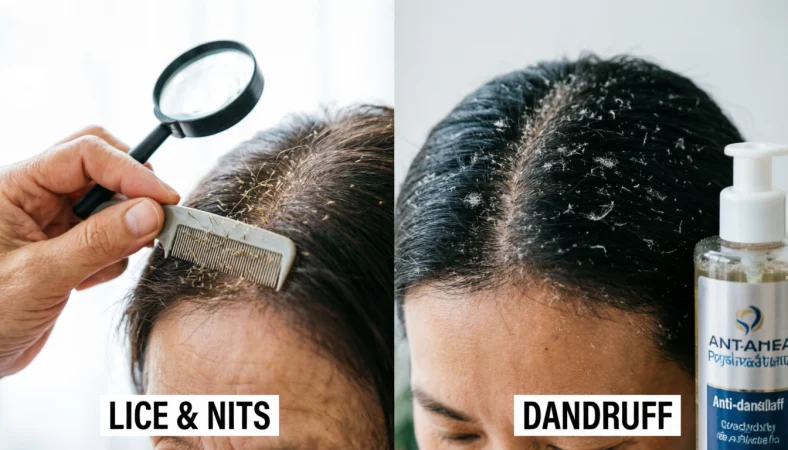
Lice and dandruff look completely different when examined closely. Live lice appear as small, dark insects that move rapidly through the hair. They are about the size of a sesame seed and are difficult to spot because they move away from light.
Dandruff flakes, on the other hand, are white or yellowish and do not move. They are easily brushed off the hair and shoulders. When you pick up a dandruff flake, it crumbles and flakes apart, whereas nits cling stubbornly to hair.
Nits look like tiny teardrop shaped eggs attached to one side of the hair shaft. They are firmly glued in place and are challenging to remove. Unlike dandruff, nits do not brush off easily and often remain attached even after washing.
Location Differences
Lice eggs are typically found near the scalp, particularly at the nape of the neck and behind the ears. These areas provide warmth and are ideal for hatching. Nits are attached to individual hair strands, usually within 0.5 inches of the scalp.
Dandruff flakes are present all over the scalp and sometimes extend to the eyebrows and shoulders. They are not attached to hair strands but sit loosely on the scalp surface or become entangled in hair.
Sensation Differences
Both conditions cause itching, but the nature of the itching differs. Lice itching is often more intense and tends to worsen at night because lice are most active in darkness. The itching results from an allergic reaction to lice saliva. Some people also feel a tickling sensation as lice move through the hair.
Dandruff itching is generally milder and more constant. It is often accompanied by a feeling of dryness or tightness on the scalp. The itching is caused by skin irritation and tends to improve after washing.
Contagiousness
This is perhaps the most significant practical difference. Lice are highly contagious. They spread through direct head to head contact and, less commonly, through shared personal items. If one person in a household has lice, it is highly likely that close contacts have also been exposed.
Dandruff is not contagious at all. You cannot catch dandruff from someone else, and you cannot spread it to others. It is a personal condition related to skin biology, environment, and habits.
Common Mistakes People Make
The confusion between lice and dandruff leads to several common mistakes that can delay effective treatment.
Mistaking nits for dandruff: This is perhaps the most frequent error. People see white specks in their hair and assume they are dandruff. However, if these specks are firmly attached to the hair and cannot be flicked off, they are likely nits. Unlike dandruff, nits require significant effort to remove.
Treating lice with dandruff shampoo: Anti dandruff shampoos are not effective against lice. They may temporarily soothe an itchy scalp, but they do not kill lice or their eggs. Using these products gives lice more time to spread to others.
Treating dandruff with lice medication: Lice shampoos contain insecticides designed to kill parasites. Applying these products to dandruff affected skin is unnecessary and can cause irritation or allergic reactions.
Assuming lice only affect unhygienic people: Lice infestations have nothing to do with cleanliness. They are transmitted through head contact and affect people of all socioeconomic backgrounds. Dandruff can also occur regardless of hygiene, though washing frequency plays a role.
Overusing anti dandruff products: When people are unsure whether they have lice or dandruff, they sometimes wash excessively with harsh shampoos. This can dry out the scalp and worsen dandruff without addressing lice if they are present.
Correct Usage Examples
The following examples illustrate how to correctly use the terms lice and dandruff in various contexts.
Casual Examples
- My daughter came home from school scratching her head. We checked and found she has lice.
- I noticed white flakes on my black sweater this morning, so I washed my hair with a dandruff shampoo.
- The school nurse sent a note home because she found lice in my son’s class.
- Winter always makes my dandruff worse because the air is so dry indoors.
Professional Examples
- The pediatrician confirmed the diagnosis of pediculosis capitis after identifying live lice on the patient’s scalp.
- The patient presented with moderate flaking and mild erythema consistent with seborrheic dermatitis, commonly known as dandruff.
- Our company policy requires employees to treat confirmed lice infestations before returning to work.
- The dermatologist recommended a ketoconazole based treatment for chronic dandruff not responding to over the counter products.
Educational Examples
- In health class, we learned that lice spread through head to head contact and require specific treatments, unlike dandruff which is a skin condition.
- The textbook explains that dandruff is the shedding of dead skin cells from the scalp, whereas lice are parasitic insects.
- Proper hygiene can help manage dandruff, but lice infestations have nothing to do with cleanliness.
Literary or Metaphorical Examples
- The uncertainty of their situation clung like lice to the family’s hopes.
- The lies spread through the community like dandruff on a black coat, falling everywhere and affecting everyone.
Word Origin and Etymology
Understanding where these words come from provides insight into their meanings and usage.
Lice
The word lice comes from the Old English “lus,” which traces back to Proto Germanic “lus” and ultimately to Proto Indo European “lus ” meaning “louse.” The word has remained remarkably consistent across Germanic languages. The plural form “lice” comes from the Old English plural “lys” or “luse,” which underwent a vowel shift over time.
Lice have been known to humans since ancient times. They are mentioned in ancient Egyptian texts, Greek writings, and the Bible. For much of human history, lice were almost universal among humans, and their presence was considered a normal part of life rather than a condition requiring special treatment.
Dandruff
Dandruff has a more colorful etymology. The word appears to have entered English around the 16th century. The “dand” part may come from the Middle English “dand,” meaning “scale” or “flake,” though its exact origin is uncertain. The “ruff” part is believed to come from “ruff” or “rough,” referring to a rough, scaly condition of the scalp, or possibly from a Norse word meaning “scab.
The term dandruff has been used to describe scalp flaking for centuries, though historical treatments have varied widely from using garlic and vinegar to more severe measures like bloodletting.
Why Lice and Dandruff Become Confused
Several factors contribute to the persistent confusion between these two scalp conditions.
Visual Similarity
White flakes in the hair can resemble nits, especially to the untrained eye. Both appear as small white specks against darker hair. This visual similarity leads many people to worry about lice when they actually have harmless dandruff and vice versa.
Similar Symptoms
Both conditions cause itching, which is a primary symptom. When people experience an itchy scalp, they may not know whether the cause is an infestation or a skin condition. The itching from both conditions can disrupt sleep and cause significant discomfort.
Lack of Awareness
Many people simply lack knowledge about the differences. They have heard about lice but never seen them, and they know dandruff exists but do not understand its causes. Without education, people default to their greatest fear, often assuming the worst.
Fear Factor
Lice carry a social stigma. Many people fear lice infestations because of the associated embarrassment, the difficulty of treatment, and the perceived judgment from others. This fear can cause people to jump to conclusions when they see white flakes in their hair.
Easy Memory Tricks
Remembering how to distinguish between lice and dandruff becomes easier with a few simple memory aids.
The Glue Test
Nits are firmly attached to hair shafts, while dandruff flakes come off easily. If you try to slide a flake off the hair and it does not move, it is likely a nit. If it falls off at the slightest touch, it is probably dandruff.
Movement Check
Live lice move. They crawl through the hair and are sometimes visible to the naked eye. Dandruff is static. Nothing moves. If you see something crawling on the scalp, you have lice.
Location Thinking
Lice nits are typically found behind the ears and at the nape of the neck. Dandruff tends to distribute across the scalp more evenly. If you only see specks in specific areas near the scalp, think lice. If the whole scalp has flakes, think dandruff.
Color Clue
Lice are brownish or grayish, while dandruff is usually white or yellowish. Nits are often described as looking like dandruff that is glued to the hair. The color can help differentiate them.
Itch Pattern
Lice itching often worsens at night. Dandruff itching is usually more consistent throughout the day. If you wake up scratching at night, this strongly suggests lice.
FAQs
1. Can you have both lice and dandruff together?
Yes, both can occur at the same time and need separate treatments.
2. How can you check for lice or dandruff?
Lice stick to hair; dandruff appears as loose flakes on the scalp.
3. Which is more common, lice or dandruff?
Dandruff is more common in adults, while lice are common in children.
4. What is the best treatment for lice or dandruff?
Use lice treatments for lice and anti-dandruff shampoos for dandruff.
5. How long do lice or dandruff last?
Lice continue until treated; dandruff can be managed but may return.
6. Are lice or dandruff dangerous?
Neither is usually serious, but lice are contagious.
7. Can pets cause lice or dandruff?
No, human lice do not come from pets, and dandruff is not caused by them.
8. How can you prevent lice or dandruff?
Avoid sharing personal items for lice and maintain scalp care for dandruff
Conclusion
The difference between lice and dandruff becomes easy to understand once you know their signs and causes. Lice are living parasites that require targeted treatment, while dandruff is a common scalp condition that can be controlled with proper hair and scalp care.
Recognizing whether you are dealing with lice or dandruff helps you avoid confusion and choose the right solution. With accurate knowledge and proper care, both conditions can be managed effectively, allowing you to maintain a healthy scalp with confidence.
Read more articles about
- Cornrows or Dreads: What’s the Difference and Which Hairstyle Is Right for You in 2026
- Stair or Staircase: Common Mistakes and How to Avoid Them In 2026