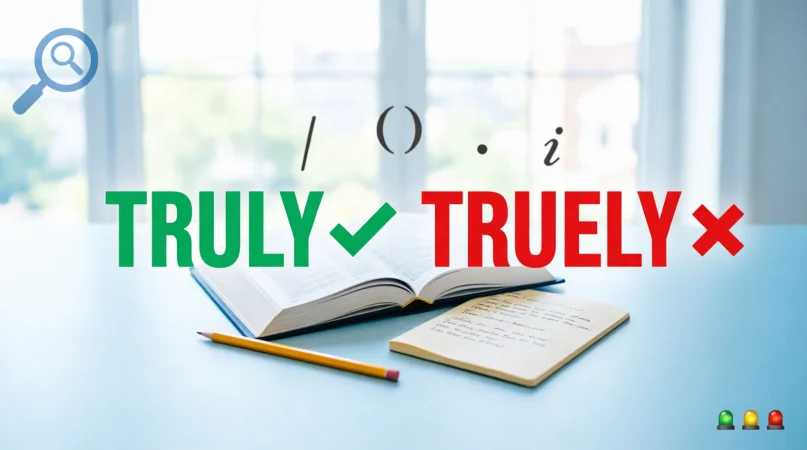
Quick answer: “Truly” is the correct spelling and means genuinely or honestly, while “truely” is a misspelling and is not a valid English word.
When writing in English, even small spelling differences can affect clarity, credibility, and professionalism. One common point of confusion is whether the correct spelling is “truly” or “truely.” Since both forms appear online, many learners and even native speakers wonder which one is accepted in standard English. The correct answer is simple: “truly” is the only correct spelling, while “truely” is a common misspelling.
The word “truly” is an adverb that means genuinely, honestly, or in a truthful manner. It is widely used in academic writing, business communication, journalism, and everyday conversation. Understanding why “truly” drops the “e” from “true” before adding “-ly” can help you avoid similar spelling mistakes with other adverbs. This guide explains the correct spelling, its meaning, grammar rules, examples, and practical tips so you can use “truly” with confidence in every type of writing.
Quick Answer Table
| Feature | Truly | Truely |
| Spelling Status | ✅ Correct | ❌ Incorrect |
| Meaning | In a truthful, sincere, or genuine way | Not recognized as standard English |
| Part of Speech | Adverb | Misspelling |
| Dictionary Recognition | Yes | No |
| Accepted in Formal Writing | Yes | No |
| Example | I truly appreciate your help. | ❌ I truely appreciate your help. |
Which One Is Correct?
The correct word is
✅ Truly
The incorrect spelling is:
❌ Truely
When forming the adverb from the adjective true, English removes the final e before adding -ly.
Correct Formation
- True → Truly
- Due → Duly
- Whole → Wholly
This spelling pattern is a recognized exception in English word formation.
Examples
- I truly believe this is the right decision.
- She was truly grateful for the support.
- The movie was truly inspiring.
Incorrect:
- ❌ I truely believe this is the right decision.
- ❌ She was truely grateful.
Meaning of the Correct Word
Definition of Truly
Truly is an adverb that means the following:
- In a truthful manner
- Genuinely
- Honestly
- Sincerely
- Really or genuinely
Dictionary-Style Definition
Truly (adverb):
In a truthful, honest, sincere, or genuine way.
How Truly Is Used
The word “truly” can express sincerity, emphasis, honesty, or authenticity.
1. To Mean Honestly
Example:
- I truly don’t know the answer.
Here, the speaker emphasizes honesty.
2. To Mean Genuinely
Example:
- She truly cares about her students.
The meaning is that her concern is genuine.
3. To Add Emphasis
Example:
- This is truly remarkable.
The word strengthens the statement.
Real-World Examples
Personal Communication
- I truly appreciate your kindness.
- Thank you for truly understanding my situation.
Workplace Writing
- We are truly honored to receive this award.
- Your feedback is truly valuable to our team.
Academic Writing
- The research provides a truly comprehensive analysis.
- This discovery is truly significant for the field.
Creative Writing
- The sunset was truly magical.
- He was truly lost in thought.
Meaning of the Incorrect or Alternative Word
What Does “Truely” Mean?
The short answer:
Nothing in standard English.
The spelling truely is considered a mistake.
Is Truely a Real Word?
No.
Major dictionaries do not recognize “truly” as a standard English word.
Is it slang?
No.
Is It a Regional Variation?
No.
Is It Accepted in British English?
No.
Is It Accepted in American English?
No.
Regardless of the English variety, the accepted spelling is always the following:
✅ Truly
Key Differences Between the Two Words
Truly vs Truely Comparison Table
| Feature | Truly | Truely |
| Correct Spelling | Yes | No |
| Dictionary Entry | Yes | No |
| Grammar Status | Standard English | Misspelling |
| Accepted in Formal Writing | Yes | No |
| Accepted in Academic Writing | Yes | No |
| Accepted in Business Writing | Yes | No |
| Pronunciation | Same | Same |
| Meaning | Genuine, sincere, truthful | None |
Spelling Difference
The only visible difference is the extra e.
- Truly ✅
- Truely ❌
That single extra letter makes one spelling correct and the other incorrect.
Pronunciation Difference
There is no pronunciation difference.
Both would be pronounced:
/ˈtruːli/
Because they sound identical, many writers accidentally spell the word incorrectly.
Grammar Difference
Truly functions as an adverb.
Example:
- She truly understands the problem.
“Truely” has no grammatical role because it is not a recognized English word.
Recognition Difference
Spell checkers, dictionaries, grammar tools, editors, and academic style guides recognize:
✅ Truly
Not:
❌ Truely
Common Mistakes People Make
Many learners assume English follows a simple rule:
adjective + ly = adverb
Examples:
- Quick → Quickly
- Slow → Slowly
- Happy → Happily
Following that pattern, writers expect the following:
- True → Truely
However, English uses a different spelling rule here.
Common Mistake #1
Writing:
❌ I truely agree.
Correct:
✅ I truly agree.
Common Mistake #2
Using It in Professional Emails
Incorrect:
❌ We are truely thankful.
Correct:
✅ We are truly thankful.
Common Mistake #3
Social Media Posts
Incorrect:
❌ I am truely excited.
Correct:
✅ I am truly excited.
Common Mistake #4
Academic Essays
Incorrect:
❌ The findings are truely important.
Correct:
✅ The findings are truly important.
Correct Usage Examples
Below are examples showing how “truly” should be used in different contexts.
Casual Examples
- I truly enjoyed the concert.
- You truly made my day.
- That was truly funny.
- I truly missed you.
Professional Examples
- We truly value our customers.
- The company is truly committed to quality.
- Your contribution was truly appreciated.
- This achievement is truly remarkable.
Educational Examples
- The teacher truly inspired her students.
- This experiment truly demonstrates the principle.
- The study truly advances scientific knowledge.
- The lesson was truly engaging.
Literary and Metaphorical Examples
- The ocean was truly endless beneath the moonlight.
- Her courage was truly a beacon in difficult times.
- He truly carried the weight of the world on his shoulders.
- The forest seemed truly alive at dawn.
Examples in Questions
- Do you truly believe that?
- Are you truly happy with the outcome?
- Did she truly say that?
Examples in Negative Sentences
- I do not truly understand the issue.
- He wasn’t truly prepared.
- They were not truly aware of the consequences.
Word Origin / Etymology
Understanding the history of a word often makes spelling easier to remember.
Origin of True
The adjective “true” comes from Old English:
trēowe
Meaning:
- Faithful
- Trustworthy
- Honest
Over centuries, it evolved into the modern English word true.
Development of Truly
When English speakers created the adverb form, spelling conventions gradually established themselves:
true → truly
Instead of:
true → truely
The omission of the final e became standardized and remains the accepted form today.
Related Words
The word belongs to a family of related terms:
- True
- Truly
- Truth
- Truthful
- Truthfully
- Trustworthy
- Authentic
- Genuine
- Honest
- Sincere
These semantic relatives help reinforce its meaning and usage.
Why the Incorrect Version Became Popular
Many misspellings arise because English spelling is not always intuitive.
Several factors contribute to the popularity of truly.
1. Logical Assumption
People naturally think the following:
- True + ly = Truely
This seems reasonable but is incorrect.
2. Pronunciation Gives No Clue
Both spellings sound identical.
Because the spoken form offers no hint, many writers rely on guesswork.
3. Typing Habits
Fast typing often leads people to preserve the e from true before adding ly.
4. Lack of Familiarity with Spelling Rules
Many learners have never encountered the rule that removes the final e in this specific case.
5. Search Engine Queries
Thousands of people search for:
- truly or truely
- How to spell truly
- is truely correct
- truly meaning
- truely vs truly
The frequency of these searches keeps the incorrect version visible online.
Easy Memory Tricks
Need a quick way to remember the correct spelling?
Trick #1: Drop the E
Think:
“True” loses its “E” before becoming “truly.”
True → Truly
Trick #2: Remember Similar Words
Compare:
| Adjective | Adverb |
| Due | Duly |
| Whole | Wholly |
| True | Truly |
The silent e disappears.
Trick #3: Dictionary Check
If you’re unsure, remember:
Every dictionary recognizes “truly,” not “truely.”
Trick #4: The Three-Letter Ending
Notice the ending:
T-R-U-L-Y
Only five letters after “tru.”
No extra e needed.
(FAQs)
1. Is it truly or truely?
Truly is correct. “Truly” is a misspelling.
2. Why is “truly” spelled without an e?
English spelling conventions drop the final e from “true” before adding “-ly,” resulting in “truly.”
3. Is truely ever correct?
No. Standard English grammar does not recognize truely as a correct spelling.
4. How do you pronounce truly?
It is pronounced:
/ˈtruːli/
Sounds like
TROO-lee
5. Is it truly an adverb?
Yes.
Truly is the adverb form of “true.”
Example:
- She truly cares.
6. Can I use “truly” in formal writing?
Absolutely.
It is widely accepted in the following:
- Academic writing
- Professional communication
- Business reports
- Journalism
- Literature
7. What does “truly” mean?
It means:
- Honestly
- Genuinely
- Sincerely
- Really
- Authentically
8. Why do so many people write truly?
Because many writers assume the word is formed by simply adding -ly to true, which seems logical but does not follow the standard spelling rule.
9. Is it truly used in British and American English?
Yes.
Both British and American English use truly as the correct spelling.
10. What is a synonym for truly?
Common synonyms include:
- Genuinely
- Honestly
- Sincerely
- Really
- Authentically
- Truthfully
- Certainly
Conclusion
In conclusion, the correct spelling is “truly,” not “truely.” Although the extra “e” may seem logical because the adjective is “true,” standard English drops the “e” before adding “-ly.” Using “truly” ensures your writing follows accepted grammar and looks polished in professional, academic, and everyday contexts. If you remember that “true” becomes “truly,” you’ll avoid a common spelling mistake and write with greater confidence and accuracy.