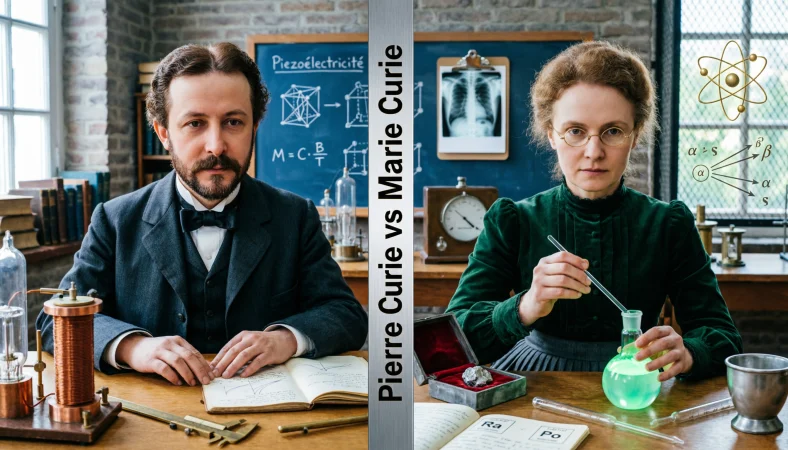
Pierre Curie and Marie Curie were both pioneers in radioactivity, but Marie Curie is more widely recognized for her groundbreaking discoveries and Nobel Prizes.
When comparing Pierre and Marie Curie, it’s impossible to overlook the extraordinary impact both had on modern science. Pierre Curie was a brilliant physicist known for his pioneering work in magnetism, crystallography, and radioactivity, while Marie Curie became one of history’s most celebrated scientists through her groundbreaking discoveries of polonium and radium.
Together, they formed one of the most influential scientific partnerships ever recorded. Although Pierre’s theoretical insights and experimental expertise laid a strong foundation, Marie’s relentless dedication and later achievements earned her global recognition, including two Nobel Prizes.
Understanding the contributions of both scientists provides a clearer picture of how their combined efforts revolutionized physics and chemistry and continue to shape scientific research today.
Quick Answer Table
| Feature | Pierre | Marie |
| Correct Spelling | Pierre | Marie |
| Gender | Masculine | Feminine |
| Language of Origin | French | French / Hebrew |
| Meaning | “Rock” or “stone” | “Beloved” or “bitter” (debated) |
| Famous Person | Pierre Curie (physicist, Nobel Prize 1903) | Marie Curie (physicist/chemist, Nobel Prizes 1903 & 1911) |
| Pronunciation | Pee-AIR (French) or Peer (Anglicized) | Mah-REE (French) or Muh-REE (English) |
| Example Sentence | Pierre Curie discovered piezoelectricity. | Marie Curie won two Nobel Prizes. |
Verdict: Both are correct names, but they refer to different people. Choosing Pierre or Marie depends entirely on which person you mean.
Which One Is Correct?
Here’s the truth: both Pierre and Marie are correct spellings of common French given names. Neither is wrong. However, the confusion arises when writers need to attribute discoveries, quotes, or biographical details to the correct Curie.
For example:
- ✅ Correct: “Pierre Curie co-discovered radium.”
- ✅ Correct: “Marie Curie pioneered radiation therapy.”
- ❌ Incorrect: “Marie Curie died in a carriage accident in 1906.” (That was Pierre.)
When people search for Pierre or Marie, they typically want to know:
- Which Curie did what?
- Which name is masculine vs. feminine?
- How do you pronounce each correctly?
- Can you use both in the same sentence?
Meaning of Pierre (The Masculine Name)
Pierre is the French form of Peter. It comes from the Greek Petros, meaning “rock” or “stone.” The name carries connotations of strength, stability, and steadfastness.
Famous Pierres in History
| Name | Field | Known For |
| Pierre Curie | Physics | Piezoelectricity, radioactivity, Nobel Prize |
| Pierre-Auguste Renoir | Art | Impressionist painter |
| Pierre Trudeau | Politics | Former Prime Minister of Canada |
| Pierre Bourdieu | Sociology | Cultural capital, habitus |
Usage Examples
- Casual: “Pierre is joining us for dinner tonight.”
- Historical: “Pierre Curie’s lab notebooks are still too radioactive to handle.”
- Educational: “The Pierre Auger Observatory studies cosmic rays.”
Pronunciation Guide
- French: Pee-AIR (two syllables, stress on second syllable)
- Anglicized: Peer (one syllable, rhymes with “beer”)
- Common mistake: Saying “Pee-ree” (that’s not correct)
Meaning of Marie (The Feminine Name)
Marie is the French form of Mary. Its Hebrew origin is debated: some scholars say it comes from Miryam, meaning “beloved” or “wished-for child.” Others link it to marah, meaning “bitter.” Either way, Marie has been one of the most enduring feminine names in Western history.
Famous Maries in History
| Name | Field | Known For |
| Marie Curie | Physics/Chemistry | Radioactivity, two Nobel Prizes |
| Marie Antoinette | Royalty | Last Queen of France before the Revolution |
| Marie Kondo | Organizing | KonMari method of tidying |
| Marie Osmond | Entertainment | Singer, TV personality |
Usage Examples
- Casual: “Marie is my grandmother’s middle name.”
- Historical: “Marie Curie refused to patent the radium extraction process so others could benefit.”
- Educational: “Marie Tharp mapped the ocean floor and proved continental drift.”
Pronunciation Guide
- French: Mah-REE (two syllables, stress on second syllable)
- Anglicized: Muh-REE (two syllables, first syllable like “mud” without the D)
- Common mistake: Saying “Mary” (Mary and Marie are different names)
Key Differences Between Pierre and Marie
| Category | Pierre | Marie |
| Gender | Masculine | Feminine |
| Language Origin | Greek via French | Hebrew via French |
| Literal Meaning | Rock/stone | Beloved/bitter (debated) |
| Typical Usage | First name for men | First name for women |
| French Pronunciation | Pee-AIR | Mah-REE |
| English Pronunciation | Peer | Muh-REE |
| Common Diminutives | Pierrot | Mariette, Mimi |
| Famous Surname Partner | Curie | Curie |
Grammar & Usage Rules
- Capitalization: Always capitalize both names (proper nouns).
- With titles: “Dr. Pierre Curie” / “Professor Marie Curie.”
- Possessive form: “Pierre’s lab” / “Marie’s discovery.”
- In compound references: “The Curies” (refers to both Pierre and Marie together)
Important: Never use “Pierre” to refer to Marie Curie or vice versa. They are distinct individuals.
Common Mistakes People Make
- Attributing Marie’s second Nobel Prize to Pierre. Pierre died in 1906. Marie won her second Nobel (Chemistry) in 1911, alone.
- Calling Pierre “Marie’s husband” only, he was a Nobel-winning physicist in his own right.
- Misspelling Pierre as “Pierr” or “Peirre.” Common typos: two R’s? No. I before E? Yes (P-I-E-R-R-E).
- Misspelling Marie as “Mary” or “Marrie” Two R’s? No. Marie has one R.
- Pronouncing Pierre as “Pee-ree.” That’s not a name. It’s “Pee-AIR” or “Peer.”
- Assuming Marie is always the French form of Mar, correct, but Mary itself has multiple origins.
Correct Usage Examples
Casual / Everyday
- “Pierre and I are grabbing coffee later.”
- “My aunt Marie makes the best croissants.”
Professional / Academic
- “The Pierre Curie Fellowship supports female researchers in Europe.”
- “Marie Curie’s legacy includes the first mobile radiology units in WWI.”
Educational / Classroom
- “When writing about radioactivity, you can mention both Pierre and Marie Curie.”
- “For this history report, choose either Pierre or Marie Antoinette, but they are very different people.”
Literary / Metaphorical
- “He stood like Pierre against the waves of criticism.” (using the literal French meaning “stone”)
- “Her kindness was a quiet Marie in a world of noise.” (poetic, uncommon)
Word Origin / Etymology
Pierre
Pierre comes from the Latin Petrus, which came from Greek Petros (πέτρος), meaning “rock” or “stone.” Jesus gave the apostle Simon the name Cephas (Aramaic for rock), which translated to Greek as Petros and later to French as Pierre. The name has been common in France since the Middle Ages.
Marie
Marie comes from the Hebrew Miryam (מִרְיָם). The meaning is uncertain. Leading theories include:
- “Beloved” (from Egyptian mr)
- “Bitter” (from Hebrew marah)
- “Rebellious” (from Hebrew marah)
The name spread through Christianity due to the Virgin Mary. The French adapted it as Marie. It remains one of the most common feminine names in French-speaking countries.
Fun fact: Pierre and Marie Curie were not related by blood; they married in 1895. Their daughter, Irène Joliot-Curie, also won a Nobel Prize.
Why the Confusion Became Popular
Why do people search for Pierre or Marie so often?
- The Curie factor, Pierre and Marie Curie are almost always mentioned together. Their names are fused in memory, leading to mix-ups.
- Similar French sounds. Both are two-syllable French names starting with consonants and ending in vowel sounds.
- Gender neutrality confusion. Non-French speakers may not realize Pierre is exclusively masculine and Marie exclusively feminine.
- Autocorrect errors. Typing “Pierre” might trigger “Marie” as a suggestion on some keyboards.
- Students rushing through homework. Quick attribution errors happen constantly.
Easy Memory Tricks
🪨 Pierre = Rock. Think of the word “petrify” (turn to stone). Pierre means rock. Are rocks masculine? Not scientifically, but grammatically in French, yes.
💕 Marie = Mary. Think of the Virgin Mary or Marie Antoinette. Both are famously feminine names.
🔬 Curie timeline trick
- Pierre died in 1906 (carriage accident). If the event is before 1906, both Curies could be involved.
- Marie lived until 1934. If the event is after 1906, it’s Marie alone.
🎨 Art association Pierre-Auguste Renoir (painter, male) vs. Marie Cassatt (Mary Cassatt, American, but close enough).
🗣️ Pronunciation reminder
- Pierre has “air” in it (like breathing airmasculine? Not really, but it works).
- Marie has “ree” at the end (sounds softer).
FAQs
1. Who was more famous, Pierre or Marie Curie?
Marie Curie is more famous globally, largely because she won two Nobel Prizes (Physics 1903, Chemistry 1911) and became a scientific icon. Pierre won only one Nobel (shared with Marie and Henri Becquerel in 1903). However, Pierre was already a respected physicist before meeting Marie.
2. Can “Pierre” mean anything other than a name?
Yes. In French, pierre (lowercase) means “stone” or “rock.” You’ll see it in words like pierre précieuse (gemstone) or pierre angulaire (cornerstone). In English, “Pierre” with a capital P is almost always the name.
3. Is “Marie” only a French name?
No. Marie is used throughout Europe, especially in French, German, Czech, and Scandinavian countries. The English equivalent is Mary. The Spanish equivalent is María.
4. What’s the correct way to address both Curies together?
“The Curies” is standard. You can also say “Pierre and Marie Curie” (alphabetical or traditional orderPierre then Marie is common). Avoid “Marie and Pierre Curie” unless you have a specific reason to put Marie first.
5. Did Pierre and Marie work together on all their research?
Yes, for most of their marriage. Pierre abandoned his own work on crystals to join Marie’s research on uranium rays. Together, they discovered polonium and radium. After Pierre’s death, Marie continued alone.
6. Is it rude to confuse Pierre and Marie?
It depends. In casual conversation, most people will correct you gently. In academic or professional writing, confusing them signals carelessness. Always double-check names when writing about historical figures.
Conclusion
In conclusion, Pierre Curie and Marie Curie made lasting contributions to science through their research on radioactivity. Pierre contributed important work in physics, while Marie achieved groundbreaking discoveries and global recognition.
Together, they advanced scientific understanding and remain respected figures in history. Their legacy continues to inspire scientists and students around the world today.