Quick Answer:
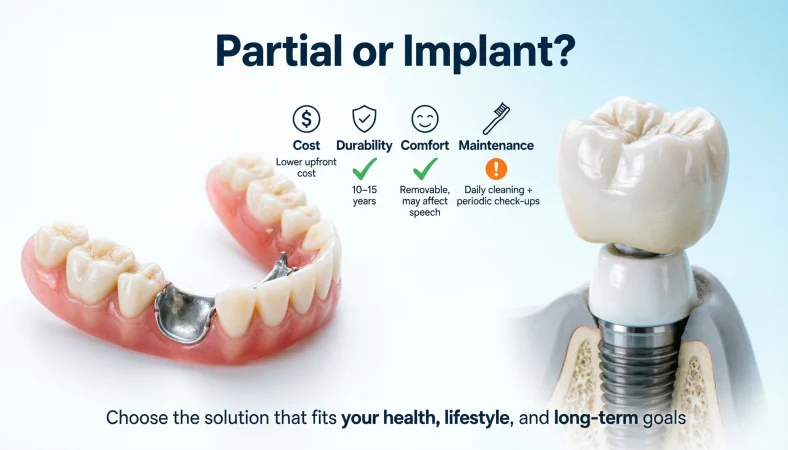
Implants are usually more stable and long-lasting, while partials are more affordable and removable, making the better choice dependent on your budget, bone health, and dental needs.
If you’re missing one or more teeth, you’ve likely come across the terms partial and implant while researching tooth replacement options. Both are popular dental solutions designed to restore your smile, improve chewing ability, and support oral health. However, they work in very different ways.
Many patients struggle to decide between a partial denture and a dental implant because each option offers unique advantages, costs, maintenance requirements, and long-term benefits. The right choice often depends on your oral health, budget, lifestyle, and treatment goals.
In this guide, you’ll learn the key differences between partial dentures and dental implants, including how they work, their pros and cons, costs, durability, maintenance needs, and who may benefit most from each option.
Quick Answer Table
| Feature | Partial Denture | Dental Implant |
|---|---|---|
| Correct Dental Option? | ✅ Yes | ✅ Yes |
| Type | Removable appliance | Permanent tooth replacement |
| Surgery Required | No | Yes |
| Cost | Lower | Higher |
| Durability | Moderate | Long-lasting |
| Bone Preservation | Limited | Excellent |
| Maintenance | Daily removal and cleaning | Similar to natural teeth |
| Best For | Multiple missing teeth on a budget | Long-term replacement solutio |
Which One Is Better?
There is no universal winner because the best option depends on individual circumstances.
In general:
- Partial dentures are more affordable and require no surgery.
- Dental implants offer greater stability, durability, and a more natural appearance.
Your dentist can help determine which solution fits your oral health needs and budget.
Meaning of a Partial Denture
Definition
A partial denture is a removable dental appliance used when some natural teeth remain in the mouth.
It fills gaps created by missing teeth and helps restore chewing and speaking abilities.
How It Works
A partial denture consists of:
- Replacement teeth
- A gum-colored base
- Metal or flexible clasps that attach to existing teeth
The appliance can be removed for cleaning and maintenance.
Usage
Partial dentures are commonly recommended when:
- Several teeth are missing
- Remaining teeth are healthy enough to support the appliance
- Patients prefer a lower-cost treatment option
Real-World Examples
- Replacing several missing molars.
- Filling gaps in the upper or lower jaw.
- Restoring function after tooth extraction.
Meaning of a Dental Implant
Definition
A dental implant is a titanium or zirconia post surgically placed into the jawbone to replace a missing tooth root.
A crown, bridge, or denture is then attached to the implant.
How It Works
A dental implant consists of:
- Implant post
- Abutment
- Dental crown
Together, these components mimic a natural tooth.
Usage
Implants are often recommended when:
- One or more teeth are missing
- Adequate jawbone exists
- Long-term stability is desired
Real-World Examples
- Replacing a single missing front tooth.
- Supporting an implant bridge.
- Stabilizing a full denture.
Key Differences Between Partial and Implant
| Feature | Partial Denture | Dental Implant |
| Removable | Yes | No |
| Surgical Procedure | No | Yes |
| Bone Integration | No | Yes |
| Appearance | Good | Excellent |
| Stability | Moderate | Excellent |
| Lifespan | Several years | Decades with care |
| Cleaning | Removed daily | Brushed like natural teeth |
| Cost | Lower | Higher |
Structure
A partial denture rests on the gums and uses surrounding teeth for support.
An implant becomes integrated into the jawbone.
Feel
Implants generally feel more like natural teeth.
Partials may require an adjustment period.
Stability
Implants are fixed in place.
Partials can sometimes shift during eating or speaking.
Longevity
Dental implants typically last much longer than removable partial dentures.
Common Mistakes People Make
Choosing Based Only on Cost
Many patients focus solely on upfront expenses.
While partial dentures cost less initially, implants may provide better long-term value.
Ignoring Bone Health
Missing teeth can lead to bone loss.
Dental implants help stimulate the jawbone, while partial dentures do not.
Assuming Implants Are Suitable for Everyone
Not all patients qualify immediately for implants.
Factors include:
- Bone density
- Overall health
- Gum health
Neglecting Maintenance
Both options require proper oral hygiene and regular dental visits.
Pros and Cons of Partial Dentures
Advantages
- Lower initial cost
- No surgery required
- Faster treatment process
- Suitable for multiple missing teeth
Disadvantages
- Can feel bulky
- May require adjustments
- Does not prevent bone loss
- Less stable than implants
Pros and Cons of Dental Implants
Advantages
- Natural appearance
- Excellent stability
- Long lifespan
- Preserves jawbone
- Comfortable chewing
Disadvantages
- Higher cost
- Requires surgery
- Longer treatment timeline
- Not suitable for every patient
Correct Usage Examples
Casual Examples
- My dentist recommended a partial denture.
- She received a dental implant after losing a tooth.
Professional Examples
- The patient selected implant-supported restoration.
- A removable partial denture was fabricated to replace missing posterior teeth.
Educational Examples
- Dental implants integrate with the jawbone through osseointegration.
- Partial dentures rely on remaining teeth for support.
Healthcare Examples
- The implant restored function and aesthetics successfully.
- A partial denture provided a cost-effective replacement solution.
Word Origin / Etymology
Origin of Partial
The word partial comes from the Latin partialis, meaning:
Relating to a part rather than the whole.
In dentistry, it refers to replacing only some missing teeth.
Origin of Implant
The word implant comes from the Latin implantare, meaning:
To plant into or insert.
This accurately describes the placement of an implant into the jawbone.
Why Dental Patients Often Compare Partial and Implant
Patients usually compare these options because both address the same problem: missing teeth.
The decision often depends on:
- Budget
- Oral health
- Number of missing teeth
- Long-term goals
- Cosmetic expectations
As dental technology advances, more people are considering implants, while partial dentures remain a practical and affordable choice.
Easy Memory Tricks
Remember Partial = Part
Think:
Partial = Replaces Part of Your Teeth
It fills gaps while natural teeth remain.
Remember Implant = Inserted
Think:
Implant = Implanted Into Bone
This helps distinguish it from removable appliances.
Cost vs Permanence
A simple memory rule:
- Partial = Lower cost
- Implant = Long-term investment
Partial vs Implant: Which Should You Choose?
Choose a Partial Denture If:
- You want a more affordable solution.
- You prefer to avoid surgery.
- Multiple teeth are missing.
- Immediate replacement is needed.
Choose a Dental Implant If:
- You want maximum stability.
- Long-term durability matters.
- Bone preservation is important.
- You’re comfortable with surgery.
Ultimately, the best option should be determined in consultation with a qualified dental professional.
Why Replacing Missing Teeth Matters
Failing to replace missing teeth can lead to:
- Difficulty chewing
- Speech problems
- Shifting teeth
- Jawbone loss
- Changes in facial appearance
Whether you choose a partial denture or a dental implant, timely treatment can help maintain oral health and quality of life.
FAQs
Is a dental implant better than a partial denture?
Implants generally provide greater stability and longevity, but the best option depends on individual needs.
Are partial dentures cheaper than implants?
Yes. Partial dentures usually have a lower upfront cost.
Do dental implants last longer?
In most cases, yes. Implants can last for decades with proper care.
Can a partial denture replace several teeth?
Yes. Partial dentures are commonly used to replace multiple missing teeth.
Do implants require surgery?
Yes. Implant placement involves a surgical procedure.
Which option looks more natural?
Dental implants often provide the most natural appearance.
Can older adults get dental implants?
Many older adults successfully receive implants if they have adequate oral and overall health.
Do partial dentures need to be removed at night?
Many dentists recommend removing them for cleaning and tissue rest.
Can implants prevent bone loss?
Yes. Implants help stimulate the jawbone similarly to natural tooth roots.
Which option should I choose?
The right choice depends on your oral health, budget, treatment goals, and your dentist’s recommendation.
Conclusion
When comparing partial or implant, both are effective tooth replacement solutions, but they serve different needs. A partial denture offers an affordable, non-surgical way to replace missing teeth, while a dental implant provides a long-lasting, stable, and natural-feeling alternative.
If cost and simplicity are your primary concerns, a partial denture may be the better choice. If you’re looking for durability, comfort, and long-term oral health benefits, an implant is often considered the gold standard.
The best decision comes from understanding your needs and discussing your options with a qualified dental professional.