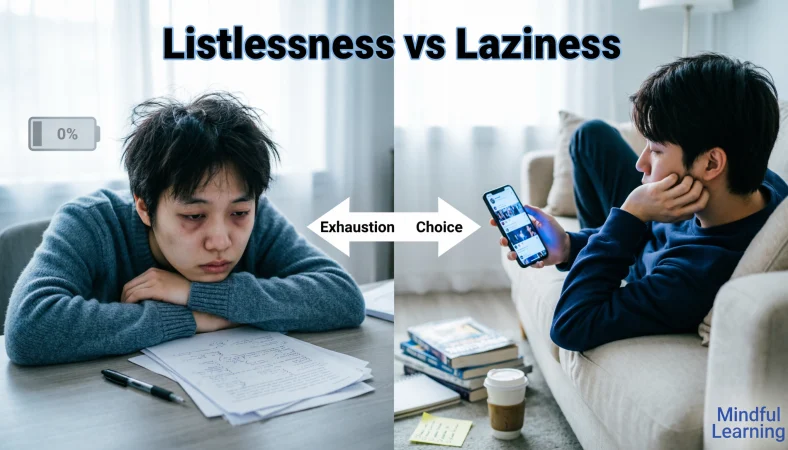
Have you ever felt too tired or unmotivated to do something and wondered whether you’re simply being lazy or if there’s a deeper reason behind it? Many people use listlessness and laziness interchangeably, but these two terms describe very different experiences. Understanding the distinction can help you better identify the root cause of low energy, reduced productivity, or lack of motivation.
Drawing on psychological insights, language usage, and real-world examples, this guide explores the key differences between listlessness and laziness. With years of educational content analysis and research-backed explanations, we’ll clarify when each word is appropriate, how they are commonly used, and why recognizing the difference matters in both personal and professional settings.
Quick Answer Table
| Feature | Listlessness | Laziness |
| Correct spelling | ✅ Yes | ✅ Yes |
| Part of speech | Noun | Noun |
| Meaning | Lack of energy, enthusiasm, or interest | Unwillingness to work or make an effort |
| Positive or negative? | Usually neutral or medical | Usually negative |
| Common usage | Health, emotions, mood, motivation | Work ethic, behavior, productivity |
| Example sentence | “She felt listlessness after recovering from the flu.” | “His laziness prevented him from finishing the project.” |
| Interchangeable? | ❌ Not usually | ❌ Not usually |
Which One Is Correct?
The question “listlessness or laziness” does not have a single correct answer because both words are legitimate English words.
The real issue is choosing the word that accurately describes the situation.
Use:
- Listlessness when someone lacks energy, vitality, enthusiasm, or interest.
- Laziness when someone is unwilling to exert effort despite being capable of doing so.
Quick Rule
If the person cannot find the energy, use listlessness.
If the person does not want to make the effort, use laziness.
This distinction is essential because confusing the two can completely change the meaning of a sentence.
Meaning of the Correct Word: Listlessness
Definition
Listlessness is a noun that means a lack of energy, enthusiasm, interest, or vitality.
It often describes a physical or emotional state rather than a character trait.
Pronunciation
Listlessness
/ˈlɪst.ləs.nəs/
Pronounced as:
LIST-luhs-nis
Explanation
When someone experiences listlessness, they may feel:
- Tired
- Unmotivated
- Drained
- Emotionally flat
- Physically weak
- Disinterested
Importantly, listlessness does not necessarily imply fault or poor character.
A person may become listless because of:
- Illness
- Stress
- Burnout
- Depression
- Lack of sleep
- Emotional exhaustion
Real-World Examples
- After several sleepless nights, she experienced severe listlessness.
- The hot weather caused widespread listlessness among the workers.
- His listlessness worried his family because it was unusual behavior.
- Many people feel temporary listlessness during recovery from illness.
Semantic Keywords Related to Listlessness
- Fatigue
- Exhaustion
- Apathy
- Weariness
- Lack of energy
- Mental fatigue
- Emotional exhaustion
- Low motivation
- Burnout
- Lethargy
Meaning of the Alternative Word: Laziness
Definition
Laziness is a noun referring to the unwillingness to work, exert effort, or take action.
Unlike listlessness, laziness is generally viewed as a behavioral choice.
Pronunciation
Laziness
/ˈleɪ.zi.nəs/
Pronounced as:
LAY-zee-nis
Explanation
A lazy person typically has the ability to act but chooses not to.
Laziness often implies:
- Avoiding work
- Lack of effort
- Procrastination
- Preference for comfort
- Resistance to responsibility
Because of these associations, the word often carries a negative judgment.
Real-World Examples
- His laziness caused him to miss several deadlines.
- Teachers often encourage students to overcome laziness and develop discipline.
- The manager criticized the team’s laziness.
- Laziness can become a habit if left unchecked.
Semantic Keywords Related to Laziness
- Procrastination
- Idleness
- Inactivity
- Lack of effort
- Sloth
- Avoidance behavior
- Poor work ethic
- Negligence
- Indifference
- Complacency
Key Differences Between the Two Words
Understanding the distinction between listlessness or laziness becomes much easier when comparing them side by side.
| Category | Listlessness | Laziness |
| Core meaning | Lack of energy | Lack of willingness |
| Cause | Physical or emotional state | Behavioral choice |
| Tone | Neutral | Negative |
| Medical usage | Common | Rare |
| Psychological usage | Common | Less common |
| Character judgment | Usually none | Often present |
| Temporary condition | Often | Sometimes |
| Moral implication | No | Often yes |
Example Comparison
Listlessness
“After the surgery, he showed signs of listlessness.”
This suggests low energy caused by recovery.
Laziness
“After the surgery, he refused to follow the exercise plan because of laziness.”
This suggests unwillingness to put in effort.
The meanings are significantly different.
Grammar Differences Between Listlessness and Laziness
Both words are nouns, but they function differently in context.
Listlessness
Often appears in:
- Medical writing
- Psychological discussions
- Health articles
- Emotional descriptions
Examples:
- The doctor noted signs of listlessness.
- Her listlessness persisted for weeks.
Laziness
Often appears in:
- Productivity discussions
- Educational settings
- Workplace communication
- Character descriptions
Examples:
- Laziness can hinder success.
- The coach warned against laziness.
When Should You Use Listlessness?
Use listlessness when describing:
Physical Fatigue
- Post-illness weakness
- Recovery periods
- Chronic fatigue
Example:
“His listlessness was caused by dehydration.”
Emotional Exhaustion
- Burnout
- Stress
- Emotional overload
Example:
“The months of pressure resulted in listlessness.”
Mental Fatigue
- Lack of concentration
- Reduced enthusiasm
Example:
“Academic stress created a sense of listlessness.”
When Should You Use Laziness?
Use laziness when describing:
Avoidance of Work
Example:
“His laziness led to unfinished assignments.”
Lack of Discipline
Example:
“Laziness often interferes with long-term goals.”
Intentional Inaction
Example:
“She admitted that laziness prevented her from exercising.”
Common Mistakes People Make
Mistake 1: Treating Them as Synonyms
Incorrect:
“He was lazy after getting the flu.”
Better:
“He experienced listlessness after getting the flu.”
The issue is low energy, not unwillingness.
Mistake 2: Assuming Every Unproductive Person Is Lazy
Many people experiencing:
- Burnout
- Depression
- Stress
- Chronic illness
may appear inactive.
However, inactivity does not automatically mean laziness.
Often, the more accurate word is listlessness.
Mistake 3: Using Listlessness for Avoidance Behavior
Incorrect:
“His listlessness made him skip homework even though he had plenty of energy.”
Better:
“His laziness made him skip homework.”
Mistake 4: Ignoring Context
Always ask:
Is the person unable to act or unwilling to act?
That question usually reveals the correct word.
Correct Usage Examples
Casual Examples
- I felt listlessness after staying up all night.
- Weekend laziness kept me on the couch all day.
- The rainy weather created a sense of listlessness.
- His laziness stopped him from cleaning his room.
Professional Examples
- Employee listlessness may indicate burnout.
- Workplace laziness can reduce productivity.
- Managers should distinguish between listlessness and laziness.
- Health-related listlessness often requires support rather than criticism.
Educational Examples
- The student’s listlessness concerned the teacher.
- Laziness can negatively affect academic performance.
- Temporary listlessness is common during exam stress.
- Chronic laziness may develop poor study habits.
Literary and Metaphorical Examples
- A strange listlessness settled over the village.
- Summer heat inspired an atmosphere of pleasant laziness.
- The hero fought through his listlessness.
- Laziness became an invisible chain holding him back.
Word Origin / Etymology
Listlessness
The word derives from:
- Listless + -ness
The adjective listless emerged from the word list, an older English term meaning “desire” or “inclination.”
Originally, listless literally meant:
“Without desire.”
Over time, it evolved into its modern meaning of lacking energy or enthusiasm.
Laziness
The word comes from:
- Lazy + -ness
The adjective lazy has roots in Middle English and has long been associated with unwillingness to work or exert effort.
For centuries, laziness has been linked to ideas of idleness, sloth, and avoidance of labor.
Why the Confusion Between Listlessness and Laziness Happens
Several factors contribute to the confusion.
Similar External Appearance
Both conditions may involve:
- Sitting still
- Reduced activity
- Lack of productivity
- Delayed action
From the outside, they can look identical.
Misunderstanding Motivation
Observers often cannot see whether someone:
- Lacks energy
- Lacks desire
- Is exhausted
- Is intentionally avoiding work
As a result, listlessness is sometimes mistakenly labeled as laziness.
Modern Discussions About Mental Health
Today, people are increasingly aware that:
- Burnout
- Anxiety
- Depression
- Chronic fatigue
can create behaviors that resemble laziness but are actually forms of listlessness.
This has made the distinction more important than ever.
Why the Incorrect Interpretation Became Popular
Although neither word is incorrect, people often misuse laziness when listlessness is more accurate.
Reasons include:
Simplicity
“Laziness” is a more common everyday word.
Social Judgment
People frequently assume inactivity reflects poor character rather than exhaustion.
Lack of Awareness
Many individuals are unfamiliar with the word “listlessness” and therefore use “laziness” as a catch-all term.
Cultural Attitudes
Some cultures strongly emphasize productivity, making it easier to label inactivity as laziness.
Easy Memory Tricks
Trick #1: Think of Energy
Listlessness = Less energy
The words share a similar sound:
- Listlessness
- Less energy
This can help you remember the meaning.
Trick #2: Think of Choice
Laziness = Choosing not to act
Laziness usually involves a decision or preference.
Trick #3: Ask One Question
Ask:
“Can’t do it or won’t do it?”
- Can’t do it → Listlessness
- Won’t do it → Laziness
This simple question works in most situations.
FAQs
1. Is listlessness the same as laziness?
No. Listlessness refers to low energy or enthusiasm, while laziness refers to avoiding effort or work.
2. Which word is more negative?
Laziness is generally more negative because it often implies personal responsibility or poor effort.
3. Can illness cause listlessness?
Yes. Illness, fatigue, stress, burnout, and emotional exhaustion commonly cause listlessness.
4. Can someone be listless but not lazy?
Absolutely. A person recovering from illness may feel listless while still wanting to be productive.
5. Is laziness considered a personality trait?
Sometimes. Laziness is often discussed as a behavioral tendency or habit rather than a temporary condition.
6. Is listlessness a medical symptom?
Yes. Healthcare professionals sometimes use the term to describe low energy, lethargy, or reduced responsiveness.
7. Which word is more common in everyday English?
Laziness is much more common in casual conversation.
8. Can burnout cause listlessness?
Yes. Burnout frequently leads to mental and physical listlessness.
9. What is a synonym for listlessness?
Common synonyms include:
- Lethargy
- Apathy
- Weariness
- Fatigue
- Exhaustion
10. What is a synonym for laziness?
Common synonyms include:
- Idleness
- Sloth
- Inactivity
- Indolence
- Procrastination
Conclusion
When deciding between listlessness or laziness, context is everything.
Although both words can describe reduced activity, they point to very different causes. Listlessness refers to a lack of energy, enthusiasm, or vitality and is often linked to physical or emotional factors. Laziness, on the other hand, describes an unwillingness to make an effort despite having the ability to do so.
A useful rule to remember is:
- Listlessness = low energy
- Laziness = low effort
Understanding this distinction will help you communicate more accurately, avoid common grammar mistakes, and choose the right word for any situation. The next time you encounter inactivity or lack of motivation, ask whether the issue is exhaustion or unwillingness the answer will usually tell you whether listlessness or laziness is the better choice.