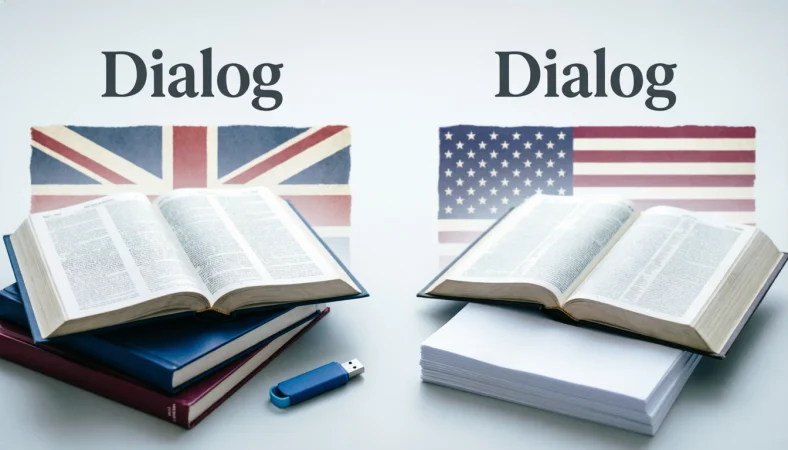
Quick Answer : Dialogue is a conversation between two or more people; an exchange of ideas while Dialog Computing, technology, and American English informal writing.
You are typing an important email. You pause. Your fingers hover over the keyboard. Is it a “dialog box” on your computer screen, but a “dialogue” in a novel? Or is one of these simply a misspelling? If you have ever second-guessed your
self, you are not alone. The battle between “dialog” and “dialogue” is one of the most persistent spelling dilemmas in the English language, right up there with “judgment vs. judgement” or “advisor vs. adviser.”
The confusion is understandable. Both forms appear in published writing, both look legitimate, and your spellchecker might even accept both. However, using the wrong version can subtly signal a lack of attention to detail, especially in formal or academic contexts. This comprehensive guide will settle the score once and for all. We will explore the nuanced history of these two spellings, clarify which one is technically correct, and explain the specific contexts where each form thrives. By the end, you will not only know the difference but also understand the “why” behind the rule, empowering you to write with absolute confidence.
Quick Answer: The Core Distinction
Before we dive deep into the etymology and stylistic nuances, here is the immediate answer to your spelling query. While both forms exist in the English lexicon, they are not universally interchangeable.
| Feature | Dialogue | Dialog |
| Linguistic Status | The standard, traditional spelling. | A recognized variant, primarily in American English. |
| Primary Meaning | A conversation between two or more people; an exchange of ideas. | Identical meaning, but often context-specific. |
| Typical Usage | Literature, film, formal writing, philosophy, general conversation. | Computing, technology, and American English informal writing. |
| Grammatical Role | Functions as both a noun and a verb. | Functions as both a noun and a verb. |
| Example Sentence | The film’s sharp dialogue won the screenwriters an Academy Award. | Please click “OK” to close the dialog box. |
Which One Is Correct?
The most accurate answer is that dialogue is always correct. Dialog is a variant spelling that is conditionally acceptable. If you want a fail-safe rule, stick to “dialogue.” You will never be wrong using “dialogue” for a conversation, a script, or an exchange of ideas. The spelling “dialog” has a narrower lane; it is the standard spelling exclusively in American English computing contexts and is used casually elsewhere, but it is widely considered an error in British English formal writing.
Decoding the Meaning of the Correct Word: Dialogue
To master the spelling, you must first understand the depth of the word’s meaning. “Dialogue” is not just a synonym for “talk.” It carries significant intellectual and artistic weight.
Definition and Core Explanation
“Dialogue” (pronounced dye-uh-log) refers to a spoken or written conversational exchange between two or more people. It derives from the Greek concept of a flowing meaning (dia- “through” + logos “word” or “reason”). This etymology is crucial; it implies that a true dialogue is not just random chatter but a flow of reason and ideas.
The Rich Landscape of Usage
The word operates on multiple levels of sophistication:
- Literary and Dramatic Context: This is the most common usage. In novels, short stories, plays, and screenplays, dialogue is the verbal interaction that drives the plot and reveals character. Good dialogue crackles with tension, subtext, and individuality.
- Philosophical and Academic Context: Here, dialogue becomes a method. Think of Plato’s Socratic dialogues, where systematic questioning aims to uncover truth. In this sense, a dialogue is a cooperative exchange of ideas aimed at solving a problem or exploring a concept, as in “a meaningful dialogue between political rivals.”
- Conversational Context: In everyday language, “dialogue” often implies a structured or purposeful discussion, elevating it above a simple chat. “We need to open a dialogue about mental health in the workplace” signals a formal, necessary, and respectful exchange.
Real-World Examples
- The author’s ear for authentic regional dialogue made the characters leap off the page.
- The summit marked the beginning of a long-awaited dialogue between the two trade partners.
- Plato’s Republic is structured as a dialogue on the nature of justice.
Unpacking the Variant: Is “Dialog” Incorrect?
Calling “dialog” strictly incorrect would be inaccurate, but calling it a fully interchangeable synonym would be poor advice. It occupies a unique, niche space in the English language.
The Technical Exception: Computing
In the realm of computer science and user interface design, “dialog” is not just common; it is the industry-standard spelling. A “dialog box” is a small window that appears on a screen to prompt the user for input or convey a warning.
- Example: The application crashed, leaving an error dialog frozen on the desktop.
In this specific technical jargon, writing “dialogue box” can look out of place to a software developer, though it remains linguistically valid.
The Regional Stylistic Choice: American English
The spelling “dialog” is a product of Noah Webster’s 19th-century crusade to simplify American English orthography. Webster successfully dropped the “u” from “colour” (color) and the “k” from “musick” (music). He attempted the same with the “-ogue” ending, advocating for “dialog,” “catalog,” and “monolog.” American English fully embraced “catalog” but only partially accepted “dialog.” As a result:
- In the United States, you will see “dialog” used informally or in business contexts. “Let’s start a dialog” is not grammatically incorrect in an American memo, but it is stylistically lighter and less formal.
- In the United Kingdom, Canada, Australia, and most other English-speaking regions, “dialog” for a conversation is a misspelling. It is treated as an error in academic papers and formal publications.
The Verdict on the Variant
Use “dialog” only in these two scenarios:
- You are writing about a computer interface element (dialog box).
- You are an American writer in an informal or internal business context, and you consciously prefer the simplified spelling.
For everything else—novels, screenplays, academic theses, journalism, diplomatic negotiations—dialogue is the definitive choice.
Key Differences: A Side-by-Side Breakdown
To further crystallize the distinction, let’s break down the differences across linguistic dimensions.
1. Spelling and Visual DNA
The most obvious difference is the ending.
- Dialogue: The “-logue” suffix visually signals a connection to classical words like “prologue,” “epilogue,” and “monologue,” all words denoting speech or discourse. This visual link reinforces its intellectual meaning.
- Dialog: The “-log” suffix aligns it with simpler, modern words like “catalog” or technical terms like “analog.” It lacks the classical, flowing visual cue.
2. Pronunciation
Despite the spelling difference, the standard pronunciation is identical: /ˈdaɪ.ə.lɒɡ/ (British) or /ˈdaɪ.ə.lɑːɡ/ (American). The “ue” at the end of “dialogue” is silent, which ironically explains why the variant “dialog” emerged—it’s a phonetic spelling.
3. Grammatical Function
Both words function identically as nouns and, less commonly, as verbs.
- Noun: The dialogue was witty. / The dialog box appeared.
- Verb: To engage in conversation. We need to dialogue with stakeholders. / The software dialogs with the main server.
The verb form, while grammatically correct, often feels clunky. A better stylistic choice is to use “converse,” “discuss,” or “negotiate.”
4. Prestige and Formality
This is the most significant unspoken rule. “Dialogue” carries an inherent prestige and formality. Using “dialogue” in an essay about international relations signals seriousness. Using “dialog” in the same essay might signal a rushed draft or a limited vocabulary, unless you are specifically using the American English convention for a less formal piece.
Steering Clear of Common Mistakes
Even seasoned writers can stumble. Here are the most frequent pitfalls to avoid.
- The British English Blunder: A London-based journalist writing “The Prime Minister called for a constructive dialog” has made a glaring error. In British English, “dialog” is never acceptable for conversation.
- The Hypercorrection Trap: Conversely, an American tech writer who pens “Click the dialogue box to proceed” is technically hypercorrecting. The established jargon term is “dialog box.” Precision in technical writing is paramount.
- The Inconsistency Issue: The cardinal sin is mixing both spellings within a single document. Choose your lane. If writing an American formal paper, stick to “dialogue” for the conceptual term, and if you must use “dialog” for a UI element, do so consistently. If you use “dialogue,” use it everywhere you mean conversation.
- Verb Tensing Oddities: As a verb, the spellings are “dialogued” and “dialoguing” or “dialoged” and “dialoging.” These can appear visually awkward.
- Awkward: We spent the afternoon dialoguing about the project.
- Better: We spent the afternoon in dialogue about the project.
Correct Usage Examples in the Wild
To fully internalize the correct usage, let’s examine how these spellings function across different domains.
Literary and Artistic Contexts
- The novel’s central dialogue between the mother and daughter is painfully raw and honest.
- Critics praised the film, noting that the script’s silent dialogue—the looks and pauses—spoke louder than words.
- Shakespeare’s dialogues are timeless models of character revelation through verse and prose.
- The graphic novel used color-coded speech bubbles to elevate its visual dialogue.
Professional and Business Contexts
- The merger talks collapsed when meaningful dialogue between the CFOs ceased.
- An open dialogue between management and staff is essential for a healthy corporate culture.
- The community liaison officer was hired to facilitate a productive dialogue about the proposed zoning changes.
- The software update included a new print dialog that simplified paper size selection.
Academic and Philosophical Contexts
- Socratic dialogue remains a powerful pedagogical tool for developing critical thinking.
- The dissertation explored the nature of selfhood through an imagined dialogue between Freud and Nietzsche.
- Interfaith dialogue is crucial for fostering mutual respect in a pluralistic society.
A Journey Through Etymology: From Ancient Greece to Your Keyboard
Why do we have this spelling headache? The answer lies in a fascinating etymological journey spanning two millennia.
The word begins with the Greek dialogos. Dia- means “through” or “across,” and logos means “word,” “speech,” or “reason.” A dialogos was therefore a flow of reasoning words.
Latin adopted the term as dialogus, keeping the Greek spirit alive.
Old French shaped it into dialoge, which was the form that entered Middle English. For centuries, “dialogue” (often with various accent marks) was the unchallenged spelling.
The split came in the early 19th century. Noah Webster, a man on a mission to rationalize American English and free it from British aristocratic flourishes, published his American Dictionary of the English Language in 1828. He argued that silent letters like the “ue” in “dialogue” served no purpose and should be purged. He championed “dialog,” “monolog,” and “catalog.” While “catalog” took deep root in American soil, “dialog” never entirely displaced “dialogue” in literary contexts. It found a new home instead in the 20th-century language of computing, a field that loves efficiency and concision.
Why Does “Dialog” Persist? The Popularity Paradox
Given that “dialogue” is the undisputed champion in formal writing, why does “dialog” still linger in our consciousness and our screens?
- The Computing Juggernaut: The most powerful reason is the graphical user interface. Since the 1980s, millions of people have clicked “OK” in a “dialog box” daily. This constant, tactile interaction with the word “dialog” embeds the simplified spelling deep in our procedural memory. It’s a term we use with our hands, not just our minds.
- Noah Webster’s Lingering Influence: The American preference for simplified spelling remains a cultural undercurrent. While “dialogue” is preferred, the aesthetic that a shorter word is a more modern, efficient word makes “dialog” an attractive choice for branding, startup names, or app features. “Dialog Health” feels sleeker and more tech-forward as a company name than “Dialogue Health.”
- Phonetic Logic: “Dialog” is a phonetic spelling. We don’t pronounce the “ue.” In an English language full of maddening silent letters (knight, psychology, gnome), the urge to write what we hear is a powerful, democratic force. This makes the error incredibly common, to the point of near-acceptance in casual American writing.
Easy Memory Tricks: Never Second-Guess Yourself Again
How do you cement this distinction so it’s automatic? Use these mnemonic devices.
The “U and I” Rule for Conversations:
Real, human conversation requires you and me—a “U” and an “I.” When writing about a rich, human exchange, remember the “U” and “I” in the middle of the word: dialUe. If it’s about people talking, don’t leave out the “U.”
The “No U in Computer” Rule for Tech:
User interfaces are precise, unemotional, and stripped down. Just as a computer doesn’t use the human pronoun “U,” the technical term drops the “ue.” A dialog box has no “U” in it.
The Literary Link:
Think of other grand, literary “-logue” words: Prologue, Epilogue, Monologue. You would never spell these as “prolog” or “epilog” in a formal context (even “catalog” is losing ground to “catalogue” in literary circles). Dialogue is part of this distinguished family. Keep the “ue” to maintain its prestigious lineage.
FAQs:
1. Is it a dialog box or a dialogue box?
Dialog box is the standard term in computing. Dialogue box is rarely used in technology.
2. Can I use “dialog” in a formal essay?
Usually no. Use dialogue in formal writing; dialog is mainly common in American English and technology.
3. Is dialog vs dialogue only a British and American difference?
Mostly yes. Dialogue is preferred internationally, while dialog is common in American tech contexts.
4. Is “dialog” a spelling mistake?
No. It is an accepted American variant, but dialogue is the more traditional form.
5. What does “dialogue” mean as a verb?
It means to have a conversation or exchange ideas with someone.
6. What is the difference between dialogue and monologue?
A dialogue is a conversation between people, while a monologue is a speech by one person.
7. How do you pronounce dialogue?
It is pronounced DYE-uh-log. The ending “ue” is silent.
8. Are there similar words like dialog/dialogue?
Yes. Examples include catalog/catalogue and analog/analogue
Final Thoughts:
Dialog and Dialogue have the same basic meaning a conversation or exchange of ideas. The main difference is spelling and usage. Dialogue is the standard and more widely accepted form, especially in formal writing and British English.
Dialog is commonly used in American English, especially for computer terms like dialog box. When writing generally, dialogue is the safer and more formal choice.