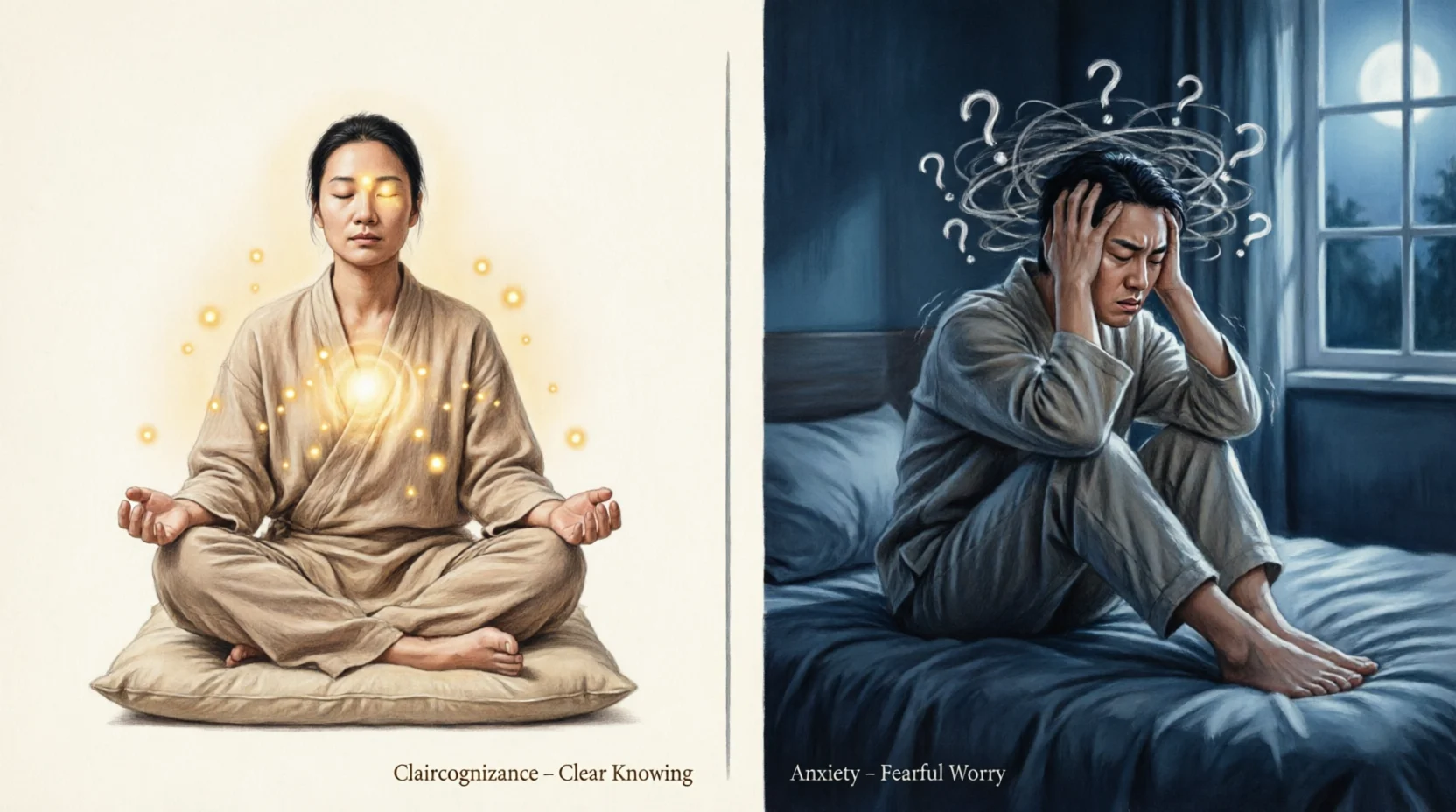
Claircognizance is often described as a sudden, calm inner “knowing” or intuition without logical explanation, while anxiety is a mental health condition that involves excessive worry, fear, and overthinking, often with physical symptoms like restlessness or a racing heart.
Many people struggle to understand whether their intense thoughts, gut feelings, or sudden inner knowing are signs of claircognizance or anxiety. While claircognizance is often described as a spiritual experience involving intuitive knowledge without logical explanation, anxiety is a recognized mental health condition that can create excessive worry, fear, and overthinking. Because both experiences can feel emotionally powerful and mentally overwhelming, it is common for individuals to confuse one with the other.
Understanding the difference between claircognizance and anxiety is important for emotional well-being and self-awareness. Claircognizance is usually associated with calm inner certainty and intuitive insight, while anxiety often brings physical symptoms such as racing thoughts, nervousness, restlessness, and emotional distress. Mental health professionals emphasize the importance of recognizing anxiety symptoms early, while spiritual practitioners may interpret intuitive experiences differently depending on personal beliefs and practices.
Quick Answer Table
| Feature | Claircognizance | Anxiety |
| Meaning | Intuitive “knowing” without logical explanation | Fear-based worry about future threats |
| Feeling in the body | Calm, neutral, peaceful | Tension, racing heart, shallow breath |
| Source | Intuition / spiritual insight | Fear response / overactive amygdala |
| Speed of thought | Suddenly, complete, “download” style | Repetitive, looping, escalating |
| Accuracy | Often correct (verifiable later) | Typically exaggerated or false |
| Emotional tone | Detached, matter-of-fact | Urgent, panicked, heavy |
| Can you control it? | No (it arrives unbidden) | Somewhat (with therapy or medication) |
| Common in | Psychic/spiritual individuals | General population |
Which One Is Correct? Claircognizance or Anxiety?
Here’s the truth: Both are real experiences, but they are not the same thing.
- Claircognizance is an intuitive ability. It means “clear knowing.” You suddenly understand something without being told or figuring it out logically.
- Anxiety is a mental health condition (or temporary state). It involves excessive worry about future events, often with physical symptoms.
The confusion between claircognizance and anxiety happens because both can feel like “knowing” something bad will happen. But claircognizance is neutral and often accurate. Anxiety is fearful and often wrong.
Learning to tell them apart can change your life and your mental health.
Meaning of Claircognizance (Clear Knowing)
Claircognizance is one of the four “clairs” (clairvoyance, clairaudience, clairsentience, claircognizance). It means clear knowing, receiving information intuitively without sensory input or logical reasoning.
Key characteristics of claircognizance
- You just know something, but you can’t explain how.
- The knowing arrives suddenly, fully formed.
- It feels calm, neutral, and matter-of-fact.
- There’s no emotional charge (positive or negative).
- It often turns out to be correct.
Real-world examples of claircognizance
- You know who is calling before you look at your phone.
- A solution to a problem pops into your head while you’re showering.
- You know a friend is pregnant before she announces it.
- You have a strong sense not to take a certain flight and later learn it was delayed or had issues.
How claircognizance feels
| Sensation | Description |
| Physical | Light, neutral, no tension |
| Emotional | Calm, detached, almost boring |
| Mental | Certain, clear, no second-guessing |
| Timing | Instant (like a download) |
“I just knew my grandmother had passed away before the phone rang. It wasn’t fear. It was a quiet, certain knowing.”
Meaning of Anxiety (Fear-Based Worry)
Anxiety is a natural stress response. It involves feelings of worry, nervousness, or fear about future events. In moderate amounts, anxiety is normal. In excess, it becomes an anxiety disorder.
Key characteristics of anxiety
- You worry about something that might happen (not something that is happening).
- The thoughts are repetitive and loop endlessly.
- It feels urgent, heavy, and uncomfortable.
- Physical symptoms accompany it (racing heart, sweating, shallow breathing).
- The feared outcome rarely happens.
Real-world examples of anxiety
- You’re convinced you’ll fail the exam even though you studied.
- You worry your partner is upset with you, with no evidence.
- Your heart races before a social event, imagining everything going wrong.
- You can’t sleep because you’re replaying a conversation from three days ago.
How anxiety feels
| Sensation | Description |
| Physical | Racing heart, sweating, trembling, nausea |
| Emotional | Fear, dread, panic, irritability |
| Mental | Racing thoughts, catastrophizing, indecision |
| Timing | Lingering, escalating, repetitive |
“I spent three hours convinced my boss was going to fire me because she didn’t say ‘good morning’ enthusiastically. She promoted me the next week.”
Key Differences Between Claircognizance and Anxiety
| Category | Claircognizance | Anxiety |
| Body sensation | Calm, light, neutral | Tense, heavy, uncomfortable |
| Heart rate | Normal | Elevated |
| Breathing | Normal | Shallow or rapid |
| Thought pattern | One-time download | Looping, repetitive |
| Certainty level | Quietly certain | Desperately uncertain (“what if”) |
| After the feeling | Peace, acceptance | Exhaustion, relief (temporary) |
| Accuracy rate | Often correct | Usually wrong or exaggerated |
| Can you ignore it? | Yes (but it remains accurate) | Difficult (intrusive thoughts) |
| Response to logic | Doesn’t need logic | Temporarily soothed by logic |
| Common phrases | “I just know.” | “What if…?” |
Common Mistakes People Make
Even spiritually aware people confuse claircognizance with anxiety. Avoid these errors:
Mistake 1: Assuming all “knowings” are intuitive
❌ “I feel anxious about the flight, so my intuition is warning me.”
✅ Flying anxiety is extremely common. Statistically, the flight will be fine. Claircognizance about a specific, verifiable detail (not general fear) is different.
Mistake 2: Dismissing anxiety as “just my intuition.”
❌ “I don’t have anxiety. I’m just highly intuitive.”
✅ If your “knowings” are always negative, always about you personally, and rarely come true, that’s anxiety, not claircognizance.
Mistake 3: Ignoring physical symptoms
❌ “My racing heart means I’m receiving important intuitive information.”
✅ Claircognizance does NOT cause a racing heart, sweating, or shaking. Those are anxiety symptoms. Intuition feels calm.
Mistake 4: Forcing claircognizance to happen
❌ “I’ll sit here and try to intuit the answer.”
✅ Claircognizance cannot be forced. It arrives spontaneously. Trying to make it happen usually produces anxiety or wishful thinking.
Mistake 5: Treating anxiety as a spiritual gift
❌ “My anxiety means I’m sensitive to energy.”
✅ This is a dangerous rationalization. Anxiety is a medical/psychological condition. Treat it with therapy or medication, not by reframing it as a superpower.
Correct Usage Examples
Casual examples (everyday life)
- When I feel claircognizance, it’s like someone whispered the answer. When I feel anxiety, it’s like someone yelled a question.
- My claircognizance told me to take a different route home. My anxiety told me every driver was trying to crash into me. Only one was right.
Professional examples (therapy & coaching)
- Therapists often teach clients to distinguish between intuitive knowing and anxious thinking. The former is calm; the latter is urgent.
- In my coaching practice, I ask clients: “Does this feeling come with body tension or relaxation?” That single question separates claircognizance or anxiety instantly.
Educational examples (psychology & spirituality)
- Psychologists define anxiety as anticipatory fear about a future threat. Claircognizance is not recognized in clinical literature but is described in parapsychology as non-sensory knowing.
- Students of intuition should learn that claircognizance never demands action. Anxiety always does.
Comparative examples (side by side)
| Situation | Claircognizance response | Anxiety response |
| Before a job interview | “I know this role is right for me.” | “What if I freeze? What if they hate me?” |
| Waiting for medical results | Calm certainty, either way | Imagining worst-case diseases |
| Relationship doubt | Quietly knowing something is off | Constant questioning, checking, reassurance-seeking |
Word Origin / Etymology
Claircognizance comes from French clair (clear) + Latin cognoscere (to know). The term was popularized in spiritual and psychic literature in the 19th and 20th centuries. It is one of several “clairs” (clairvoyance = clear seeing, clairaudience = clear hearing, clairsentience = clear feeling).
Anxiety comes from Latin anxietas (distress, uneasiness), from angere (to choke or squeeze). The physical sensation of a tight throat or chest is literally built into the word’s origin. Anxiety entered English in the 16th century.
The two words could not be more different in origin. One describes a clear, calm knowing; the other describes a choking, squeezing fear.
Why “Claircognizance or Anxiety” Confuses So Many People
The rise of spiritual social media (TikTok, Instagram, YouTube) has made “clair” abilities trendy. Meanwhile, anxiety rates are at all-time highs. The result:
- Overlapping language: Both involve “knowing” something without logical proof.
- Normalization of anxiety. Many people don’t realize they have an anxiety disorder. They think everyone feels this way.
- Spiritual bypassing. Some spiritual communities discourage medical treatment, encouraging people to reframe anxiety as intuition.
- Confirmation bias: When an anxious thought happens to be correct (rare), people remember it forever. When it’s wrong (common), they forget.
The result? Millions of anxious people believe they are highly intuitive and never get the help they need.
Easy Memory Tricks
Never confuse claircognizance or anxiety again with these simple tests.
The Body Test
| Body sensation | Likely |
| Calm, light, neutral | Claircognizance |
| Tight chest, racing heart, sweating | Anxiety |
The “What If” Test
- Anxiety always asks, “What if…?” (What if I fail? What if they leave?)
- Claircognizance never asks questions. It states facts.
The Repetition Test
- Anxiety repeats the same fear over and over.
- Claircognizance says it once and goes quiet.
One-sentence rule
Claircognizance whispers the answer once. Anxiety shouts the question a hundred times.
The “After” Test
| After the feeling, you feel… | Likely |
| Peaceful, certain, relaxed | Claircognizance |
| Exhausted, drained, still worried | Anxiety |
FAQs
Is claircognizance real, or is it just anxiety?
Claircognizance is considered real by many spiritual traditions and parapsychology researchers. However, it is not scientifically proven. Anxiety is medically proven. If you’re unsure, get evaluated by a mental health professional first. Treat the anxiety. Then see what intuitive “knowings” remain.
Can I have both claircognizance and anxiety?
Yes. Many intuitive people also have anxiety disorders. The key is learning to tell them apart. Anxiety will still be there even when you’re not “receiving” anything. Claircognizance arrives suddenly and leaves.
How do I know if my “knowing” is intuition or fear?
Ask yourself: Does this feel calm or urgent? Does it come with body tension? Is it a one-time thought or a loop? Calm + one-time = likely intuition. Urgent + repetitive = likely anxiety.
Can anxiety ever be a form of intuition?
No. Anxiety is a fear response, not intuitive knowing. However, some people’s intuition triggers anxiety because the knowing is uncomfortable. But the knowing itself and the anxiety response are separate.
What should I do if I can’t tell the difference?
See a therapist. Rule out anxiety disorders first. If, after treatment, you still have “knowings” that are calm, accurate, and non-anxious, explore claircognizance. Never self-diagnose spiritual abilities over mental health conditions.
Can medication for anxiety affect claircognizance?
Many intuitive people report that anti-anxiety medication improves their claircognizance because it quiets the “noise” of anxious thoughts. Less fear = clearer knowing.
Conclusion
In conclusion, understanding claircognizance or anxiety requires careful self-awareness and a balanced perspective. While claircognizance is often viewed as an intuitive or spiritual experience, anxiety is a mental health condition that can affect thoughts, emotions, and daily life. The two can sometimes feel similar, especially when a person experiences strong emotions, overthinking, or unexplained feelings.
Recognizing the difference is important because anxiety may require emotional support, stress management, or professional mental health care, while intuitive experiences are often interpreted through personal beliefs and spiritual practices. Paying attention to emotional patterns, physical symptoms, and overall mental well-being can help individuals better understand what they are experiencing.