Quick Ans:
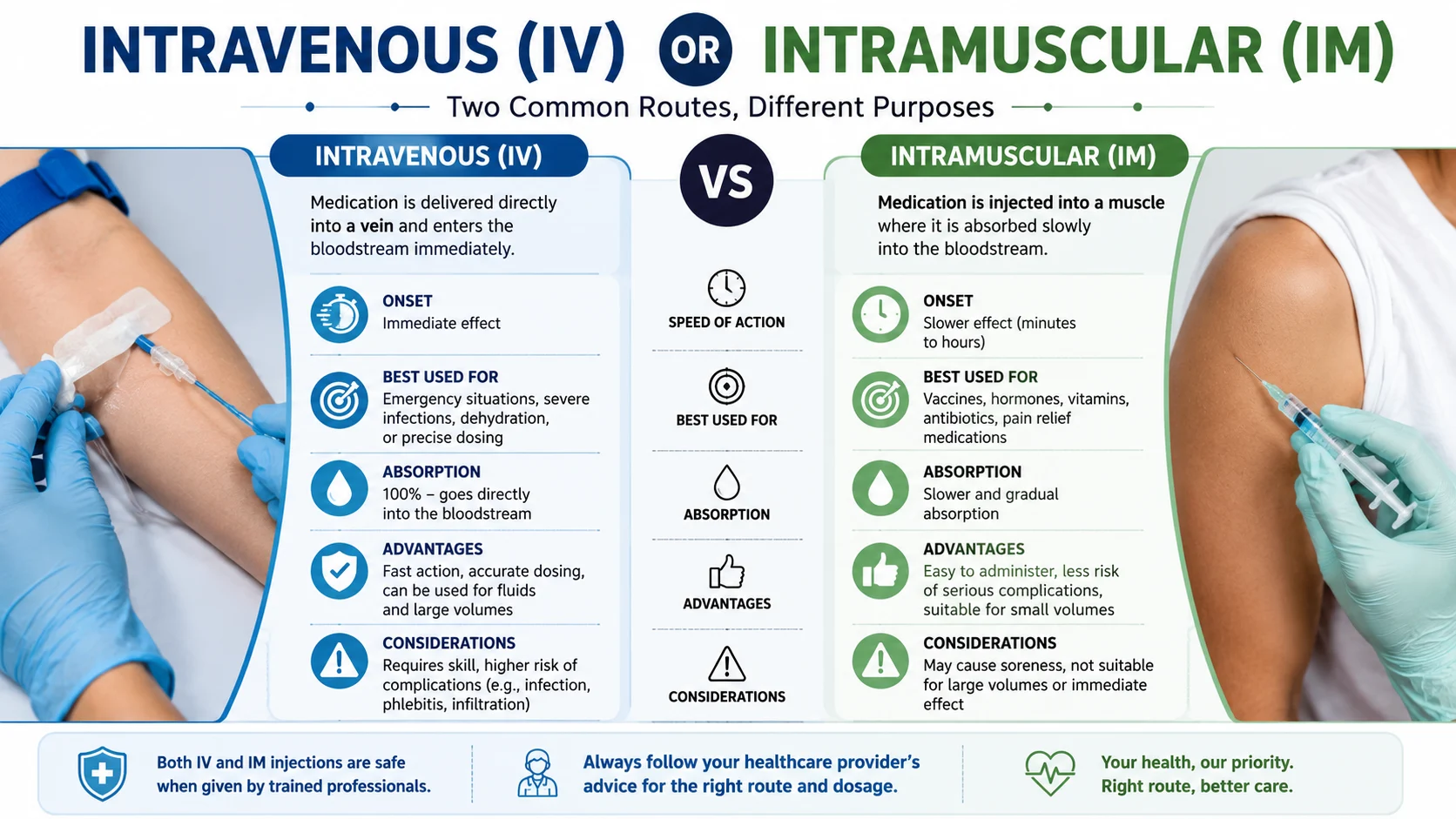
Intravenous (IV): Injected directly into a vein for immediate effect and precise dosing.
Intramuscular (IM): Injected into muscle for slower absorption and longer-lasting action.
When you hear the words “intravenous or intramuscular,” you are likely standing in a pharmacy, sitting in a doctor’s office, or reading a prescription label. The confusion between these two injection types is common and medically significant. Choosing the wrong route for a medication can make it ineffective or even dangerous. This guide explains the difference in plain English, so you never mix them up again.
As someone who has spent over a decade translating complex medical terminology into plain English, I have seen the “intravenous or intramuscular” confusion cause real anxiety in pharmacy lines, doctors’ offices, and even emergency rooms. Patients stare at prescription labels. Parents grip their children’s hands tighter. Nobody wants the wrong needle in the wrong place. I have personally interviewed nurses, pharmacists, and patients about this exact
confusion.
Quick Answer Table
| Feature | Intravenous (IV) | Intramuscular (IM) |
| Correct Spelling | ✅ Intravenous | ✅ Intramuscular |
| Meaning | Into the vein | Into the muscle |
| Common Usage | Fluids, electrolytes, chemotherapy, emergency drugs | Vaccines, antibiotics, hormones, and pain medication |
| Speed of Effect | Seconds to minutes | Minutes to hours |
| Who Administers | Doctor, nurse, paramedic | Doctor, nurse, pharmacist, sometimes self-injected |
| Example Sentence | The nurse started an intravenous line before surgery. | The flu vaccine is given as an intramuscular injection in the upper arm. |
Which One Is Correct?
Both “intravenous” and “intramuscular” are correct medical terms. They are not interchangeable. You cannot say “intravenous shot” when you mean a vaccine, and you cannot say “intramuscular drip” when you mean an IV bag. Each word describes a specific route of administration into the body.
The confusion happens because both involve needles. Both hurt a little. Medical professionals give both. But the vein and the muscle are completely different tissues that absorb medications at different rates and for different purposes. Using the wrong word could mean getting the wrong treatment.
Neither word is incorrect. The question is which one matches your medical situation.
Meaning of Intravenous
Intravenous means “within a vein.” The word breaks down into “intra” (inside) and “venous” (relating to veins). An intravenous injection or infusion delivers medication or fluids directly into your bloodstream through a small tube called a catheter inserted into a vein, usually in your arm or hand.
Because the medicine goes straight into your blood, it works very fast. This is why emergency rooms use intravenous lines for critical care. Dehydration, heart attacks, severe infections, and surgeries all involve intravenous access.
Real-world examples of intravenous use:
Have you ever been in a hospital and seen a bag hanging from a pole with a tube running to someone’s arm? That is an intravenous drip. Chemotherapy patients receive intravenous drugs because the medication needs to reach every part of the body quickly. Patients with food poisoning who cannot keep water down get intravenous fluids to prevent organ failure.
Intravenous medications require trained professionals because a misplaced needle can damage a vein or inject medicine into surrounding tissue. You cannot safely give yourself an intravenous injection at home without medical training.
Meaning of Intramuscular
Intramuscular means “within a muscle.” The word breaks down into “intra” (inside) and “muscular” (relating to muscles). An intramuscular injection delivers medication deep into a large muscle, where blood vessels carry it into the rest of the body more slowly than an intravenous injection.
Muscles have a rich blood supply, but not as direct as veins. This slower absorption is actually desirable for many medications. Vaccines work better when released gradually. Some antibiotics and hormonal treatments need to be extended.
Real-world examples of intramuscular use:
The flu shot you get every year is intramuscular. The needle goes into your deltoid muscle in your upper arm. The COVID-19 vaccines were also intramuscular. If you have ever received a vitamin B12 shot or an epinephrine injection for severe allergies, these were intramuscular as well.
Some intramuscular injections can be given at home. People with multiple sclerosis or certain hormonal conditions learn to inject themselves into the thigh or abdomen. The needle is longer than an intravenous catheter because it needs to reach the muscle, not just the vein.
Key Differences Between Intravenous and Intramuscular
| Difference | Intravenous | Intramuscular |
| Target Tissue | Vein (blood vessel) | Muscle (flesh) |
| Typical Needle Length | 0.5 to 1 inch | 1 to 1.5 inches |
| Absorption Speed | Immediate (seconds) | Slow to moderate (10 to 30 minutes) |
| Volume Capacity | Large (liters of fluid possible) | Small (usually 1 to 5 mL) |
| Duration of Effect | Short to immediate | Longer, sustained release |
| Risk Level | Higher (infection, air bubbles, infiltration) | Lower (muscle soreness, nerve damage rare) |
| Common Locations | Arm, hand, foot | Upper arm, thigh, buttocks |
| Medical Training Required | High (doctors, nurses, paramedics) | Moderate (nurses, pharmacists, trained patients) |
| Cost | Higher (equipment, monitoring) | Lower (single needle, syringe) |
Pronunciation difference:
Intravenous is pronounced in truh VEE nus. The emphasis is on the third syllable. Intramuscular is pronounced in truh MUSS cue lur. The emphasis is on the second syllable. Listening for the “VEE” versus “MUSS” sound helps you tell them apart.
Grammar difference:
Both words are adjectives. They describe the route of administration. You say “intravenous injection” or “intramuscular medication.” You can also use them as nouns informally: “She started an intravenous” or “He gave me an intramuscular.”
Common Mistakes People Make
Mistake 1: Using “intravenous” for all needle-based treatments.
Not every shot goes into a vein. Vaccines and most antibiotics go into the muscle. Calling a flu shot an “intravenous vaccine” is medically inaccurate.
Mistake 2: Thinking intramuscular is always slower.
Some intramuscular medications are formulated for rapid release. Epinephrine (EpiPen) works within minutes, even though it goes into the muscle.
Mistake 3: Confusing the abbreviations.
IV stands for intravenous. IM stands for intramuscular. Medical charts use these abbreviations constantly. Mixing them up could lead to a patient receiving the wrong medication route.
Mistake 4: Assuming you can switch routes at home.
Some oral medications have intravenous or intramuscular versions. Never assume you can inject a pill dissolved in water. Pharmaceutical formulations are route-specific.
Mistake 5: Spelling errors.
Common misspellings include “intravenus,” “intraveneous,” “intramuscular,” and “intramuskular.” The correct spellings are intravenous and intramuscular.
Correct Usage Examples
Casual examples:
“My mom is in the hospital with pneumonia. They started an intravenous antibiotic because she cannot swallow pills.”
“I hate intramuscular shots. My arm always hurts for two days after the flu vaccine.”
Professional examples (healthcare setting):
“The physician ordered intravenous fluids at 125 milliliters per hour to correct the patient’s dehydration.”
“Intramuscular epinephrine is the first-line treatment for anaphylaxis in community settings.”
Educational examples (classroom context):
“Nursing students practice intravenous insertion on simulation arms before ever touching a real patient.”
“The pharmacology lecture explained that intramuscular absorption depends on blood flow to the injection site.”
Literary or metaphorical examples:
“Fear hit him like an intravenous dose of adrenaline, fast and overwhelming.”
“Loyalty was not something you could inject intramuscularly into a team. It had to grow slowly.”
Word Origin / Etymology
Intravenous comes from two Latin roots. “Intra” means “inside” or “within.” “Vena” means “vein.” The term emerged in medical literature around the 1850s when doctors first began experimenting with injecting substances directly into blood vessels.
Intramuscular also uses the Latin “intra,” meaning “inside.” “Musculus” means “little mouse,” which is how the Romans described the shape of muscles moving under the skin. The term became common in the early 20th century as vaccine development advanced.
Both words follow the same pattern: intra + body part + ous (adjective ending). Understanding that pattern helps you decode other medical terms like intradermal (into the skin), intraosseous (into the bone), and intraperitoneal (into the abdominal cavity).
Why the Incorrect Version Became Popular
Neither word is incorrect, but people misuse them for a few reasons. First, both involve needles, so the brain lumps them together. Second, television medical dramas show intravenous lines constantly, so viewers assume all medical injections work like that. Third, the abbreviations IV and IM look similar, especially on small prescription labels.
Some people also invent fake hybrid terms like “intramuscular intravenous” or “intravenous shot.” These are not real medical terms. A shot is intramuscular. A drip is intravenous. A healthcare provider never mixes them.
The popularity of “intravenous” in everyday conversation has made it the default word for many people, even when they mean intramuscular. This is like calling all tissues “Kleenex” or all adhesive bandages “Band Aids.” It is common but not accurate.
Easy Memory Tricks
Trick 1: V for Vein, V for Intravenous.
The letter V appears in “intravenous” and “vein.” If you see a V, think vein. The word “intramuscular” has no V. It has M for muscle.
Trick 2: M for Muscle, M for Intramuscular.
The letter M connects “intramuscular” and “muscle.” Say “M is for muscle” every time you write or say the word.
Trick 3: Speed association.
Intravenous is fast like a racecar. Veins go directly to the heart. Intramuscular is slower like a hiking trail. Muscles release medication gradually.
Trick 4: Visualize the needle.
Short, thin needle in your hand or arm? That is intravenous. Longer, thicker needle in your upper arm or thigh? That is intramuscular.
Trick 5: Remember a vaccine.
Your last flu shot was intramuscular. Anchor that memory. Anything that feels like that shot is intramuscular. Anything with a tube and a bag is intravenous.
FAQs
1. What is the main difference between IV and IM injections?
IV injections go directly into a vein for immediate effect, while IM injections are given into muscle for slower absorption.
2. Which works faster, IV or IM?
IV works fastest because the medication enters the bloodstream instantly.
3. Is IV more painful than IM?
IV may cause less muscle pain, but inserting the needle into a vein can feel uncomfortable. IM can cause soreness in the muscle afterward.
4. When is IV preferred?
IV is used in emergencies, dehydration, or when precise dosing is required.
5. When is IM preferred?
IM is used for vaccines, hormones, and medications that need gradual absorption.
6. Can the same drug be given IV and IM?
Some drugs can be given both ways, but it depends on the medication and medical advice.
7. Which is safer?
Both are safe when done by professionals, but IV carries a slightly higher risk of complications if not administered properly.
8. Do IV or IM injections require professional administration?
Yes, both should be given by trained healthcare providers.
Conclusion
The difference between intravenous and intramuscular is not complicated once you learn the anchor points. Veins are for speed. Muscles are for sustained release. Intravenous contains the letter V for vein. Intramuscular contains the letter M for muscle.
Both are correct medical terms. Neither is interchangeable. The next time someone offers you a shot or starts an IV, you will know exactly which word to use and why it matters.
Your veins and muscles serve different purposes. The medicines that go into them should too.